Practice interpreting transit light curves and radial velocity data to detect and describe exoplanets.
Read each problem carefully. Show your work in the space provided and include units when they are needed.
Using starlight to find planets around other stars
Astronomy - Grade 9-12
- 1
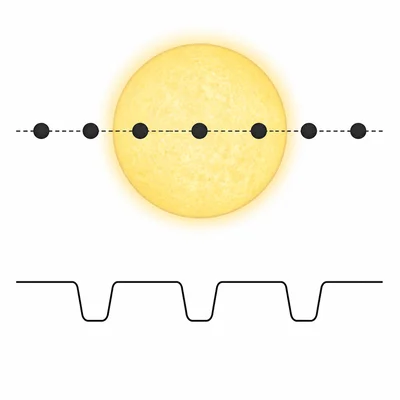
A star's brightness drops by 1 percent every 10 days, and each drop lasts about 3 hours. What detection method is being used, and what does the repeating drop in brightness suggest?
- 2
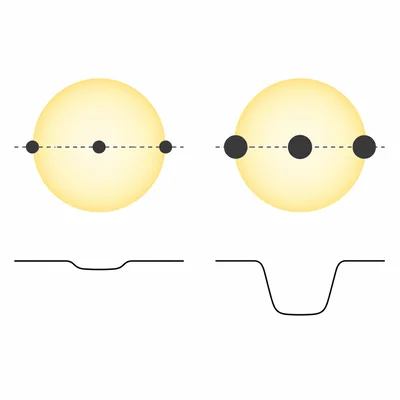
In a transit light curve, what does the depth of the dip mainly tell astronomers about the planet?
- 3
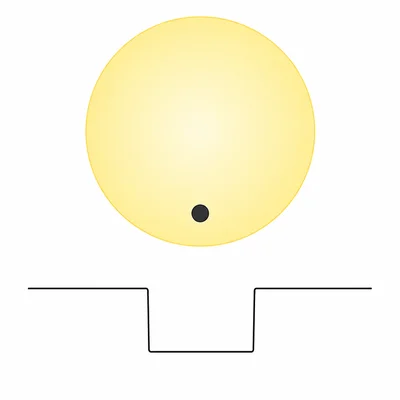
A planet transiting a Sun-sized star causes the star's light to decrease by 0.01, or 1 percent. Use transit depth = (planet radius / star radius)^2 to find the planet's radius compared with the star's radius.
- 4
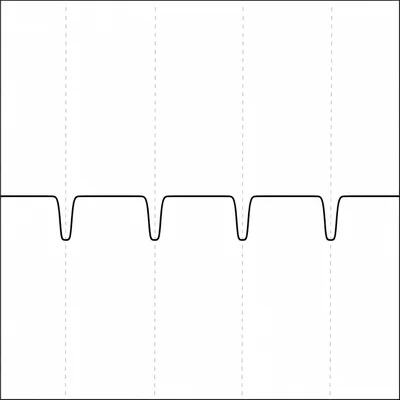
A light curve shows transit dips at day 4, day 16, day 28, and day 40. What is the orbital period of the planet?
- 5
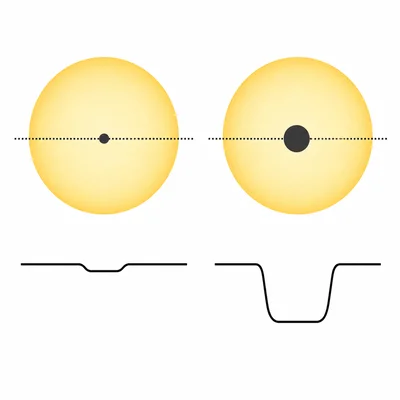
Two planets orbit identical stars. Planet A causes a 0.5 percent transit dip. Planet B causes a 2 percent transit dip. Which planet is larger, and how do you know?
- 6
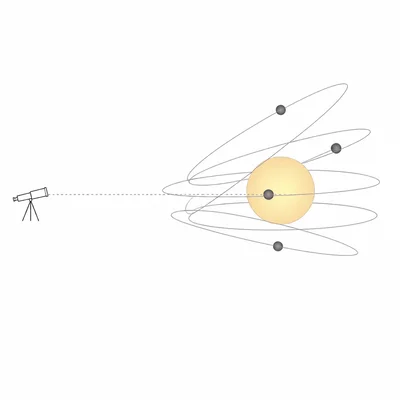
Why can the transit method miss many planets even if they really orbit other stars?
- 7
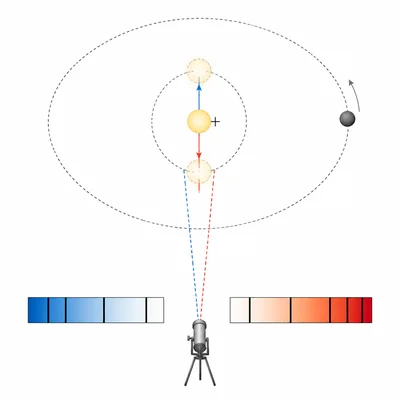
A star's spectral lines shift slightly toward blue, then later toward red, in a repeating pattern. What detection method is being used, and what motion of the star is being measured?
- 8
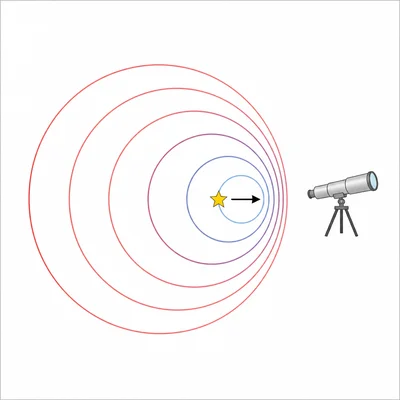
What is the Doppler effect, and why is it important for detecting exoplanets with radial velocity?
- 9
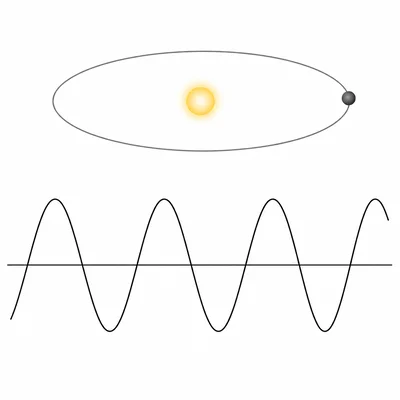
A star shows a radial velocity pattern that repeats every 6.2 days. What does this period represent for the planet?
- 10
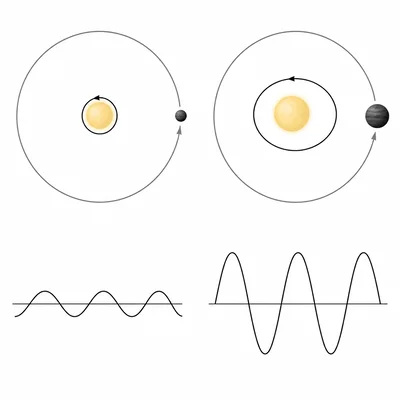
Planet X causes its star to wobble with a maximum radial velocity of 2 meters per second. Planet Y orbits an identical star at the same distance and causes a maximum radial velocity of 20 meters per second. Which planet is likely more massive, and why?
- 11
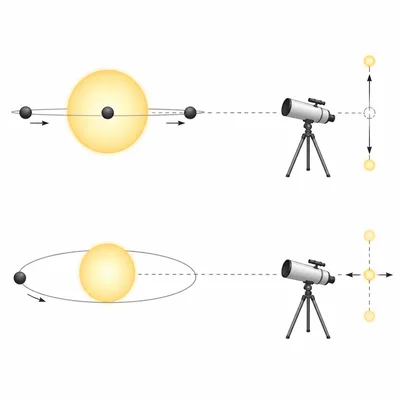
A transit is observed every 30 days, but the radial velocity signal of the same star is very small. Give one possible reason the radial velocity signal is small.
- 12
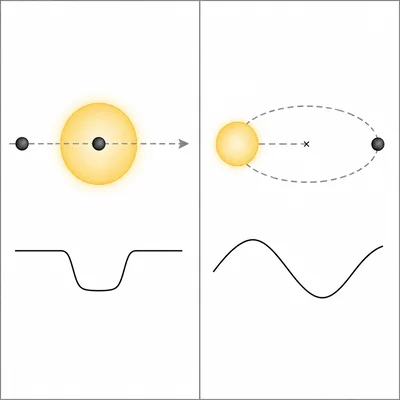
Explain how using both transit and radial velocity measurements can help astronomers learn more about an exoplanet than either method alone.
- 13
A planet has a mass of 6 Earth masses and a radius of 2 Earth radii. Compared with Earth, its density is mass divided by radius cubed: 6 / 2^3. Calculate its density compared with Earth's density.
- 14
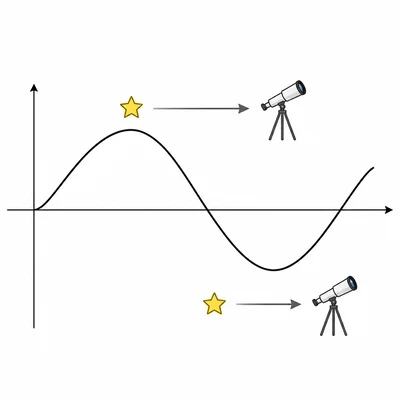
The graph of a star's radial velocity is a smooth wave crossing from positive to negative values and back again. What do the positive and negative values usually represent?
- 15
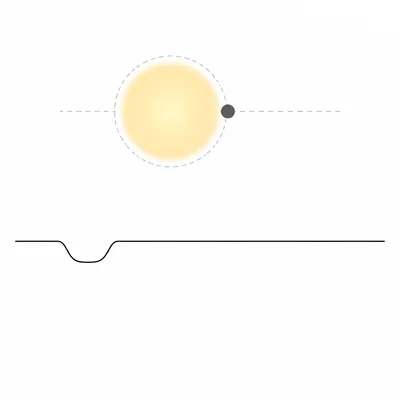
A light curve shows one shallow dip that never repeats during a 90 day observation. Explain why astronomers would be cautious about claiming they found a planet.