Sign in to save

Bookmark this page so you can find it later.

Sign in to save

Bookmark this page so you can find it later.

Astronomy middle-school May 24, 2026

Why Does the Sun Shine?

Fusion turns tiny bits of mass into sunlight
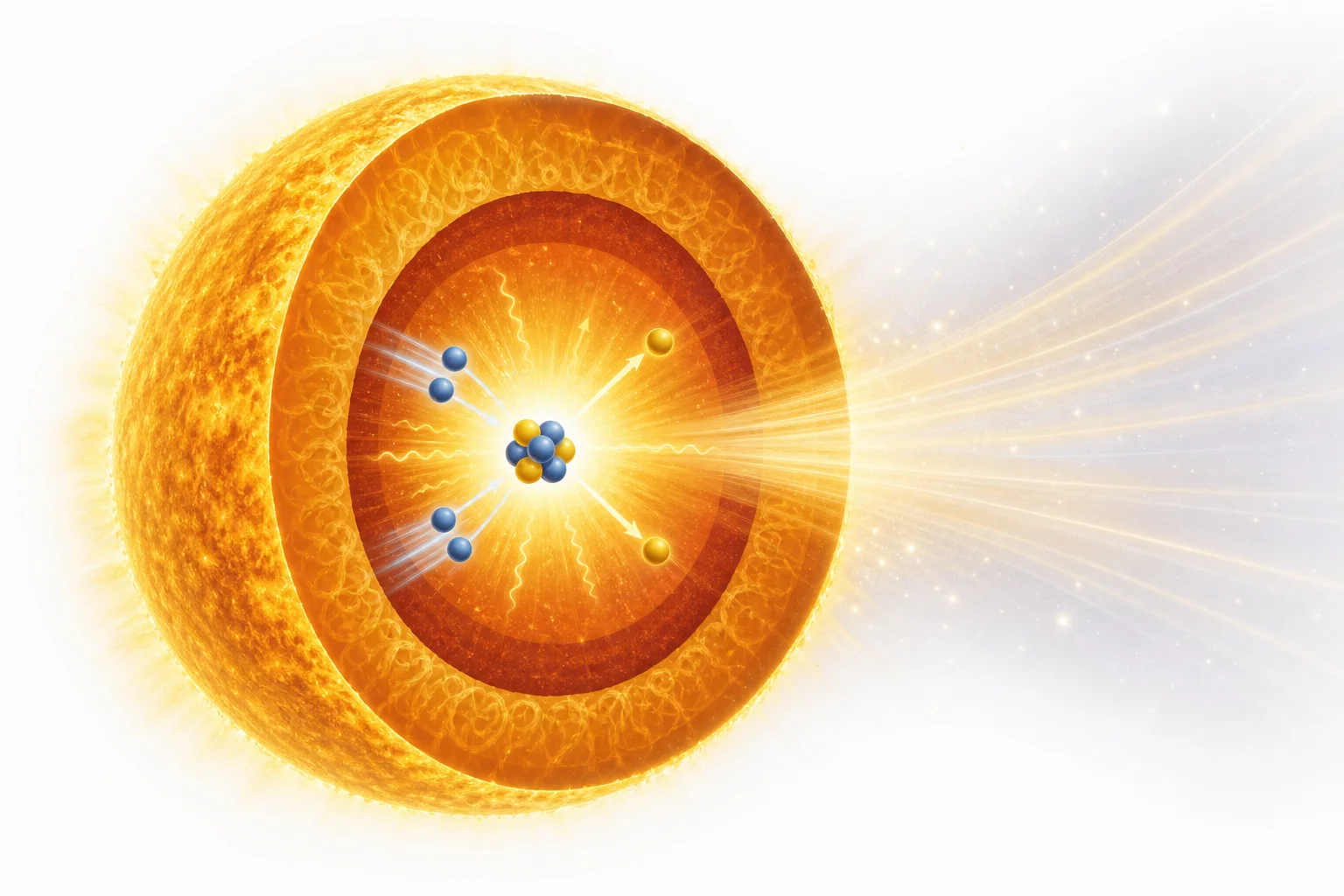
Cutaway diagram of the Sun showing the hot core where energy is made and light traveling outward to space

The Sun shines because its center is hot and squeezed by gravity. There, tiny hydrogen pieces join together and release energy. That energy slowly moves outward, then leaves the Sun as light and heat.

Big Idea. NGSS MS-ESS1-1 connects the Sun’s energy to models of the Sun, Earth, and solar system.

The Sun looks steady from Earth. It rises, warms the ground, powers weather, and lets plants grow. But the Sun is not burning like wood or gas. A fire needs oxygen and fuel near the surface. The Sun’s light comes from deep inside, where gravity squeezes matter so strongly that hydrogen can change into helium. In that change, a tiny amount of mass becomes energy. Einstein’s idea is written as $E=mc^2$, which means a small amount of mass can make a large amount of energy because the speed of light is so large. That energy does not fly straight out. It bumps, scatters, and slowly works through the Sun before reaching space. The same source has powered the Sun for about 4.6 billion years, and the Sun still has billions of years of fuel left.

Gravity builds the furnace
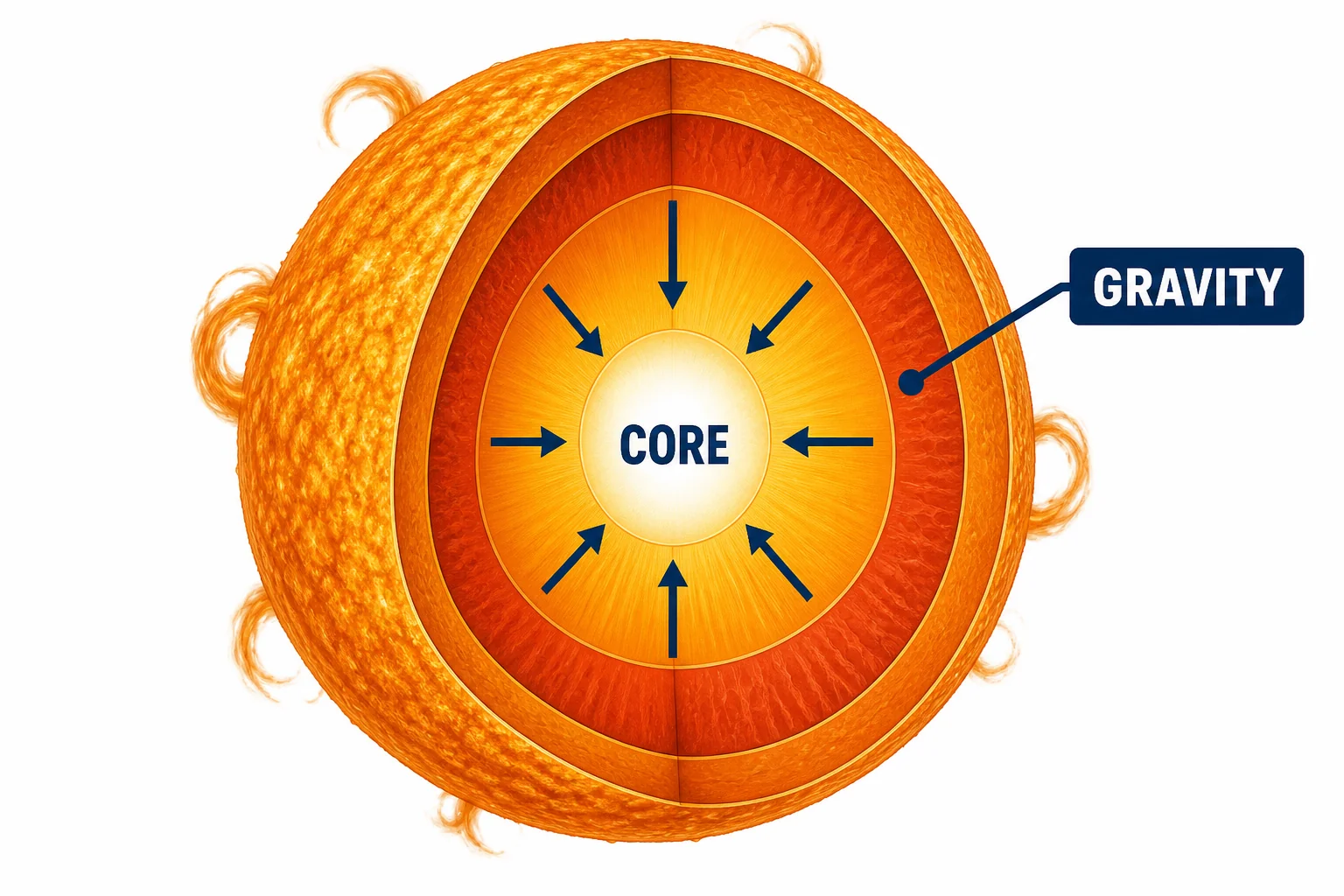
Cross section of the Sun showing outer gas layers pressing inward toward a very hot dense core
Gravity squeezes the Sun’s core
The Sun is a huge ball of gas held together by gravity. Every layer pulls inward on the layers below it. That makes the center extremely hot and dense. The core reaches about 15 million degrees Celsius. At that temperature, particles move very fast. They crash into each other again and again. Most crashes do not make anything new. Some crashes in the core are energetic enough to start nuclear fusion. Gravity does not make light by itself. It creates the pressure and temperature needed for fusion to happen. This is why the Sun shines from the inside out, not from a burning surface. The visible surface is called the photosphere, but it is only the layer where light finally escapes into space.

Gravity creates the conditions needed for fusion.

Hydrogen becomes helium
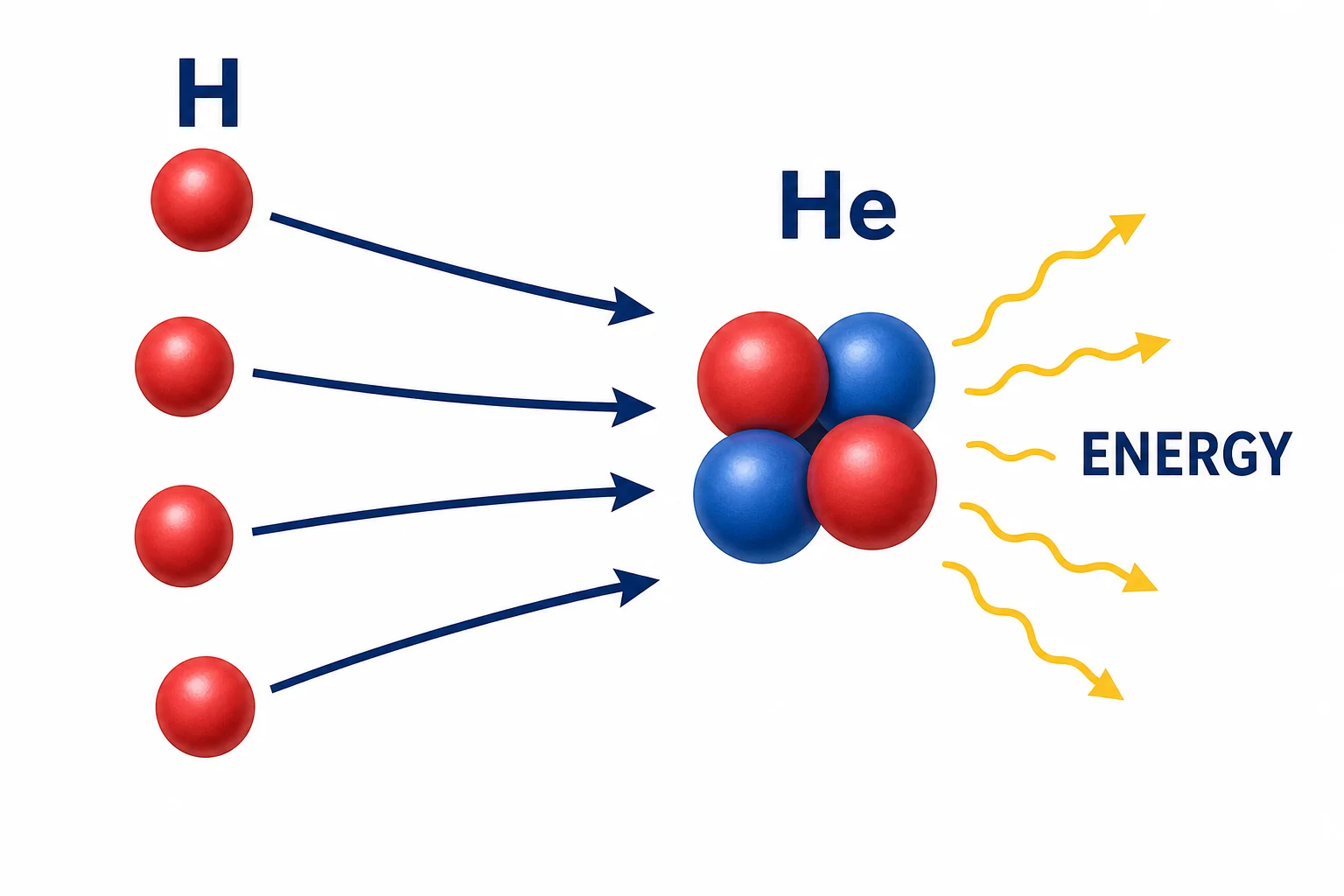
Simple particle diagram showing four hydrogen nuclei combining into one helium nucleus with energy leaving the reaction
Four hydrogen nuclei can become one helium nucleus
The Sun’s main fuel is hydrogen. In the core, hydrogen nuclei are squeezed close enough that some can join through a series of steps called the proton-proton chain. The full process turns four hydrogen nuclei into one helium nucleus. It also releases particles and energy. Middle-school students do not need to track every step to understand the main idea. The important point is that the starting pieces and ending piece do not have exactly the same mass. The helium and released particles have a little less mass than the four hydrogen nuclei had at the start. The missing mass did not vanish. It became energy. That energy helps keep the Sun hot and bright.

Fusion changes hydrogen into helium and releases energy.

A little mass makes a lot of energy
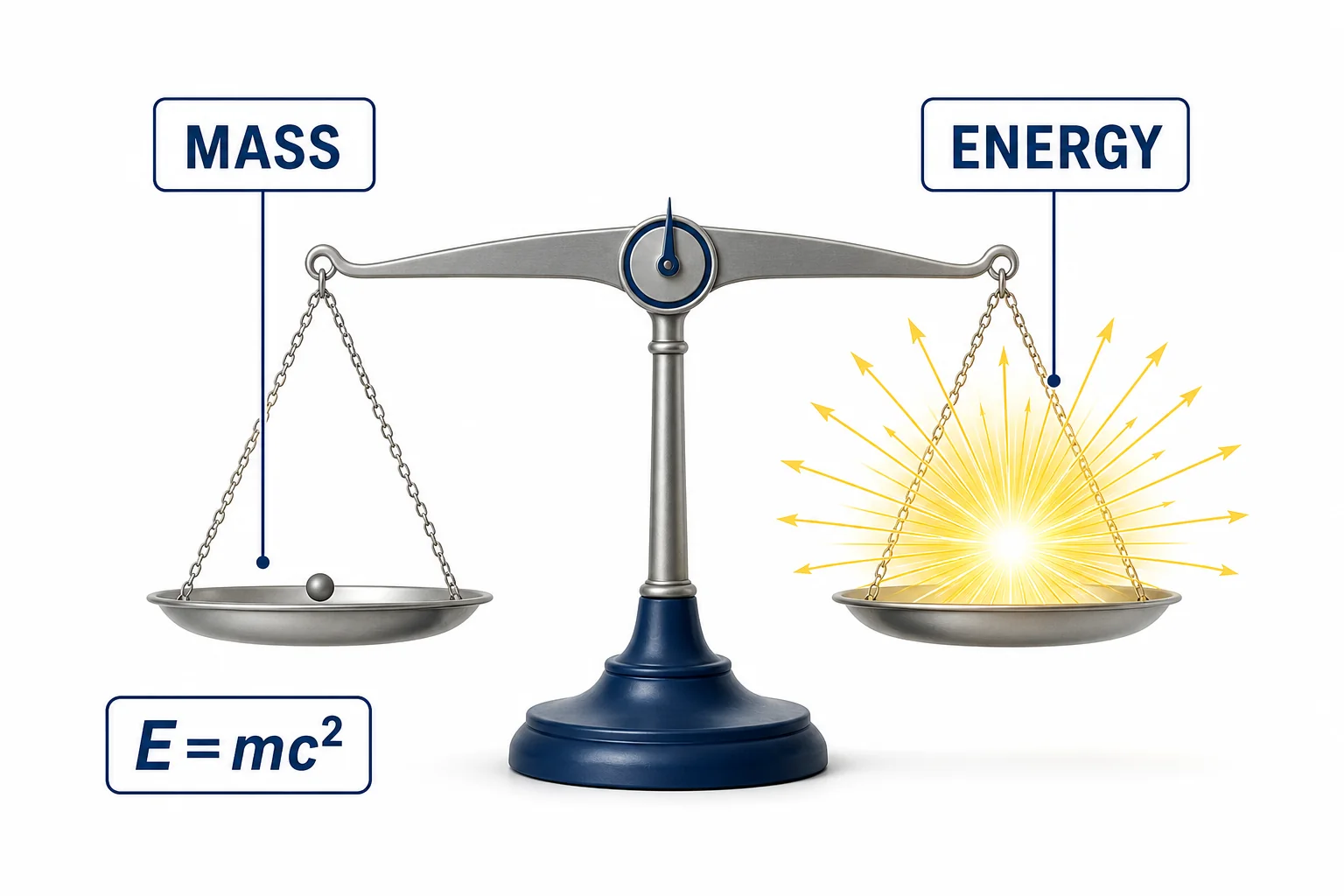
Intuitive diagram showing a tiny missing mass from fusion becoming a much larger burst of energy
Tiny mass loss becomes energy
Einstein’s equation $E=mc^2$ helps explain why the Sun can shine for so long. The letter E means energy. The letter m means mass. The symbol c is the speed of light, which is a very large number. When a tiny bit of mass changes into energy, it gets multiplied by a huge value. That is why a small mass difference in each fusion reaction matters. The Sun does not need to turn all of its mass into energy. It only changes a small fraction of the mass involved in fusion. But there are enormous numbers of fusion reactions happening every second in the core. Together, they produce the light and heat that spread through the solar system.

The Sun’s power comes from mass changing into energy.

Light takes a slow trip out
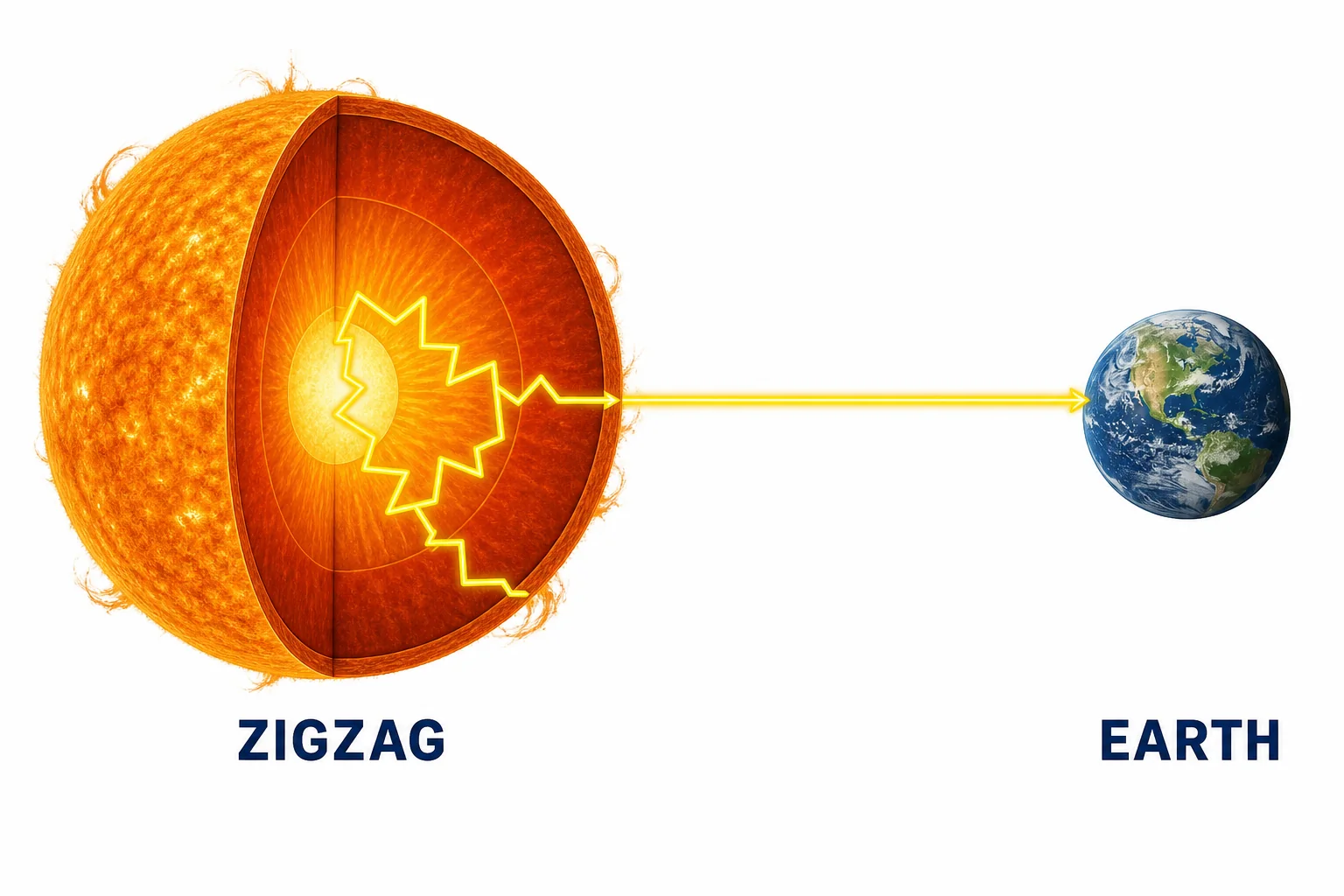
Diagram of energy taking a zigzag path through the Sun before traveling straight to Earth
Energy zigzags inside the Sun, then travels to Earth
Energy made in the core does not leave the Sun right away. Deep inside, light is absorbed and re-emitted many times by charged particles. Each step changes its direction. This random path can take a very long time. Scientists often describe the trip from the core to the surface as taking thousands to hundreds of thousands of years. Near the surface, energy also moves by rising hot gas and sinking cooler gas. Once light reaches the photosphere, it can travel through space much more freely. From the Sun’s surface to Earth, sunlight takes about 8 minutes. The delay inside the Sun is very different from the quick trip across space.

Sunlight forms in the core but escapes only after a long journey.

The Sun has time left
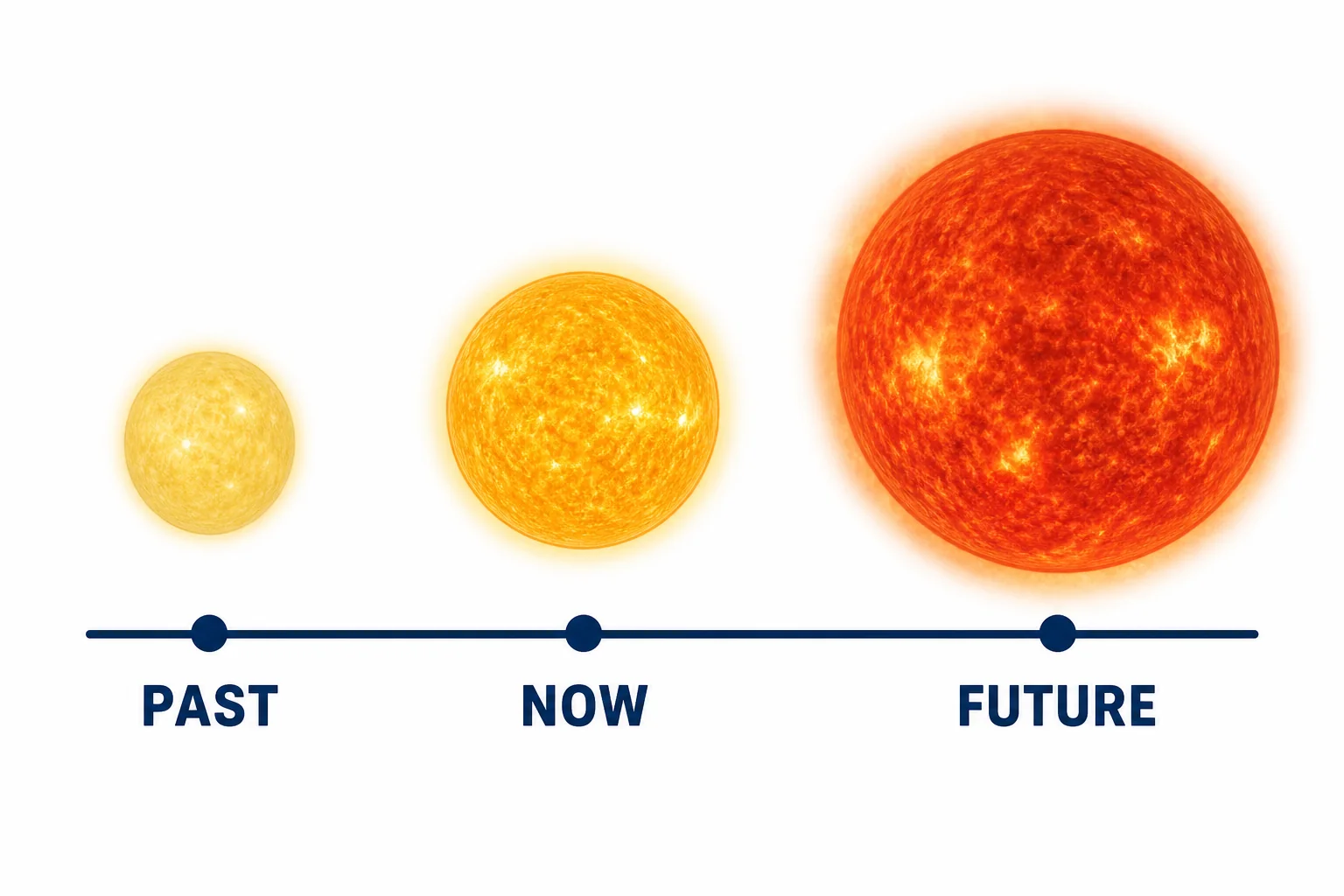
Timeline showing the Sun at its present middle age with past formation and future red giant stage marked
The Sun is in the stable middle of its life
The Sun has already shined for about 4.6 billion years. It can keep shining because it started with a huge amount of hydrogen. Only the core is hot and dense enough for steady fusion, so the Sun is not using all of its hydrogen at once. Models of stars show that the Sun is about halfway through the stable part of its life. It has roughly 5 billion years before major changes begin. That does not mean the Sun is unchanging. Its brightness slowly increases over very long time spans. But on human time scales, the Sun’s energy output is steady enough to support climate, water cycles, and life on Earth.

The Sun is middle-aged and still has billions of years of fuel.

Vocabulary

Nuclear fusion
A process where small atomic nuclei join to make a larger nucleus and release energy.
Hydrogen
The lightest element and the main fuel for fusion in the Sun’s core.
Helium
An element made in the Sun when hydrogen nuclei join through fusion.
Core
The Sun’s central region, where temperature and pressure are high enough for fusion.
Mass-energy
The idea that mass can be converted into energy, described by $E=mc^2$.
Photosphere
The visible surface layer of the Sun where light escapes into space.

In the Classroom

Model the Sun’s layers

20 minutes | Grades 6-8

Students draw a cutaway Sun and use arrows to show gravity squeezing inward. They add where fusion happens and where light escapes.

Mass to energy scale idea

15 minutes | Grades 6-8

Students compare a tiny paper dot of mass with a large drawn burst of energy. The goal is not calculation, but the idea that a small mass change can make a large energy release.

Photon random walk

25 minutes | Grades 6-8

Students roll a die or use a spinner to decide the direction of each step from the center of a grid. They compare the slow zigzag path inside the Sun with the straight trip from the Sun to Earth.

Key Takeaways

  • The Sun shines because fusion happens in its hot, dense core.
  • Fusion changes hydrogen into helium and releases energy.
  • A tiny amount of mass becomes energy, described by $E=mc^2$.
  • Energy takes a long, zigzag path through the Sun before light escapes.
  • The Sun is about halfway through its stable lifetime and has billions of years left.