Sign in to save

Bookmark this page so you can find it later.

Sign in to save

Bookmark this page so you can find it later.

Chemistry elementary May 24, 2026

Why Do Onions Make You Cry?

Tiny onion chemicals meet your eyes
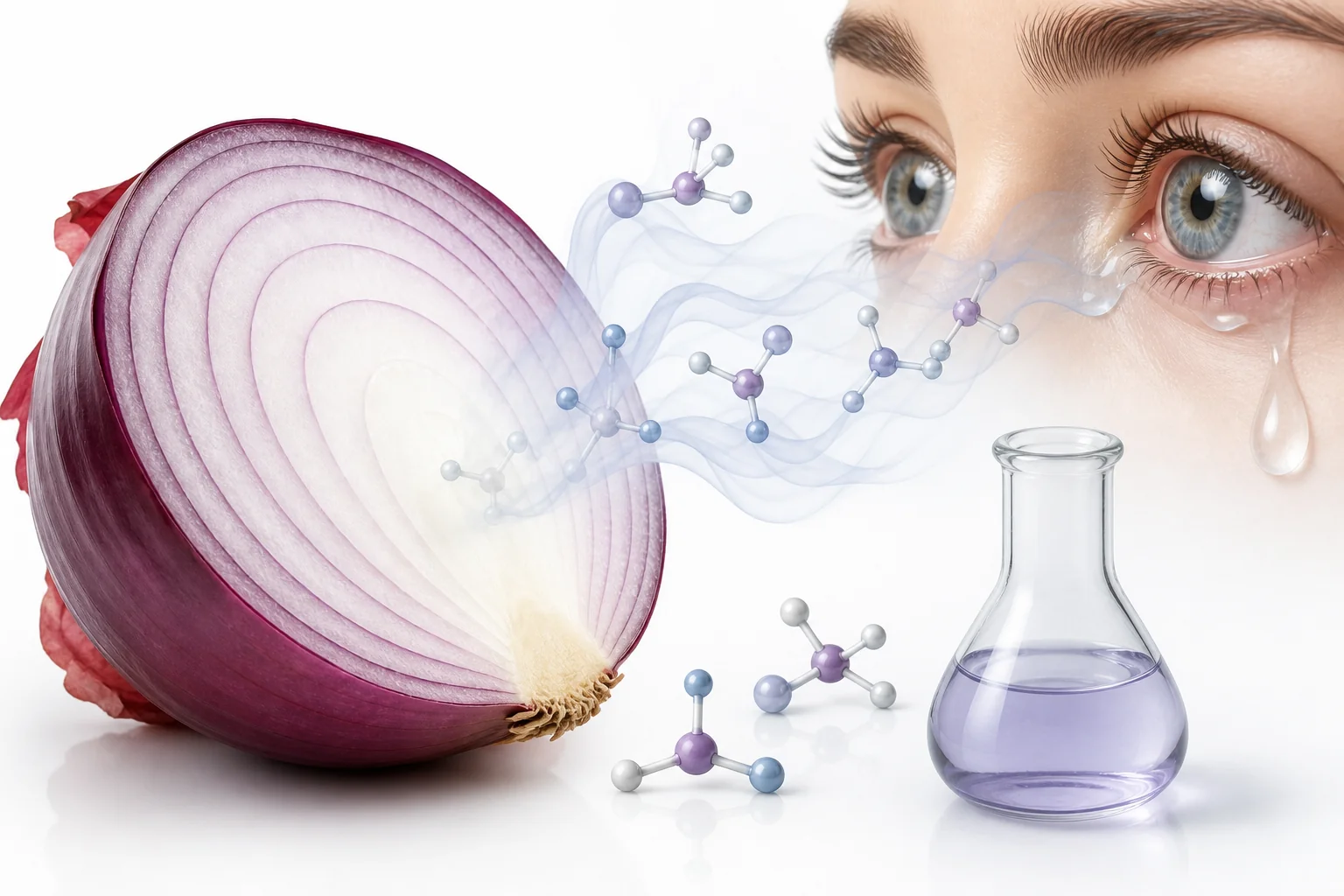
A cut onion releasing tiny particles toward a person's eye, showing that broken onion cells can send chemicals into the air

Cutting an onion breaks tiny onion cells. The broken cells release chemicals that float up to your eyes. Your eyes make tears to wash the stinging chemicals away.

Big Idea. NGSS 5-PS1-4 connects onion tears to the idea that mixing substances can make new substances.

An onion looks quiet on a cutting board, but it is full of tiny cells. Each cell holds different materials in separate spaces. When a knife cuts through the onion, those spaces break open. Materials that were apart can mix. That mixing starts a chain of chemical changes. One new chemical can drift through the air. When it reaches the wet surface of your eyes, it changes again and makes a tiny amount of acid. Your eyes notice the sting and make tears to rinse it away. This is not the onion trying to attack you. It is chemistry in a kitchen. The same idea shows up in many science lessons. Matter is made of particles, and particles can rearrange during a reaction. Onions give students a safe, familiar way to see why new substances can have new properties.

Onion cells break
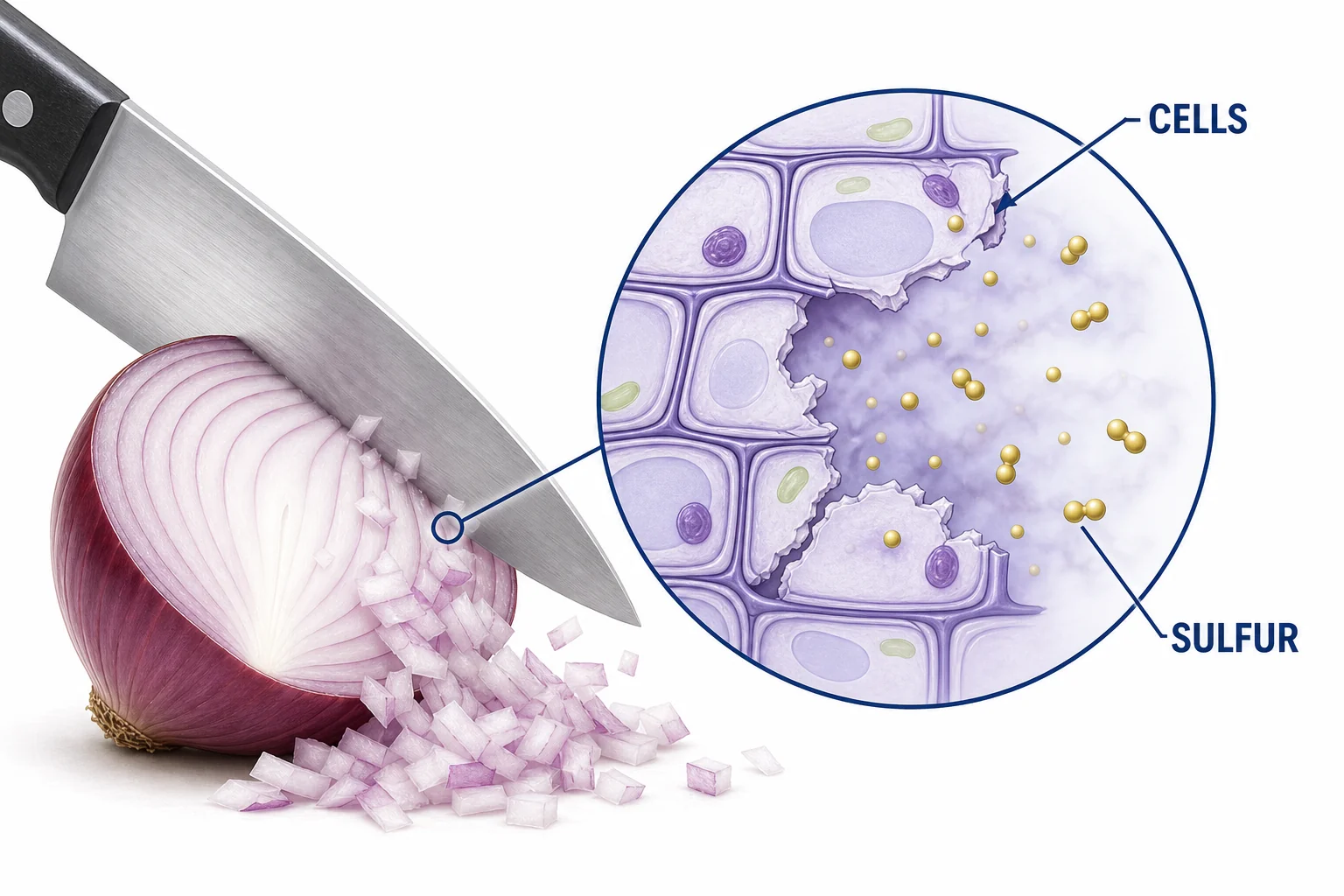
A magnified cutaway of onion cells, with a knife breaking cell walls and small sulfur compounds leaving the damaged cells
Cutting opens onion cells
An onion is made of many tiny cells. A cell is like a small water-filled room with thin walls. Inside those rooms are different substances. Some are sulfur compounds. Sulfur is an element found in onions, garlic, eggs, and many living things. While the onion is whole, many of these substances stay separated. Cutting, crushing, or biting the onion breaks cell walls. Then the separated materials can touch. That contact matters. In chemistry, particles have to meet before they can react. A sharp knife damages fewer cells than a dull knife, so it may release less of the tear-making material. Chopping finely breaks many more cells, so it often feels stronger. The first step in onion tears is simple. The onion tissue is damaged, and hidden chemicals are released from their tiny storage spaces.

Broken cells let onion substances mix.

A gas forms
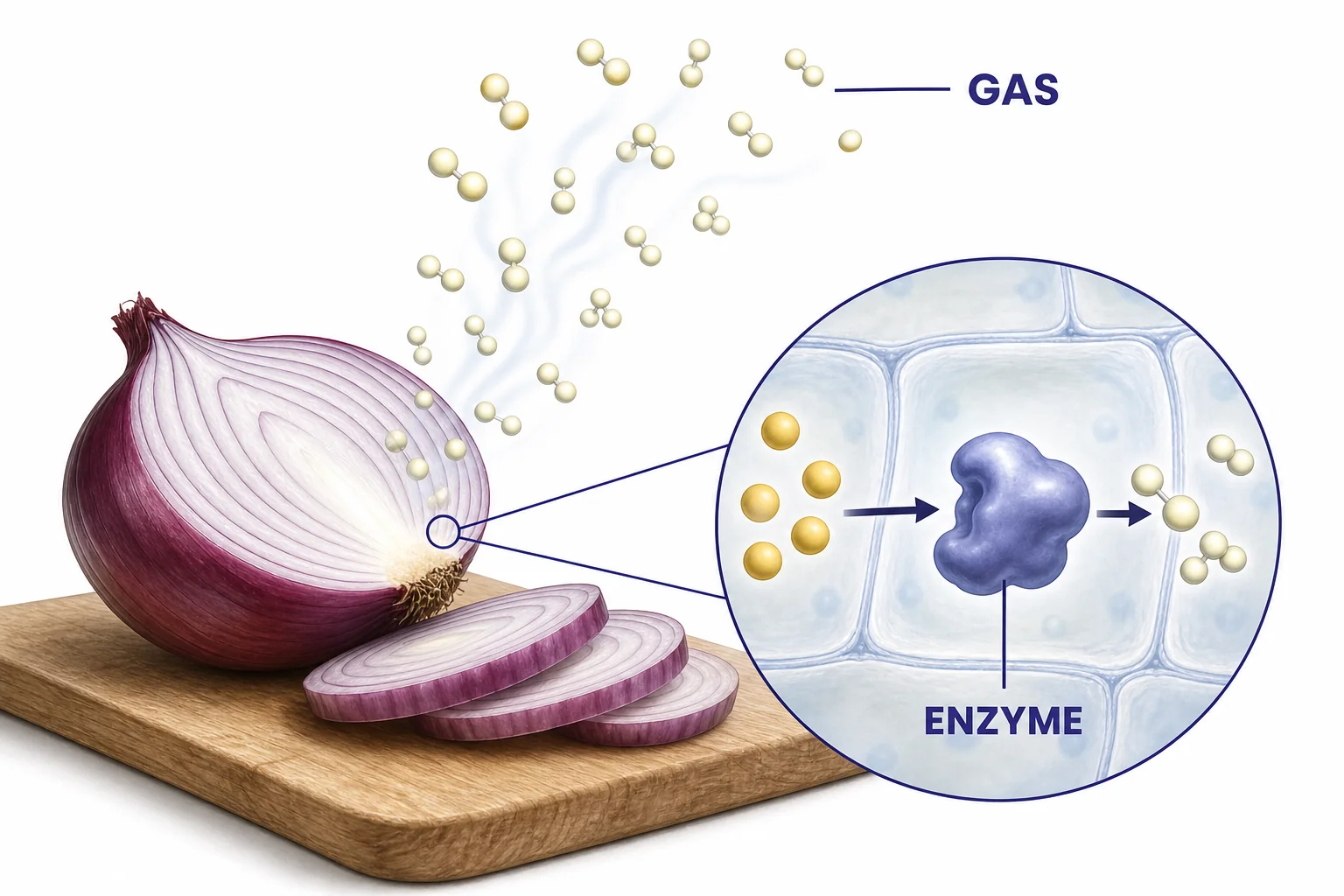
An onion slice releasing small airborne molecules after enzymes act on sulfur compounds
A tear-making gas can drift upward
After the onion cells break, enzymes get to work. Enzymes are special proteins that help chemical changes happen faster. In an onion, an enzyme changes sulfur-containing molecules into a new substance. One important product is called propanethial S-oxide. That name is long, but the idea is simple. It is a small molecule that can move into the air. Scientists call this kind of substance volatile because it evaporates easily. You do not need to touch the onion juice to feel it. The molecule can travel from the cutting board to your face. Warm air helps particles move faster. A warm onion may send more of this tear-making gas upward. A cold onion usually releases and spreads the gas more slowly. That is why chilling an onion can make chopping a little easier.

The tear-maker can float through the air.

Your eyes react
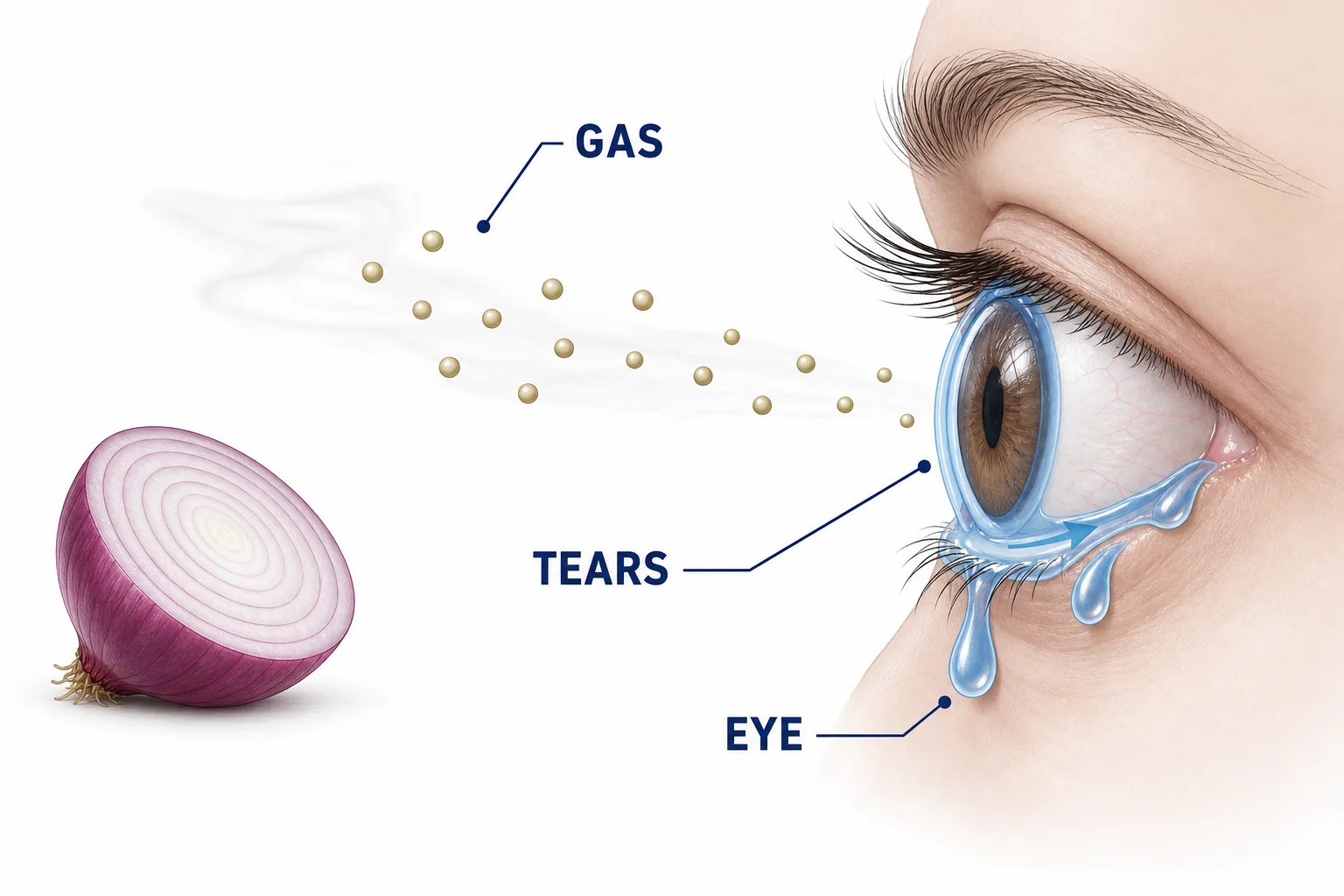
A close view of an eye with onion gas dissolving in the moist tear layer and tears washing the surface
Moist eyes turn the gas into an irritant
Your eyes are always covered by a thin layer of water. This wet layer helps keep your eyes clean and comfortable. When the onion gas reaches that water, it dissolves. Then it reacts with the moisture on your eye. One result is a tiny amount of sulfuric acid and other irritating products. The amount is very small, but your eyes are sensitive. Nerves near the surface of the eye send a warning signal. Your tear glands respond by making more tears. The extra tears dilute the irritating substances and wash them away. Blinking spreads the tears over the eye like windshield wipers. This is a protection system, not a sign that your eyes are harmed by normal onion cutting. The sting stops when the irritating molecules are gone or when you move away from the onion.

Tears help rinse away the irritant.

Cold slows it down
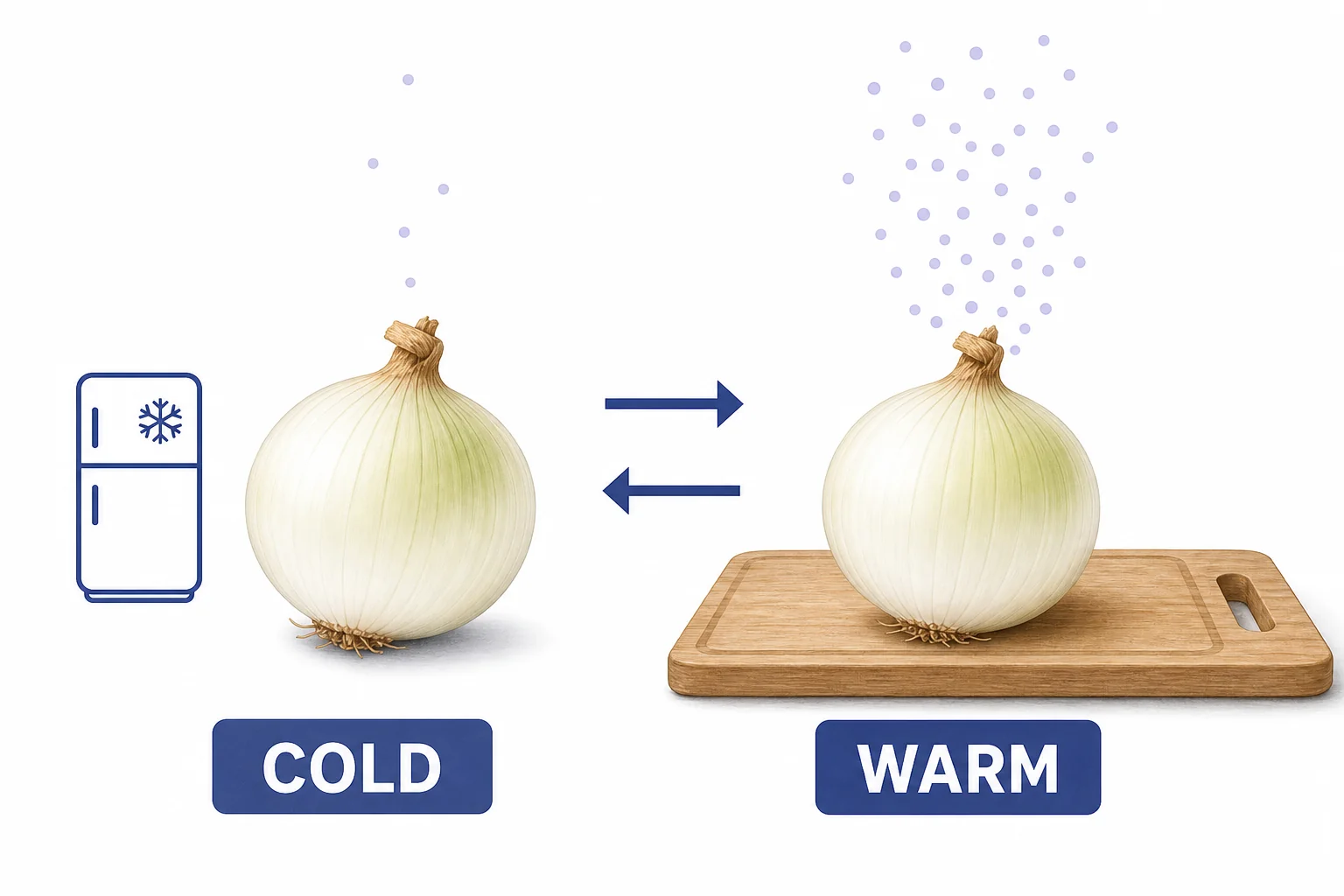
A chilled onion from a refrigerator releasing fewer particles than a warm onion on a counter
Cold onions release gas more slowly
Many cooks chill onions before cutting them. This trick has a chemistry reason. Cooling an onion slows the movement of its particles. Slower particles tend to evaporate less quickly. The enzymes inside the onion also work more slowly at lower temperatures. That means less tear-making gas may form and spread during the first minutes of chopping. The refrigerator does not remove the onion chemicals. It just slows their release. The effect is temporary. As the onion warms on the counter, its particles move faster again. Other tricks also try to control where the gas goes. Good airflow can carry the gas away from your face. Cutting near a fan or under a vent can help, as long as an adult says the setup is safe. Chemistry explains why some kitchen tricks work better than others.

Cooling slows both particle motion and enzyme action.

A kitchen reaction
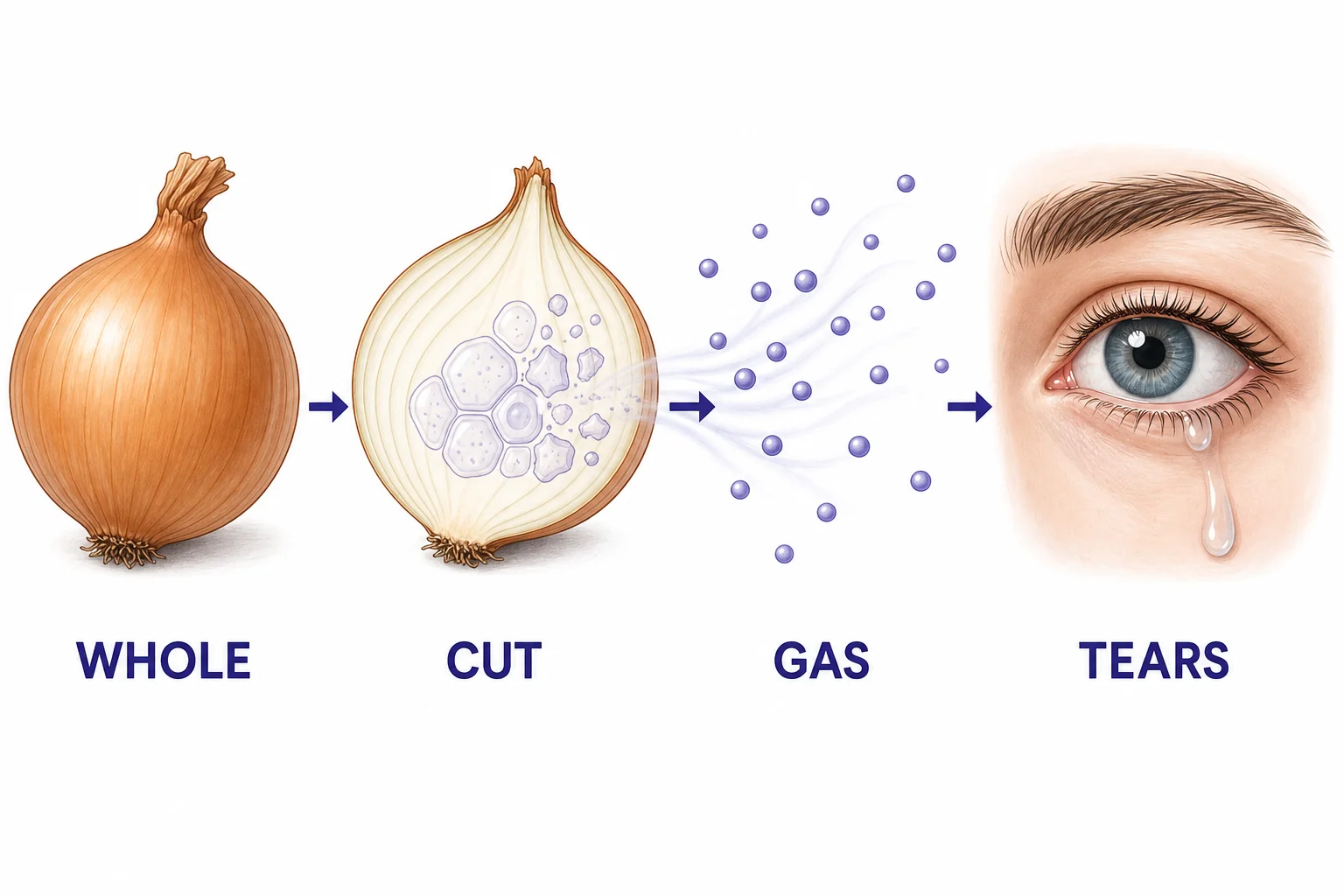
A simple sequence showing a whole onion, a cut onion, airborne gas, and tears as evidence of a chemical reaction
New substances can have new properties
Onion tears are a good example of a chemical reaction. The starting substances in the onion are not the same as the substances that reach your eye. After cells break, particles rearrange and make new materials with new properties. The new gas has a strong effect even though it is invisible. This connects to the grade 5 idea that matter can be described by its properties. Smell, state of matter, and how a substance affects living tissue are all properties. Students can observe some parts of the onion story safely. They can compare a whole onion, a cut onion, and a chilled onion. They should not put onion juice near anyone's eyes on purpose. The goal is to notice evidence. A stronger smell, more tears, or less sting after chilling can all be observations that point to particle behavior.

A new substance can cause a new effect.

Vocabulary

Cell
A tiny building block of a living thing. Onion cells hold water and many substances.
Sulfur compound
A substance that contains sulfur atoms. Some sulfur compounds help give onions their strong smell.
Enzyme
A protein that helps a chemical reaction happen faster.
Volatile
Able to evaporate and move into the air easily.
Chemical reaction
A process in which substances change into new substances with different properties.
Irritant
A substance that bothers body tissue, such as the surface of the eye.

In the Classroom

Cold onion comparison

20 minutes | Grades 3-5

Chill one onion piece and keep another at room temperature. Students compare smell strength from a safe distance and record which one seems stronger.

Broken cells model

15 minutes | Grades 3-5

Give students paper circles or bags that hold two colors of beads. When the model cell is opened, the colors mix to show how cutting onion cells lets substances meet.

Evidence chart

25 minutes | Grades 4-5

Students make a chart with observations from a whole onion, sliced onion, and chilled sliced onion. They connect each observation to particle movement or chemical change.

Key Takeaways

  • Onions make you cry because cutting breaks their cells.
  • Broken onion cells release sulfur-containing substances.
  • Enzymes help turn those substances into a gas that can reach your eyes.
  • The gas reacts with eye moisture and causes stinging.
  • Cold onions often cause fewer tears because reactions and evaporation slow down.