Sign in to save

Bookmark this page so you can find it later.

Sign in to save

Bookmark this page so you can find it later.

Earth Science high-school May 24, 2026

How Do Geologists Know How Old Rocks Are?

clues from layers and radioactive clocks
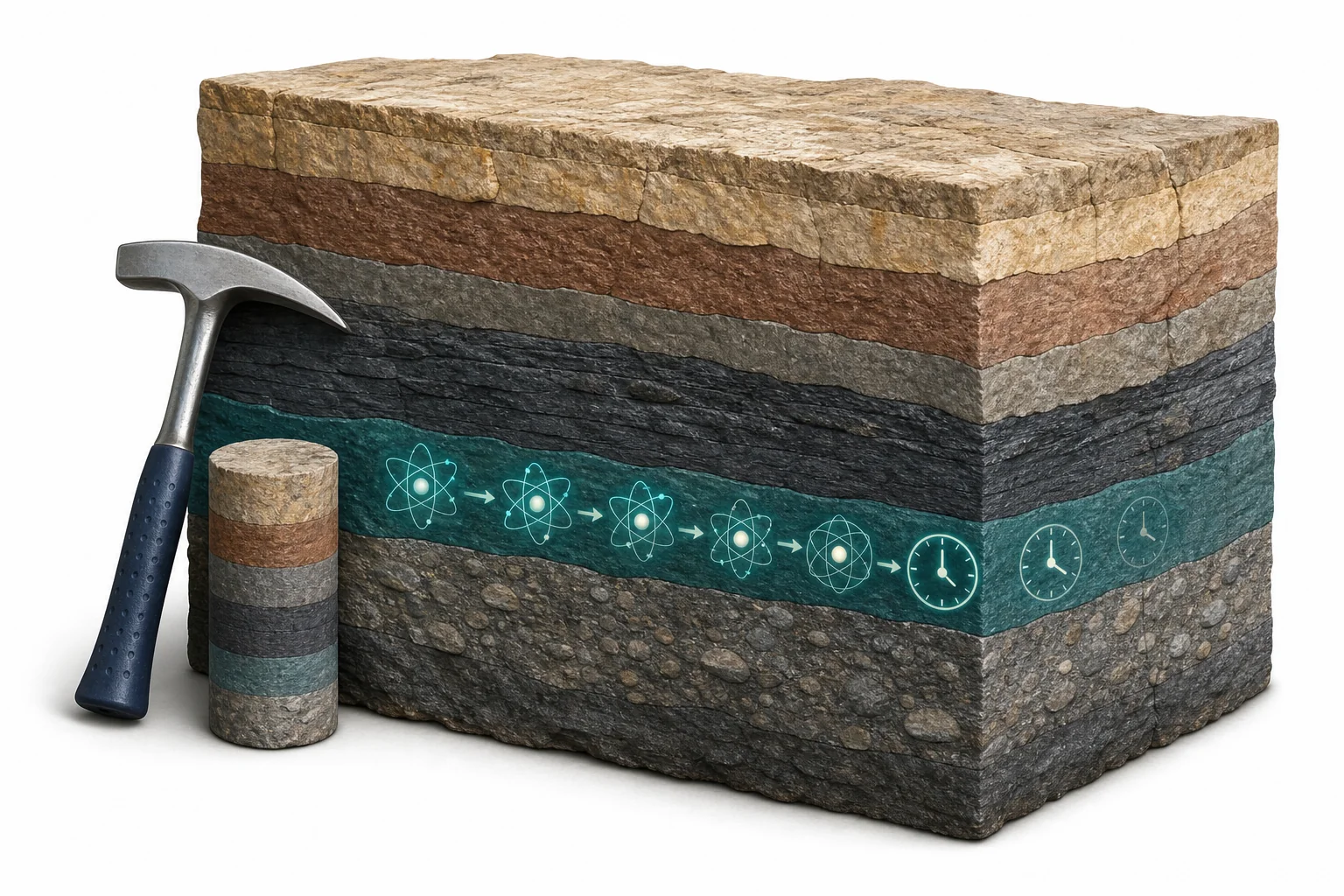
Geologist comparing tilted rock layers, fossil clues, and a lab sample used for radiometric dating

Geologists compare rock layers to tell which rocks formed first and which formed later. They also measure tiny changes inside some minerals that happen at steady rates over time. Together, these clues help scientists build a timeline for Earth history.

Big Idea. NGSS HS-ESS1-6 connects radioactive decay and rock evidence to the history of Earth and the solar system.

A rock can look still and silent, but it may carry a record of events that happened millions or billions of years ago. Geologists read that record in two main ways. First, they study where a rock sits compared with other rocks. In many places, lower layers formed before layers above them, unless the rocks were later folded, faulted, or overturned. Fossils can also match layers across long distances. Second, geologists measure radioactive atoms trapped inside minerals. Some atoms change into other atoms at steady rates. This acts like a clock that starts when a mineral forms. The clock is not a stopwatch in the usual sense. It is a ratio of parent atoms to daughter atoms. By combining layer evidence with radiometric dating, geologists can test one line of evidence against another and build a timeline for Earth.

Relative dating starts with layers
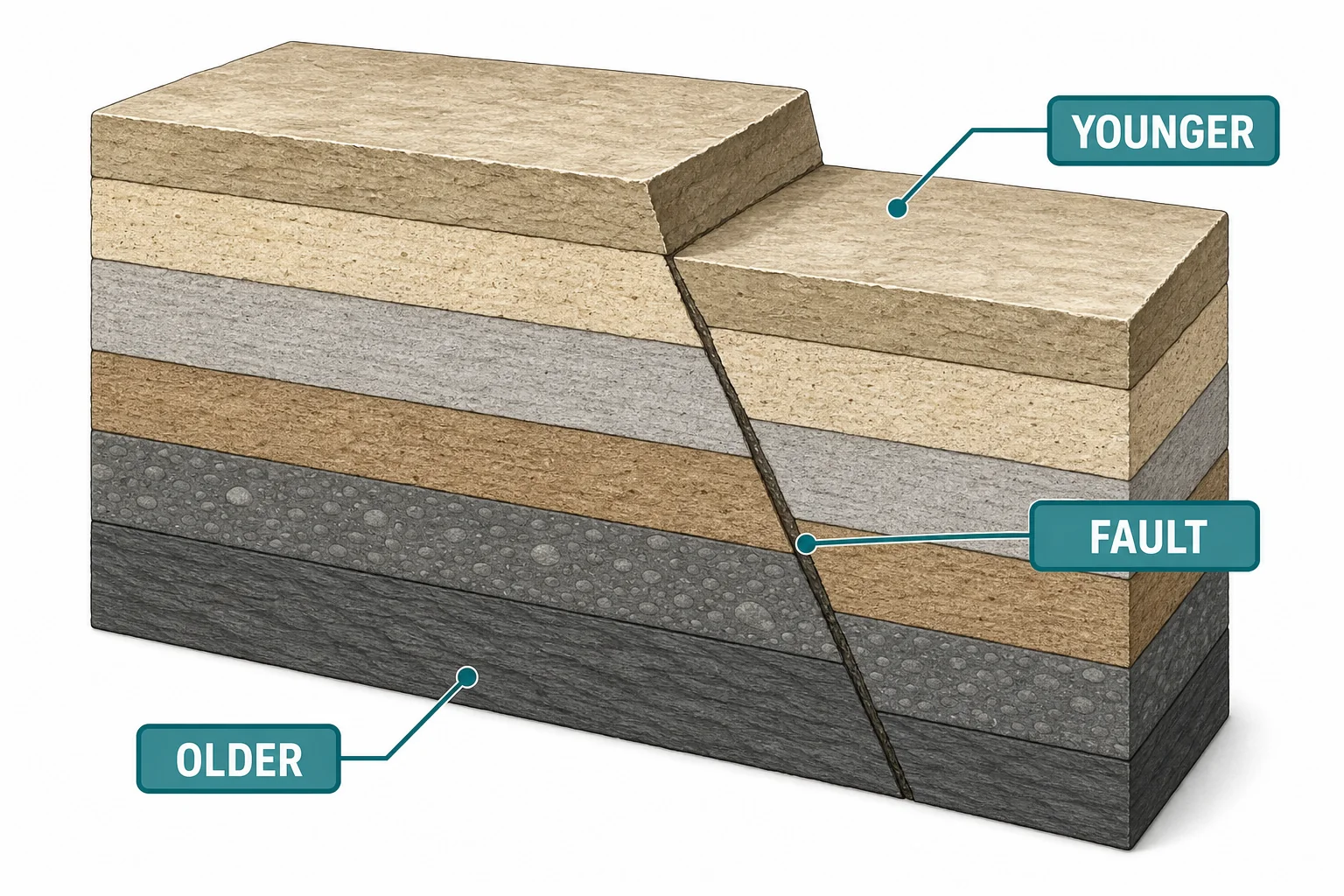
Diagram of sedimentary rock layers showing older layers below younger layers, with a fault cutting across them
Layer position gives a first timeline.
Relative dating does not give an age in years. It tells order. In an undisturbed stack of sedimentary rocks, the oldest layer is usually at the bottom and the youngest is at the top. This is called the law of superposition. Other clues help when the stack has been changed. A fault must be younger than the rocks it cuts. An igneous intrusion must be younger than the rocks around it. A buried surface of erosion marks a gap in time. Fossils can also help. If the same fossil species appears in two far apart layers, those layers may be close in age. Relative dating is like putting pages of a torn book back in order. The page numbers may be missing, but the sequence still carries meaning.

Relative dating tells what came before and what came after.

Radioactive decay acts like a clock
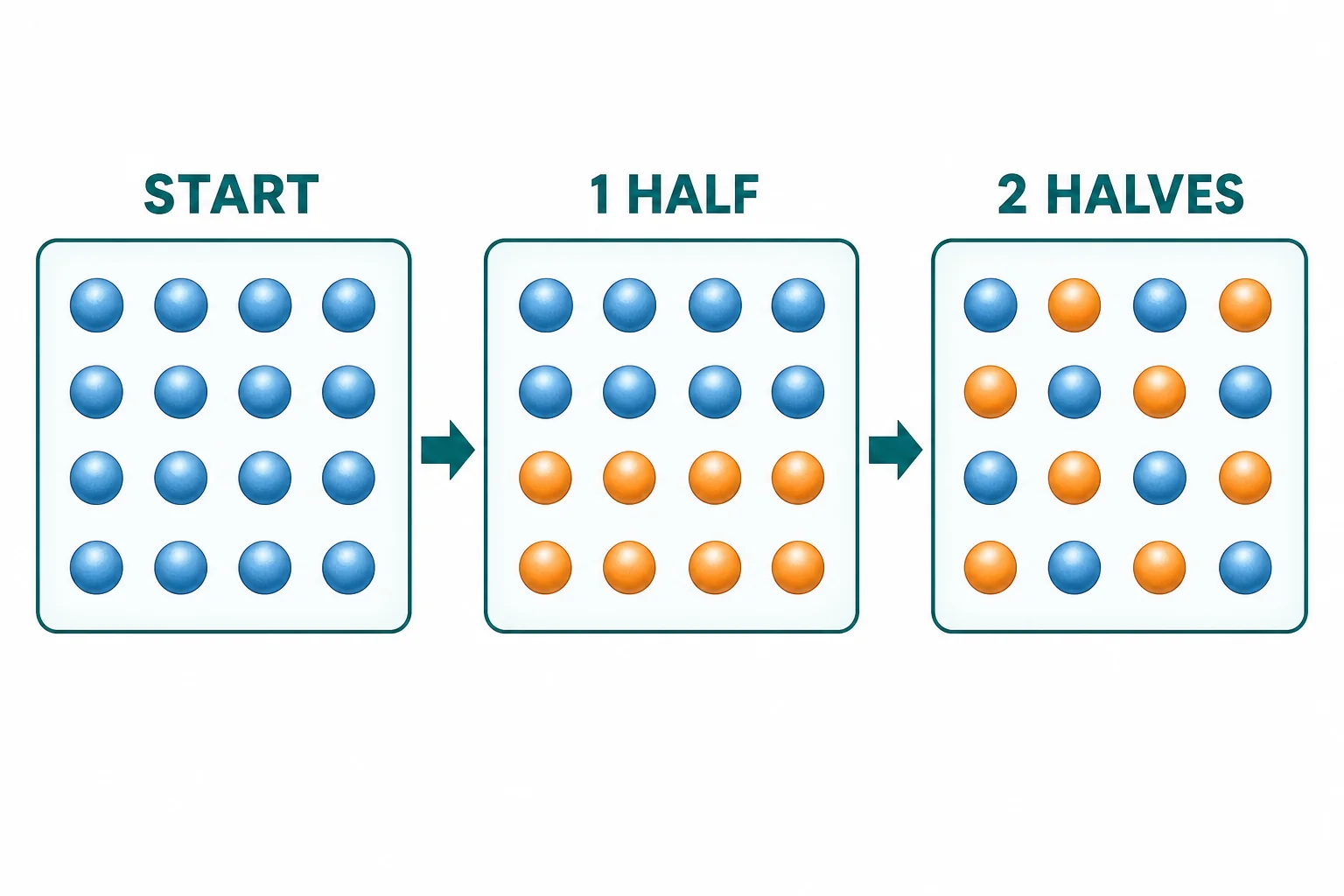
Half-life diagram showing parent atoms decreasing and daughter atoms increasing over three time steps
A half-life cuts the parent atoms in half.
Some atoms are unstable. Over time, they change into different atoms. The starting atom is called the parent. The new atom is called the daughter. Each radioactive material changes at a steady average rate called its half-life. After one half-life, about half of the parent atoms remain. After two half-lives, about one fourth remain. The pattern can be written as $N=N_0(\frac{1}{2})^{t/T}$, where $T$ is the half-life. Scientists do not watch one atom and predict its exact moment of change. They measure large numbers of atoms. Large groups follow a dependable pattern. When a mineral forms, it may trap parent atoms and exclude daughter atoms. From that starting point, the changing ratio can record elapsed time.

A half-life is a steady statistical pattern, not a guess.

Uranium-lead dates ancient minerals
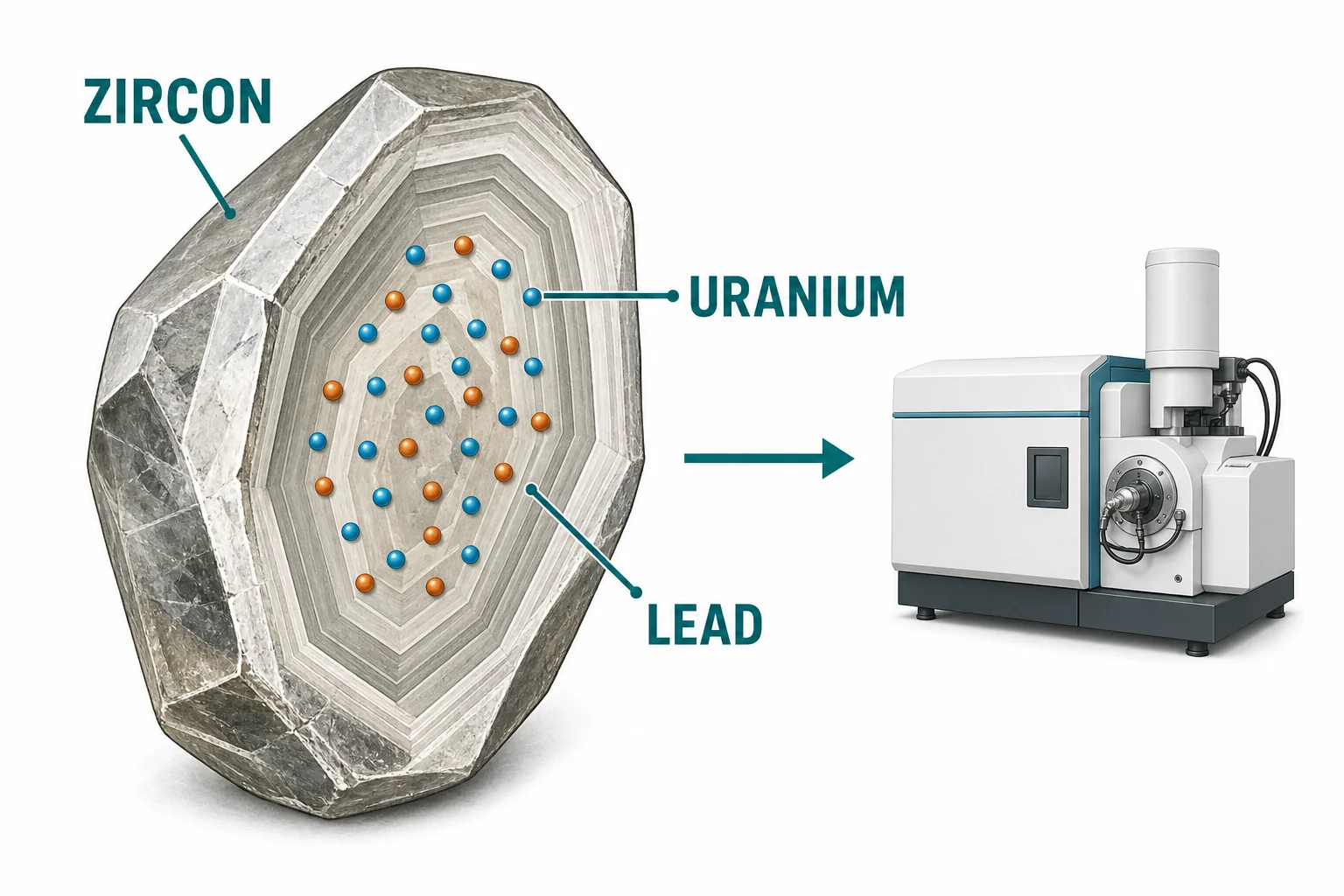
Zircon crystal with uranium atoms inside and lead atoms produced by decay, linked to a laboratory age measurement
Zircon crystals can preserve very old clocks.
Uranium-lead dating is one of the most important methods for very old rocks. It is often used on a mineral called zircon. Zircon can include uranium atoms when it crystallizes, but it usually rejects lead atoms at the start. That makes it useful because any lead found inside the zircon is likely the result of uranium decay. Uranium has two decay paths used in dating. Uranium-238 changes to lead-206, and uranium-235 changes to lead-207. These two clocks run at different rates. If both give the same age, the result is stronger. If they disagree, the mineral may have lost lead or gained uranium during heating, pressure, or fluid movement. Geologists use this method to date volcanic ash layers, ancient crust, and crystals older than most fossils.

Uranium-lead dating is best for very old minerals.

Carbon-14 dates recent organic remains
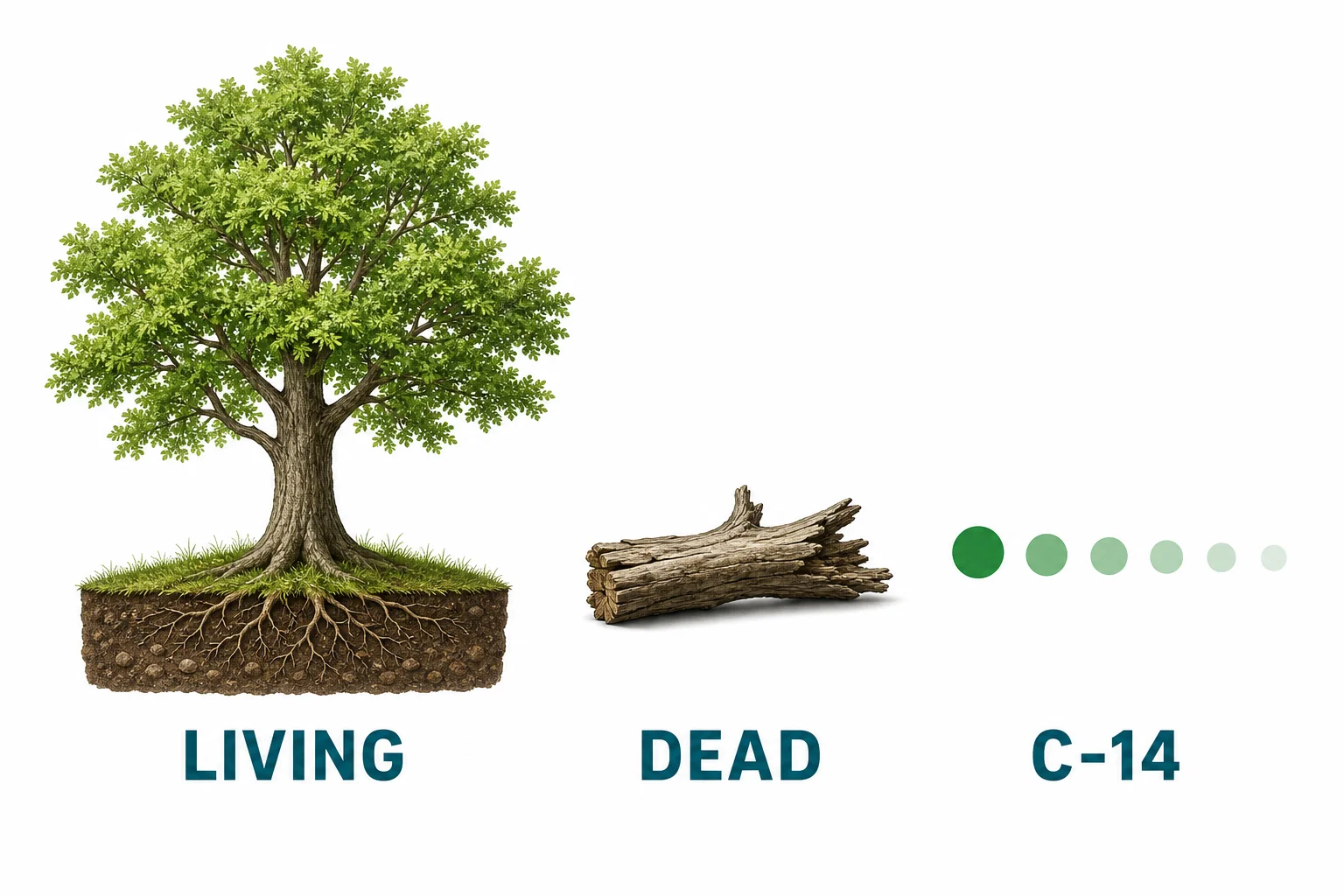
Carbon-14 dating diagram showing a living tree, a dead wood sample, and decreasing carbon-14 through time
Carbon-14 is for recent once-living samples.
Carbon-14 dating works on once-living material, not most rocks. Living things take in carbon while they are alive. A tiny part of that carbon is radioactive carbon-14. After the organism dies, it stops exchanging carbon with the environment. The carbon-14 then decays into nitrogen-14. Because carbon-14 has a short half-life compared with uranium, it is useful for recent history. It can date wood, bone, cloth, charcoal, and shells from roughly the last 50,000 years. It cannot date dinosaur bones that are tens of millions of years old in the usual way. It also cannot directly date a granite or basalt crystal. Geologists may still use carbon-14 to date material found in young sediments, which can help place nearby layers in time.

Carbon-14 is powerful, but only for young organic material.

Best ages come from matching evidence
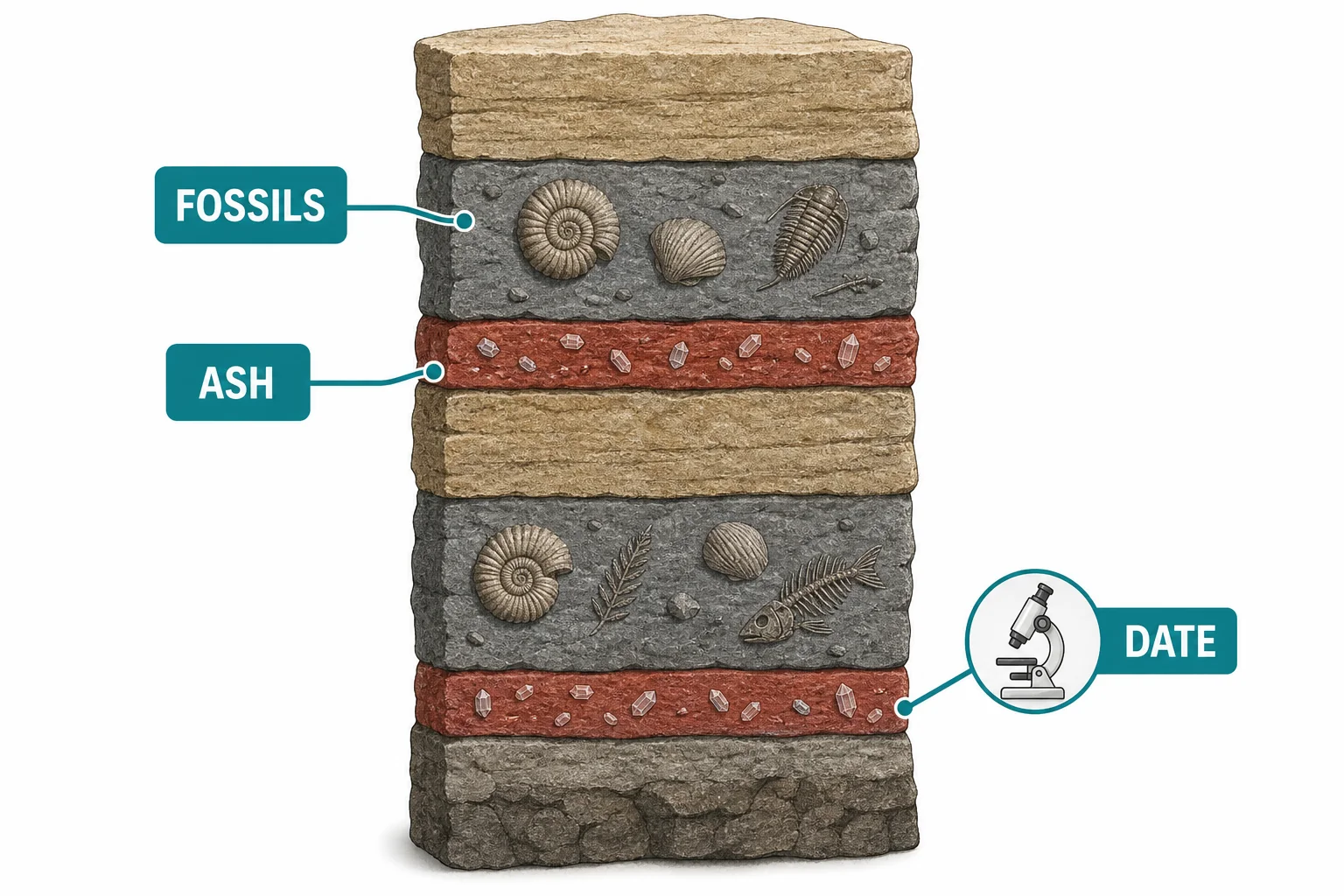
Rock sequence with fossil layers and dated volcanic ash layers used together to build an Earth history timeline
Layer clues and lab dates work together.
A single date is not the whole story. Geologists look for agreement among several clues. Suppose a volcanic ash layer lies between two fossil-rich sediment layers. The ash contains zircon crystals that can be dated with uranium-lead methods. The fossils give a relative age range, and the ash gives a numerical age for that moment in the sequence. If several ash beds are dated, the ages should get younger upward. If they do not, geologists check for reworked grains, disturbed layers, or lab problems. This testing matters because rocks are often changed after they form. Heat, pressure, erosion, and groundwater can reset or disturb some clocks. The strongest timelines come from multiple samples, clear field relationships, and methods that match the age range of the material.

Reliable rock ages come from evidence that checks itself.

Vocabulary

Relative dating
A method that places rocks or events in order from older to younger without giving an exact age in years.
Radiometric dating
A method that estimates age by measuring parent and daughter atoms produced by radioactive decay.
Half-life
The time it takes for half of the parent atoms in a sample to decay.
Parent isotope
The radioactive form of an element that changes into a different atom over time.
Daughter isotope
The atom produced when a radioactive parent isotope decays.
Zircon
A durable mineral that can trap uranium when it forms and is often used in uranium-lead dating.

In the Classroom

Build a relative age sequence

25 minutes | Grades 9-12

Give students a paper cross section with rock layers, faults, intrusions, and fossils. Students list events from oldest to youngest and explain the rule they used for each step.

Model half-life with coins or cubes

30 minutes | Grades 9-12

Students start with 100 coins or two-color cubes and remove the pieces that land on one chosen side each round. They graph the remaining parent atoms and compare the curve with the idea of half-life.

Choose the right dating method

20 minutes | Grades 9-12

Students sort sample cards such as zircon in ash, charcoal from a fire pit, dinosaur bone, and basalt lava. For each card, they choose relative dating, carbon-14, uranium-lead, or a combination and justify the choice.

Key Takeaways

  • Relative dating places rocks and events in order.
  • Radiometric dating can give numerical ages when the right minerals are present.
  • Half-life describes the steady decay pattern of large groups of radioactive atoms.
  • Uranium-lead dating is useful for very old minerals such as zircon.
  • Carbon-14 dating is useful for recent once-living material, not ancient rocks.