Sign in to save

Bookmark this page so you can find it later.

Sign in to save

Bookmark this page so you can find it later.

Earth Tunnel Simulator

Click anywhere on the globe to dig a tunnel straight through Earth. Discover what is on the other side, how long it takes to fall through, and which layers you pass through along the way.

Interactive Globe

Click anywhere to place your tunnel

Origin
Antipode
Click to place tunnel · Drag to rotate

Click the Globe to Start

Rotate the globe with drag, then click any point to dig a tunnel and see what is on the other side of Earth.

1Drag to rotate the globe
2Click to place your tunnel origin
3See antipode, fall time, and Earth layers

The Science Behind the Simulator

Fall Time

Assuming uniform Earth density and ignoring air resistance, the fall time through any tunnel is the same: about 42 minutes. This is because gravity decreases linearly toward the center, creating simple harmonic motion.

Antipodes

The point directly opposite you on Earth is your antipode. Most land locations have antipodes in ocean water. New Zealand and parts of Spain are rare exceptions where land faces land.

Earth Layers

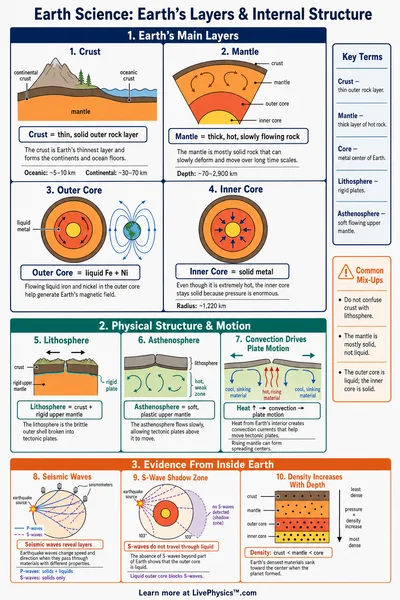
Earth has four main layers: the thin crust (0-35 km), the rocky mantle (35-2890 km), the liquid outer core (2890-5150 km), and the solid inner core (5150-6371 km).
Related Content

Related Tools

Earthquake Magnitude Calculator
Four modes: magnitude scales (Richter Mₗ, moment magnitude M𝑤, energy), energy comparison (each step = 31.6× more energy, logarithmic bar chart), Modified Mercalli Intensity I-XII with descriptions, and Richter magnitude from seismograph amplitude. Presets include Minor M3 through Great M8, 1906 San Francisco M7.9, and 2011 Japan M9.1.
Carbon Footprint Calculator
Estimate annual CO₂ emissions from transportation (car miles, fuel type, flights), home energy (electricity, heating, AC), diet (meat consumption, food waste), and lifestyle (shopping, recycling). Pie chart breakdown, country comparison bar chart, trees-to-offset and equivalent-driving metrics. Five presets: Average American, Eco-Conscious, Heavy Commuter, Frequent Flyer, Work from Home.
Star Lifecycle Visualizer
Three modes: interactive HR diagram with 23 real stars (click to see properties), stellar evolution pathway from nebula to end state (white dwarf, neutron star, or black hole based on initial mass), and star properties calculator (luminosity L∝M^3.5, radius, lifetime t∝M^-2.5, apparent magnitude). Six presets: Sun, Red Dwarf (0.3 M☉), Sirius A (2 M☉), Blue Giant (20 M☉), Betelgeuse (15 M☉), Supergiant (50 M☉). Includes spectral class colour strip and SVG star visualization.
H-R Diagram Explorer
Three modes: plot a single star on the Hertzsprung-Russell diagram from temperature, radius, and mass (Stefan-Boltzmann luminosity, spectral class O-M, absolute magnitude, HR region); compare multiple stars side by side; and browse the spectral atlas with typical properties for each class. 23 reference stars plotted, 6 presets from Proxima Centauri to Rigel.