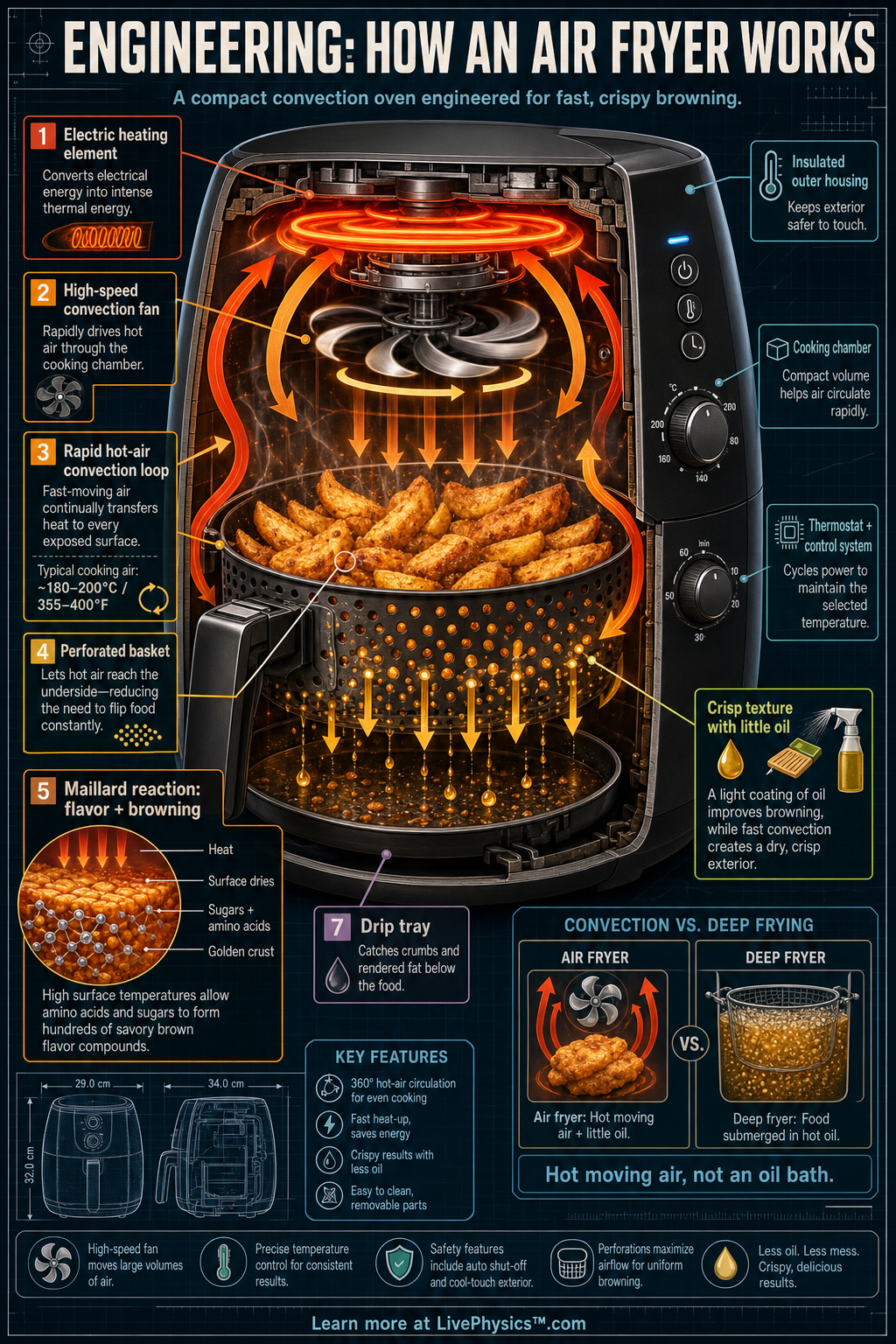
Inside the appliance, the heating element near the top converts electrical energy into thermal energy, while a fan drives a circulating airflow loop. Hot air moves downward around the food in a perforated basket, then returns upward to be reheated and recirculated. The basket openings expose more food surface to the moving air, and a drip tray below catches fat, crumbs, and liquid.
Surface temperatures and drying allow Maillard reactions between amino acids and sugars, producing brown color and roasted flavors.
Understanding Engineering, How an Air Fryer Works
Air cooking depends on several heat transfer paths at once. Moving air carries heat to the food surface. Infrared radiation from the hot parts inside the appliance can heat exposed surfaces directly.
The basket itself becomes hot and transfers heat by conduction where food touches it. Air holds much less heat than liquid oil, so an air fryer cannot heat food in exactly the same way as deep frying.
Its strength comes from fast airflow, a compact cooking space, and a high temperature difference between the food and its surroundings. Preheating helps because the walls, basket, and air start closer to the set temperature before cold food enters.
Temperature control is an engineering problem, not a guarantee that every point is equally hot. A sensor measures the air or a nearby surface, then a controller switches the heater on and off to stay near the chosen setting. The displayed temperature is therefore an average target.
Food can be cooler in crowded spots or near the centre of a thick piece. Opening the drawer releases hot air and lets in cooler room air. This lowers the cooking temperature for a short time.
A full basket can block flow paths, creating zones where air moves slowly. Shaking fries or turning larger items changes which surfaces receive the strongest heating.
Water has a major effect on texture. As food warms, water near its surface evaporates. Evaporation takes a large amount of energy, which holds the surface near the boiling temperature of water while it remains wet.
This is why a wet coating stays pale for longer. Once the outer layer dries, its temperature can rise enough for browning and crisping. A small amount of oil can help by filling tiny surface gaps and improving contact between heat and food.
Too much oil can pool, smoke, or leave a greasy surface. Patting food dry, spacing pieces apart, and using a light oil coating often improve results because they support evaporation.
Students can connect this appliance to familiar ideas about energy use and material design. Electrical energy used equals power times time, so a higher power setting uses energy faster, though cooking time may be shorter. The appliance casing uses insulation and an air gap to reduce heat loss to the kitchen.
Vents must remain clear because the motor and electronics need cooling. The drip tray matters for more than cleaning. Fat or crumbs left near very hot surfaces can produce smoke and unpleasant smells.
When comparing cooking results, pay attention to food size, starting temperature, moisture, basket loading, and cooking time. These variables explain why the same setting can give different results for different foods.
Key Facts
- An air fryer is primarily a forced-convection oven, not a device that fries food by submerging it in oil.
- The electric heating element converts electrical energy to heat, E = P t.
- Electrical power is related to voltage and current, P = V I.
- A fan increases convective heat transfer by replacing the cooler air layer near the food with hotter moving air.
- The perforated basket allows hot air to contact the top, sides, and bottom of the food while drippings fall to the tray.
- Maillard browning occurs most effectively on a relatively dry food surface at elevated cooking temperatures, often above about 140°C.
Vocabulary
- Convection
- Convection is heat transfer caused by the motion of a fluid such as air.
- Heating element
- A heating element is an electrical component that produces heat when electric current passes through it.
- Forced convection
- Forced convection is convection produced by a fan or other device that actively moves fluid.
- Maillard reaction
- The Maillard reaction is a set of chemical reactions between amino acids and sugars that creates browned color and savory flavors in cooked food.
- Perforated basket
- A perforated basket is a container with holes that supports food while allowing air and drippings to pass through.
Common Mistakes to Avoid
- Packing the basket tightly blocks airflow, so hot air cannot reach all surfaces evenly and the food steams instead of browning well.
- Assuming an air fryer cooks with no oil is wrong because a small amount of oil can improve surface browning and help seasonings adhere, even though deep-frying amounts are unnecessary.
- Covering the basket holes with solid foil prevents circulation from below, reducing convection and increasing uneven cooking.
- Forgetting to preheat when a recipe requires it lowers the initial air and surface temperature, which can delay browning and lengthen cooking time.
Practice Questions
- 1 An air fryer has a rated power of 1500 W and runs for 12.0 min. How much electrical energy does it use in joules? Use E = P t.
- 2 A heating element operates at 120 V and draws 12.5 A. Calculate its electrical power using P = V I.
- 3 Two equal potato pieces are cooked for the same time and temperature. One is placed in a single layer with space around it, while the other is buried in an overcrowded basket. Predict which piece browns more evenly and explain using airflow, convection, and moisture removal.