Practice making engineering decisions for a solar house by comparing design options, using simple calculations, and explaining trade-offs.
Read each problem carefully. Use evidence, calculations, and clear reasoning to explain your design choices. Show your work in the space provided.
Balancing energy, cost, comfort, and constraints in a solar home
Engineering - Grade 6-8
- 1
A team is designing a small solar house. List three goals the team should consider besides making as much electricity as possible.
- 2
A roof can hold either 8 high-efficiency solar panels that each produce 350 watts or 12 standard panels that each produce 250 watts. Which option produces more power, and by how much?
- 3
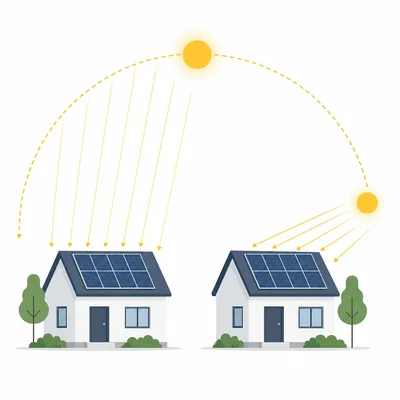
A south-facing roof gets strong sunlight for 6 hours each day. An east-facing roof gets strong sunlight for 4 hours each day. If the same 500-watt solar array could be placed on either roof, how much more energy would the south-facing roof produce in one day?
- 4
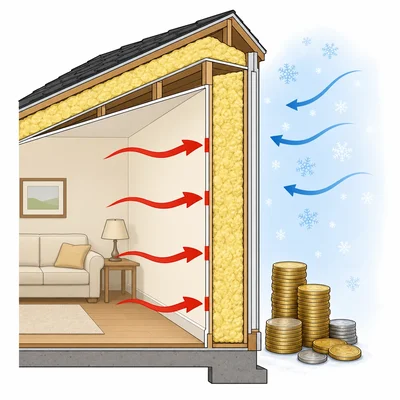
A design choice adds extra insulation to the house. It costs more at first, but it reduces heating and cooling needs. Explain the trade-off.
- 5
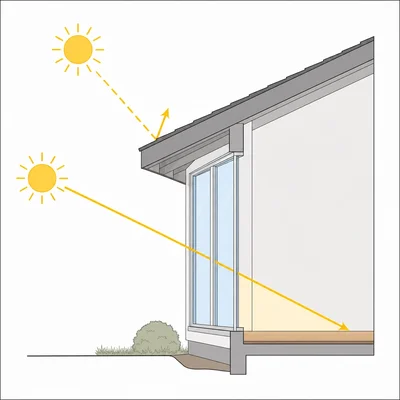
A window design uses very large south-facing windows to let in winter sunlight. In summer, the same windows may overheat the house. Name one design feature that could reduce overheating while still allowing winter solar gain.
- 6
A student says, "We should cover every part of the roof with solar panels because more panels is always better." Explain why this may not be the best engineering decision.
- 7
A solar house has a daily energy need of 18 kilowatt-hours. Its solar panels produce 12 kilowatt-hours on a cloudy day. How much extra energy must come from a battery or the electric grid?
- 8
Compare these two wall materials for a solar house: Material A costs less but has low insulation. Material B costs more but has high insulation. Which would you choose for a cold climate, and why?
- 9
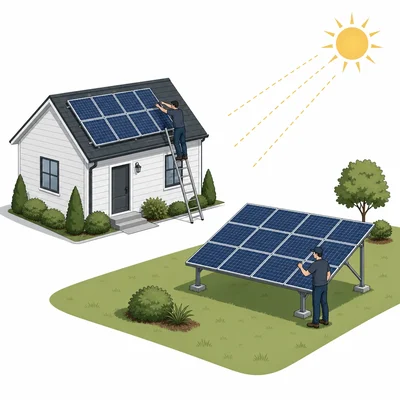
A design team must choose between placing solar panels on a roof or on a ground rack. Give one advantage and one disadvantage of each option.
- 10
A battery system costs $4,000 and stores enough energy to power the house at night. Without the battery, the house must use grid electricity at night. What are two benefits and one drawback of adding the battery?
- 11
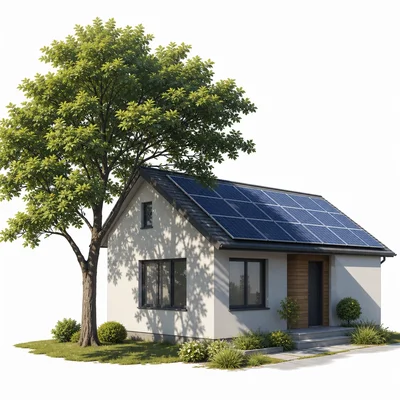
A house design includes a tall tree on the west side. The tree shades the house on hot afternoons, but it also shades some solar panels. Explain how this creates a trade-off.
- 12
A team has a budget of $10,000. Solar panels cost $7,000, better insulation costs $2,500, and smart energy controls cost $1,200. Can the team include all three choices? If not, how much over budget would they be?
- 13
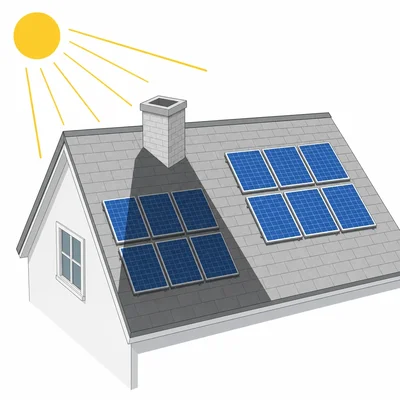
A solar panel works best when it is not shaded. Look at this situation: a chimney casts a shadow on the roof from 2 p.m. to 5 p.m. each day. What is one design change that could improve performance?
- 14
Rank these design priorities from most important to least important for a solar house in a storm-prone area: lowest cost, strong roof structure, maximum window area, secure panel mounting. Explain your ranking.
- 15
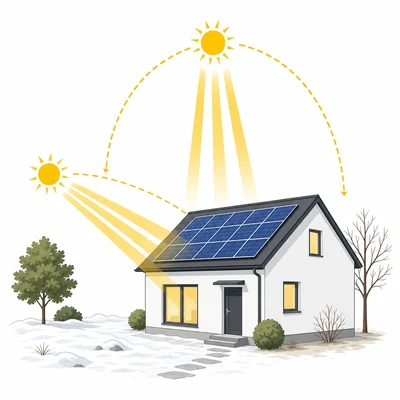
A final design produces enough solar energy in summer but not in winter. Give two reasons this might happen and one possible improvement.