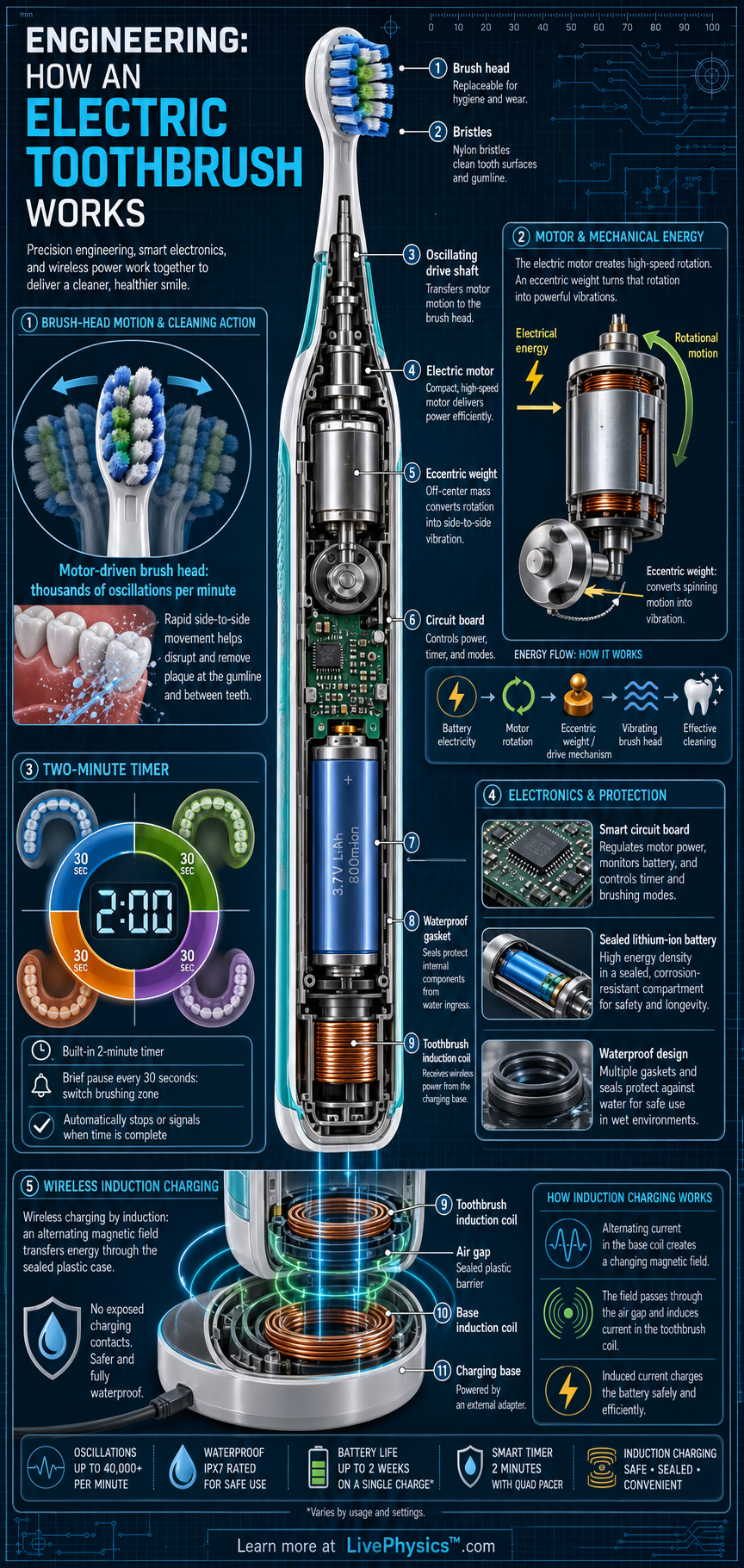
An electric toothbrush is a compact electromechanical system that converts stored electrical energy into rapid motion at the brush head. Its sealed body must protect the battery, motor, and electronics from water while remaining comfortable to hold. By moving the bristles thousands of times per minute, it can help remove plaque with less hand motion than a manual toothbrush.
The charging base and timer add useful engineering features without requiring exposed electrical contacts on the toothbrush.
Understanding Engineering, How an Electric Toothbrush Works
The control electronics do more than switch the motor on. They manage battery voltage, limit current, watch the charging process, and run the timer. A rechargeable cell does not deliver exactly the same voltage throughout a brushing session.
Its voltage falls as energy is used. The circuit must keep the brush motion reasonably steady despite that change. It may use short pulses of power rather than a constant supply.
This method, called pulse width control, can adjust the motor speed while wasting less energy as heat. Some designs detect when the brush head is pressed too hard. They use a pressure sensor or changes in motor current to trigger a light, vibration, or slower motion.
The type of motion at the brush head affects the mechanical design. In an oscillating rotating brush, gears reduce the motor speed and increase twisting force. A small round head then turns a short distance one way before reversing.
The repeated reversal puts stress on gears, shafts, and joints. Engineers choose materials that resist wear and shape parts so they stay aligned. In a sonic brush, the head moves back and forth through a small distance at a high frequency.
This can be produced by a motor with an offset mass or by an electromagnetic actuator. The bristles bend during each motion. Their stiffness, length, and arrangement affect how well they reach tooth surfaces without feeling harsh.
Wireless charging solves a waterproofing problem. Metal charging contacts can corrode or collect dirt in a bathroom. A charging base instead creates a changing magnetic field in a coil.
A coil inside the handle receives part of that changing field and produces a voltage. The receiving circuit changes this into suitable power for the battery. The coils need to be close and reasonably centered for efficient energy transfer.
Much of the charger design is about reducing wasted energy. Poor alignment, large gaps, and unwanted heating reduce efficiency. The battery charging circuit is equally important because overcharging can shorten battery life or create a safety risk.
Water protection depends on details that are easy to miss. The handle usually has plastic shells, rubber seals, welded joints, and a sealed opening around the moving shaft. Every opening is a possible path for water.
Repeated temperature changes can make materials expand or contract, which can weaken a seal over time. The moving brush head must be removable for cleaning, yet the connection below it must resist moisture. When studying this system, trace each energy change from the battery to the circuit, motor, mechanism, and bristles.
Then trace the forces in the opposite direction. Brushing pressure acts on the head, shaft, gears, and motor. This shows why a simple household device needs electrical, mechanical, materials, and safety engineering.
Key Facts
- A rechargeable battery stores electrical energy and supplies DC power to the toothbrush electronics and motor.
- The motor converts electrical energy into rotational motion, which a linkage, gear system, or eccentric weight can convert into oscillation or vibration.
- An eccentric weight has its center of mass away from its rotation axis, producing a repeating unbalanced force as it spins.
- Brush-head motion can occur thousands of times per minute, but the exact rate depends on whether the design is oscillating-rotating or sonic vibrating.
- Wireless charging uses electromagnetic induction, Vsecondary = -N(dΦ/dt), where changing magnetic flux induces a voltage in the toothbrush coil.
- A built-in timer commonly signals after 120 s, helping users divide brushing into four approximately 30 s sections.
Vocabulary
- Electric motor
- A device that converts electrical energy into mechanical motion, usually rotation.
- Drive shaft
- A metal rod that transfers motion from the motor inside the handle to the brush head.
- Eccentric weight
- A rotating mass mounted off-center that creates vibration because its mass is unbalanced.
- Electromagnetic induction
- The production of voltage in a conductor by a changing magnetic field.
- Rechargeable battery
- A battery that stores energy through reversible chemical reactions and can be charged repeatedly.
Common Mistakes to Avoid
- Assuming the charging base sends electricity directly through exposed metal contacts. Many modern toothbrushes use insulated coils, so energy crosses the gap through a changing magnetic field instead.
- Thinking the motor itself must move back and forth to make the brush head oscillate. The motor often rotates continuously, while a linkage, gears, or an eccentric weight changes that rotation into the required brush motion.
- Calling every electric toothbrush a sonic toothbrush. Some designs use oscillating-rotating heads, while sonic models use high-frequency vibration, so their mechanisms and motion patterns differ.
- Believing that a waterproof shell alone protects every internal part. Seals, gaskets, bonded joints, and protected electronics are all needed to prevent water from reaching the battery and motor.
Practice Questions
- 1 A toothbrush timer is set for 2 minutes. If the mouth is divided into four equal sections, how many seconds should be spent brushing each section?
- 2 An eccentric weight spins at 8,000 revolutions per minute. Assuming one major vibration cycle per revolution, calculate its vibration frequency in hertz.
- 3 A toothbrush is placed on its charging base but has no exposed charging contacts. Explain how energy can still reach its battery and why this design is useful in a wet bathroom.