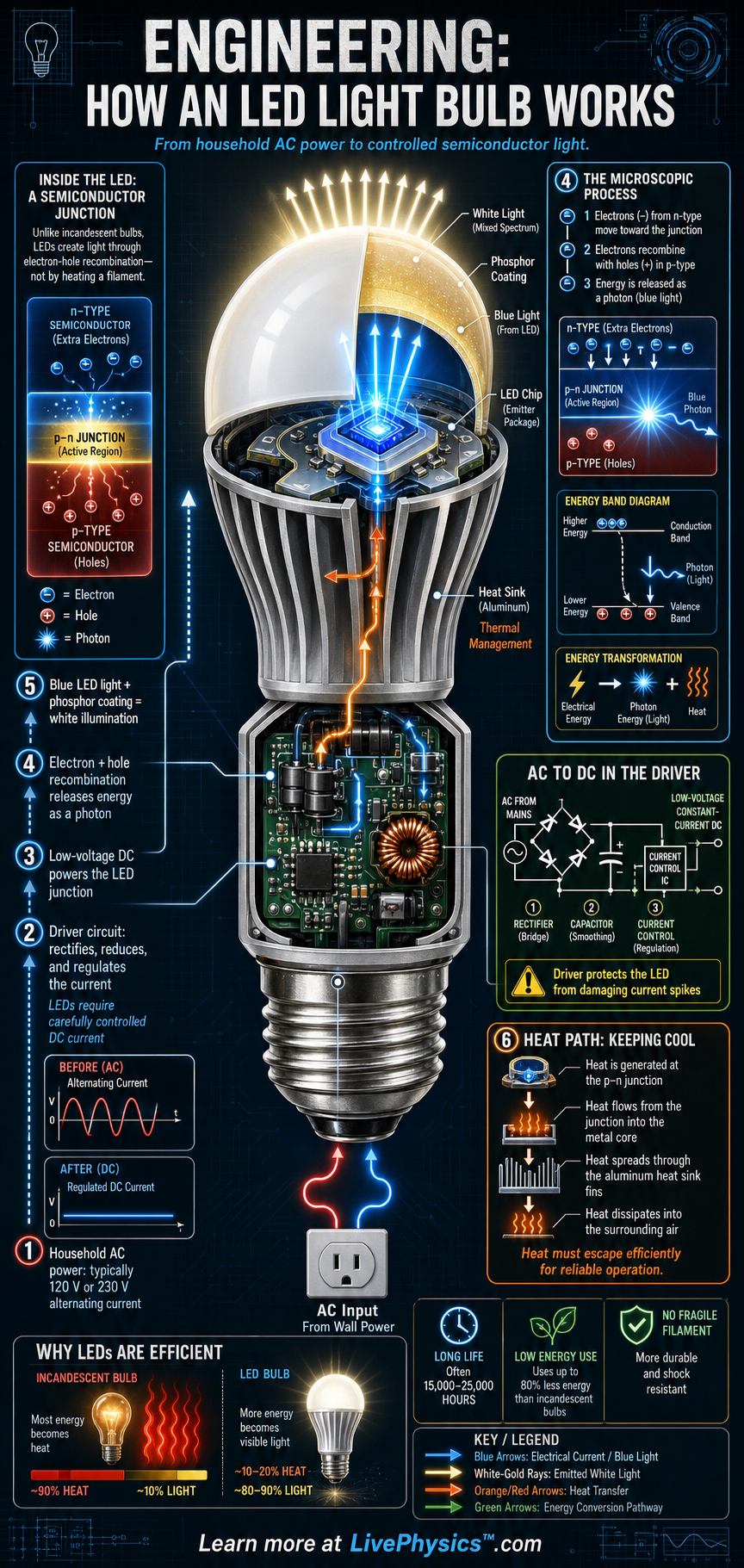
An LED light bulb converts electrical energy into visible light using semiconductor devices rather than a heated filament. This makes LEDs much more efficient than incandescent bulbs, which lose most of their input energy as heat. A household LED bulb is a compact engineered system containing a driver circuit, light-emitting diode chips, optical materials, and thermal management parts.
Each part helps the bulb produce useful white light safely and reliably.
Household power enters the screw base as alternating current, or AC, but LED chips require controlled low-voltage direct current, or DC. The driver circuit rectifies and regulates the incoming electricity before sending it to the LED package. Inside each LED, electrons recombine with holes at a semiconductor junction and release energy as photons, usually blue light.
A phosphor coating absorbs some blue photons and re-emits other colors, creating white-looking light, while a metal heat sink carries waste heat away from the chips.
Understanding Engineering, How an LED Light Bulb Works
The semiconductor material determines the color an LED can make. In a solid, electrons can occupy certain energy ranges. The gap between important ranges is called the band gap.
When an electron loses energy while crossing this gap, that energy can leave as a photon. A larger band gap gives a photon with more energy, which means a shorter wavelength. This is why different semiconductor compounds can produce red, green, blue, or infrared light.
Engineers choose materials carefully because making a bright LED is not only about producing photons. The photons must escape the chip instead of being absorbed inside it.
LED chips are sensitive to current. A small increase in current can make more light, but it can raise the chip temperature quickly. For this reason, a good driver is usually designed to control current rather than simply hold the voltage at one value.
The driver may use a rectifier to make one-direction current from the supply, capacitors to smooth changes, and electronic switches that limit current efficiently. Cheap or poorly designed drivers can cause visible flicker.
Flicker happens when light output rises and falls with the electrical supply. It may be hard to notice directly, yet it can affect video recordings, moving machinery, and some people who are sensitive to it.
White LED light is made from a mixture of colors, so not every white bulb makes objects look the same. The phosphor layer changes part of the original light into longer-wavelength colors. The final balance affects color temperature.
Warm white light has more red and yellow content and often looks similar to older household lamps. Cool white light has relatively more blue content and can look sharper or harsher. Color rendering describes how naturally colors appear under a lamp.
A bulb can look white while still making red fabric, green leaves, or skin tones appear unusual. This matters in homes, classrooms, shops, art rooms, and places where workers inspect products.
Heat is one of the main limits on LED lifetime. The chip may be tiny, but it produces heat in a very small area. That heat must move through the LED package, circuit board, heat sink, and surrounding air.
If the path is poor, the junction temperature rises. High temperature reduces light output over time and can damage the phosphor, solder joints, driver parts, or plastic cover. An LED bulb placed inside a sealed fitting often runs hotter than the same bulb in open air.
When comparing bulbs, students should notice power rating, light output in lumens, color temperature, dimmer compatibility, and the fitting where the bulb will be used. A low-power bulb is not automatically better if it provides too little useful light or fails early because it cannot release heat.
Key Facts
- An LED is a p-n junction diode that emits photons when electrons recombine with holes.
- Photon energy is approximately E = hf, where h is Planck's constant and f is frequency.
- A higher-energy blue LED can excite phosphor materials that produce broader-spectrum white light.
- The driver converts household AC into regulated low-voltage DC for the LED chips.
- Electrical input power is P = VI, where V is voltage and I is current.
- Heat flow increases with temperature difference, Q/t = kAΔT/L for conduction through a material.
Vocabulary
- LED
- A light-emitting diode is a semiconductor device that produces light when electric current flows through it in the forward direction.
- P-n junction
- A p-n junction is the boundary between p-type and n-type semiconductor regions where electron-hole recombination can occur.
- Driver circuit
- A driver circuit converts and controls incoming electrical power so an LED receives the correct voltage and current.
- Phosphor
- A phosphor is a material that absorbs light of one wavelength and emits light at longer wavelengths.
- Heat sink
- A heat sink is a thermally conductive component that spreads and releases heat from electronic parts to the surrounding air.
Common Mistakes to Avoid
- Thinking an LED bulb runs directly from household AC because it screws into a normal socket. LED chips need regulated DC, so the bulb contains a driver circuit that converts the incoming AC power.
- Assuming white LEDs naturally emit all colors of visible light. Many white LEDs begin with blue-emitting chips and use a phosphor coating to convert part of that blue light into other wavelengths.
- Treating an LED as if it produces no heat. LEDs are efficient, but energy not converted to light becomes heat that must be removed to prevent damage and early failure.
- Connecting an LED directly to a voltage source without limiting current. Small changes in LED voltage can cause a large current increase, so a driver or current-limiting component is necessary.
Practice Questions
- 1 An LED driver supplies 12.0 V DC and 0.50 A to an LED module. Calculate the electrical power delivered to the module.
- 2 A bulb uses 9.0 W of electrical power and converts 2.7 W into visible light. Calculate its visible-light energy efficiency as a percentage.
- 3 Explain why an LED bulb with a damaged heat sink may become dimmer or fail sooner even if its driver circuit still supplies the correct current.