Electrolytes & Conductivity Lab
Dip two electrodes into a solution and watch the bulb. Solutions that break apart into ions carry an electric current and light the bulb, while solutions of neutral molecules leave it dark. Pick a substance, change its concentration, and classify it as a strong electrolyte, weak electrolyte, or non-electrolyte. Every test is recorded in the data table for your lab report.
Guided Experiment Classifying Solutions by Electrical Conductivity
When two electrodes connected to a battery and a light bulb are dipped into a solution, what do you predict will happen with a salt solution, a weak acid, and a sugar solution, and why?
Write your hypothesis in the Lab Report panel, then click Next.
Controls
Test a Solution
Choose a substance, set its concentration, then dip the electrodes to see how brightly the bulb glows.
Data Table
(0 rows)| # | Trial | Substance | Concentration (M) | Class | Bulb Brightness |
|---|
Reference Guide
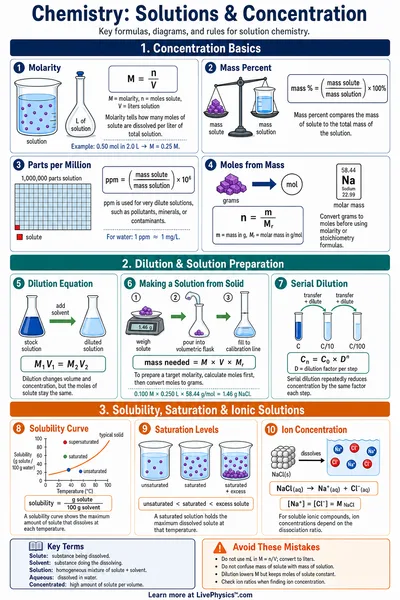
What an Electrolyte Is
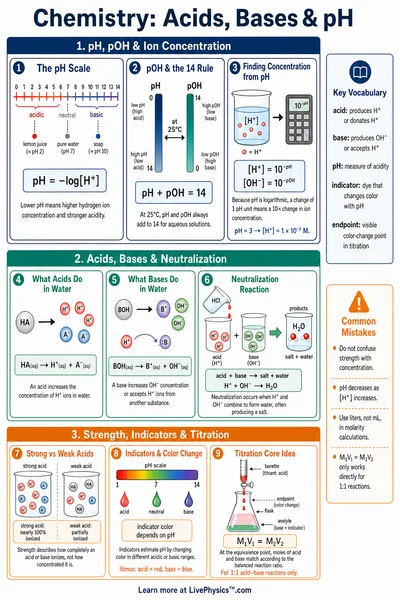
An electrolyte is a substance that produces ions when it dissolves in water. Those free ions can move through the solution, so they carry electric charge between two electrodes and complete a circuit. The light bulb in a conductivity tester lights up only when current can flow.
A non-electrolyte dissolves as neutral molecules instead of ions. With no charged particles to move, the solution cannot carry current and the bulb stays dark, even though the substance has clearly dissolved.
Strong, Weak, and Non-electrolytes
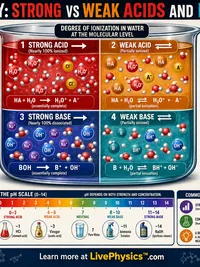
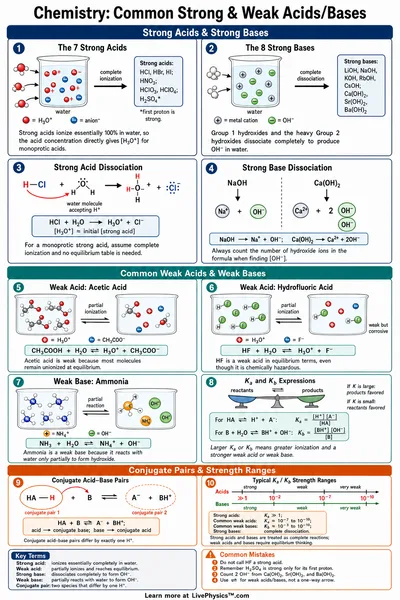
Strong electrolytes. Dissociate almost completely into ions, so the solution is full of charge carriers and the bulb glows brightly.
Weak electrolytes. Ionize only slightly, setting up an equilibrium in which most of the substance stays as molecules. Few ions form, so the bulb glows dimly.
Non-electrolytes. Form no ions at all, so the solution does not conduct and the bulb stays dark.
Dissociation and Ions Carrying Current
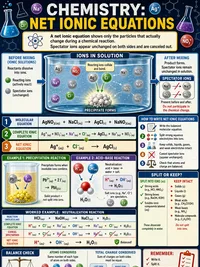
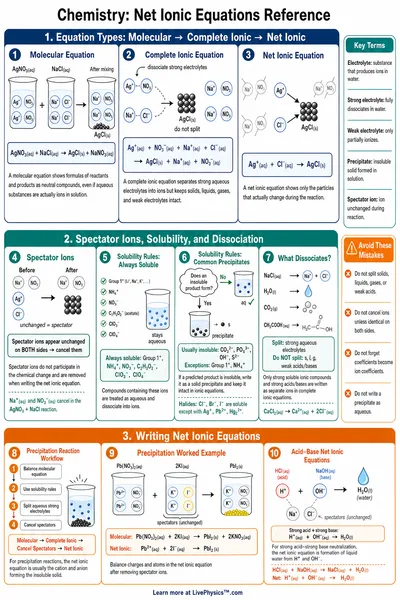
When an ionic compound such as NaCl dissolves, it separates into Na⁺ and Cl⁻ ions. Strong acids and bases such as HCl and NaOH also ionize fully. These mobile ions drift toward the oppositely charged electrode, and that movement of charge is the electric current the bulb detects.
A weak acid such as acetic acid (CH₃COOH) only partly ionizes. At any moment most of it is still neutral molecules, so the ion concentration stays low and the current is small.
Why Concentration Matters
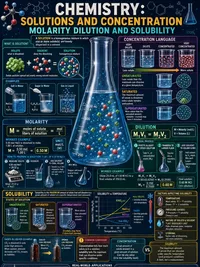
Brightness depends on how many ions are actually present, which is set by both the degree of dissociation and the concentration. A concentrated strong electrolyte has the most ions and the brightest bulb. Diluting it lowers the ion count and dims the bulb, even though it is still a strong electrolyte.
A very dilute strong electrolyte can carry less current than a more concentrated weak one, which is why concentration must always be reported alongside the classification.
Examples of Each Class
Strong electrolytes. NaCl, HCl, NaOH, KNO₃, and H₂SO₄. Soluble salts and strong acids and bases.
Weak electrolytes. Acetic acid (CH₃COOH), ammonia (NH₃), and carbonic acid (H₂CO₃). Weak acids and bases.
Non-electrolytes. Sucrose (C₁₂H₂₂O₁₁), ethanol (C₂H₅OH), glucose, and pure distilled water. Molecular substances that dissolve without forming ions.