Understanding Bird Beak Adaptation Lab
A beak can help a bird obtain one kind of food more effectively than another. This lab uses familiar utensil shapes as simple stand-ins for beaks, then follows how their population shares change across generations in different food environments.
The tweezer, spoon, clothespin, and straw represent different feeding abilities. They are classroom analogies rather than descriptions of four actual bird species, and the feeding-success values are illustrative choices rather than measurements from wild populations.
Start by comparing the available foods with the beak types. Predict which type will leave the most descendants in the selected environment, then run the model and watch how the population shares develop over several generations.
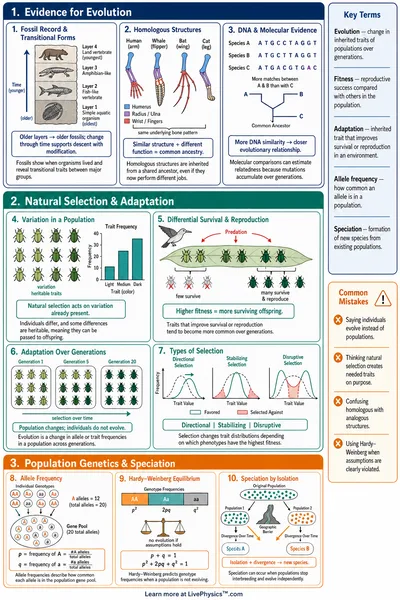
Natural selection requires variation that can be inherited. In this model, offspring retain their parent's beak type, so differences in feeding success can influence the representation of those types in the next generation.
The change happens in the population across generations. An individual bird does not choose a better beak because it needs one, and the model does not transform each existing bird's beak into whichever shape would be most useful.
Food availability determines which feeding abilities are useful. A beak favored in one environment can have a smaller advantage in another, so there is no single best shape independent of the conditions in which it feeds.
Compare two food environments using the same initial population and seed. Record the population shares after the same number of generations, keeping the comparison focused on the environmental difference rather than unequal run lengths.
Chance also affects which parents contribute offspring in a finite population. A type with an advantage is more likely to increase, but small fluctuations can occur from one generation to the next instead of producing a perfectly smooth trend.
The seed makes those random choices repeatable. Reusing a seed reproduces the same modeled sequence under the same conditions, while comparing several seeds helps distinguish a general selection pattern from an unusual outcome in one run.
The model holds the total population size fixed. When one beak type gains a larger share, the others together must account for a smaller share, so a rising line should be interpreted as a change in composition rather than unrestricted population growth.
A type that disappears has no remaining parents to pass it on within this model. There is no mutation or immigration to introduce it again, which is a useful reminder that the processes included in a simulation determine the changes it can show.
Use your report to connect an environmental condition, a feeding advantage, and a change in inherited population traits. Cite the recorded generations and compare more than one run, then explain how real ecosystems add other influences such as predators, migration, changing population sizes, and competition for mates.