Food Web Energy Pyramid Lab
Investigate how energy is lost at each trophic level as it moves through an ecosystem. Apply the 10% rule, compare five ecosystems, and discover why apex predators are always so rare compared to producers.
Guided ExperimentHow Does Transfer Efficiency Affect Top Predator Populations?
If you increase the energy transfer efficiency from 10% to 20%, how do you predict the top predator energy will change? Will it double, triple, or increase by some other factor?
Write your hypothesis in the Lab Report panel, then click Next.
Ecosystem
🌾 Grassland
Producer Energy
200.0 kJ
Top Predator Energy
0.200 kJ
Ecological Efficiency
0.1000%
Controls
Ecosystem
Energy Pyramid (kJ/m²/day)
Energy Flow Summary
| Level | Organisms | Energy (kJ/m²/day) | % of Solar | Biomass (g/m²) | Transfer % |
|---|---|---|---|---|---|
Producers | Grasses, Wildflowers +1 | 200.0 | 1.000% | 10.00 | 1.0% |
Primary Consumers | Rabbits, Grasshoppers +1 | 20.0 | 0.100% | 1.00 | 10.0% |
Secondary Consumers | Foxes, Snakes +1 | 2.0 | 0.010% | 0.10 | 10.0% |
Tertiary Consumers | Eagles, Coyotes | 0.200 | 1.00e-3% | 0.01 | 10.0% |
Decomposers | Fungi, Bacteria +1 | 0.020 | 1.00e-4% | 1.00e-3 | 10.0% |
Data Table
(0 rows)| # | Trial | Ecosystem | Transfer Efficiency | Producer Energy (kJ) | Top Predator Energy (kJ) | Ecological Efficiency (%) |
|---|
Reference Guide
The 10% Rule
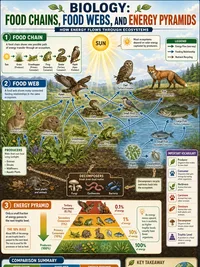
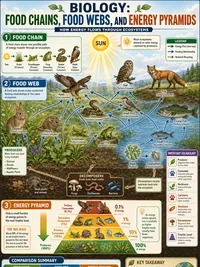
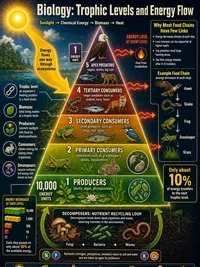
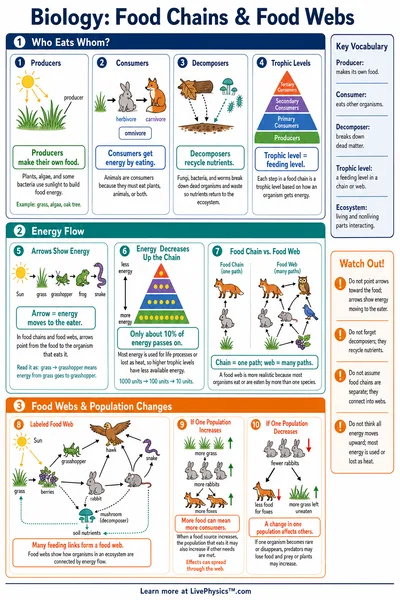
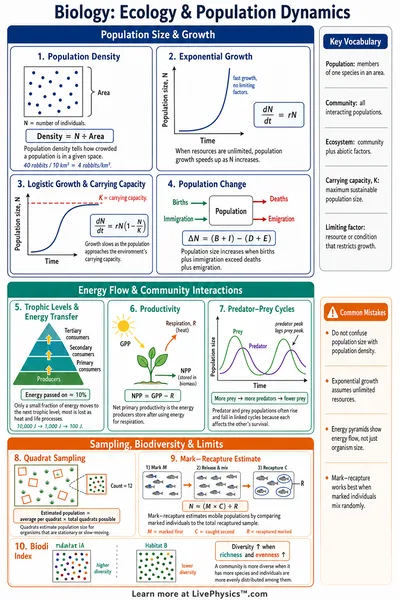
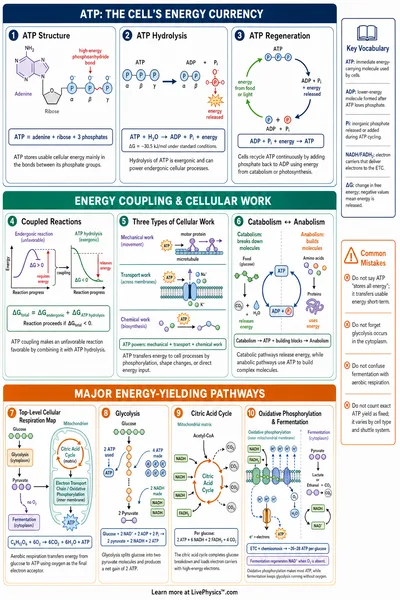
On average, only about 10% of the energy stored in one trophic level is transferred to the next. The remaining 90% is lost as heat through cellular respiration, movement, and metabolic processes.
Where is the transfer efficiency (typically 0.10 for most food chains). This compounding loss severely limits the number of trophic levels an ecosystem can sustain.
Trophic Levels
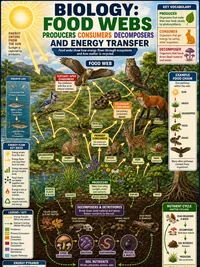
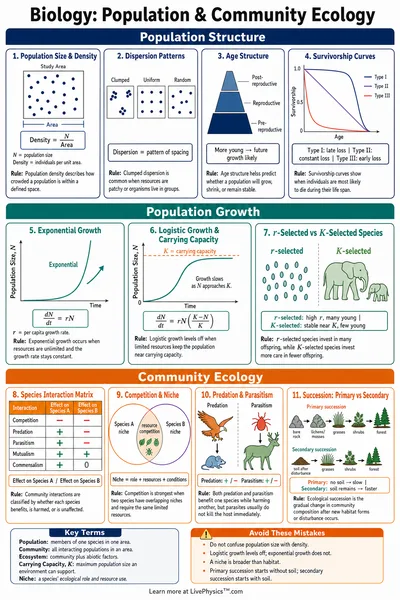
Each trophic level represents a feeding position in the food chain. Producers (autotrophs) form the base by capturing solar energy via photosynthesis. All other levels are consumers (heterotrophs).
- Producers (Level 1). Plants, algae, phytoplankton. Convert solar energy into biomass.
- Primary Consumers (Level 2). Herbivores. Eat producers directly.
- Secondary Consumers (Level 3). Carnivores or omnivores. Eat herbivores.
- Tertiary Consumers (Level 4+). Top predators with few or no natural predators.
Ecological Efficiency
Ecological efficiency measures how much of the producer energy reaches the top predator. It compounds the losses across all trophic levels.
In a typical 4-level grassland ecosystem with 10% transfer efficiency, ecological efficiency is only 0.1%. This means to support 1 gram of top predator biomass, the ecosystem needs 1,000 grams of producer biomass.
Why the Pyramid Shape?
The pyramid shape reflects the fact that energy decreases dramatically at each level. With only 10% transfer efficiency, a 4-level food chain loses 99.9% of its energy before reaching the top predator.
This energy loss has direct ecological consequences. It limits how many top predators an ecosystem can sustain, creates large base populations of producers, and makes energy-intensive behaviors (like flight or active hunting) increasingly costly at higher levels.
- Short food chains are more energy efficient
- Apex predators need large territories to find enough prey
- Humans eating plants vs meat changes our energy footprint significantly