Limiting Reactant and Percent Yield Lab
Select a balanced chemical reaction, set the amount of each reactant in moles or grams, and instantly see which reactant limits the reaction, how much product forms, and what percent yield you achieve from a measured actual yield.
Guided Experiment Limiting Reactant Investigation
If you double the amount of one reactant while keeping the other constant in the water synthesis reaction, what do you predict will happen to the theoretical yield of water?
Write your hypothesis in the Lab Report panel, then click Next.
Reactant Diagram
Each bar shows moles/coefficient ratio. The dashed line is the reaction extent (limited by the shortest bar).
Controls
Enter the mass of product obtained from an experiment to calculate percent yield.
Results
Data Table
(0 rows)| # | Trial | Reaction | Limiting Reactant | Theoretical Yield (g) | Actual Yield (g) | Percent Yield (%) |
|---|
Reference Guide
Limiting Reactant Concept
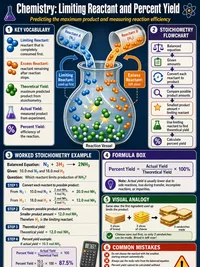
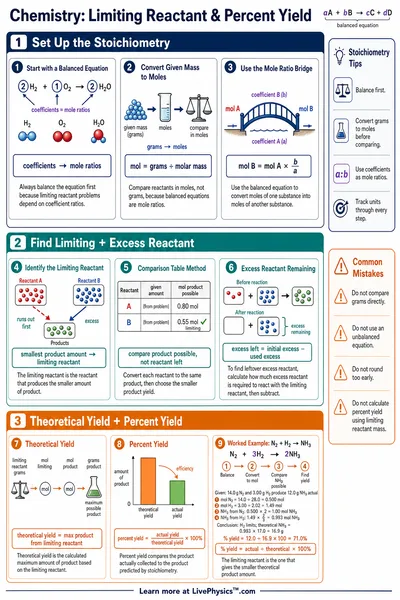
In a chemical reaction, the limiting reactant is the substance that is completely consumed first. Once it runs out, the reaction stops regardless of how much of the other reactants remain. The excess reactants are left over.
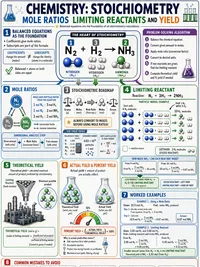
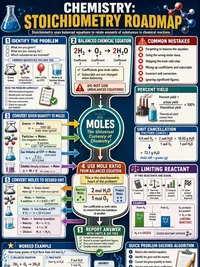
To identify the limiting reactant, divide the available moles of each reactant by its stoichiometric coefficient. The reactant with the smallest ratio is the limiting reactant. That ratio is called the reaction extent.
Mole Ratios from Balanced Equations
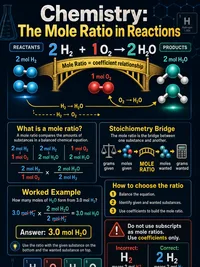
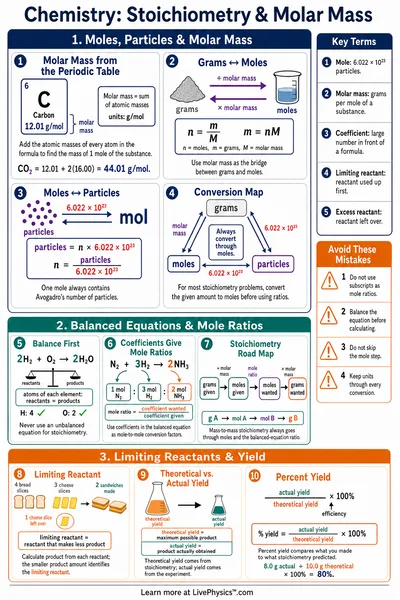
The coefficients in a balanced equation give the exact mole ratios in which reactants combine and products form. For water synthesis
Every 1 mol of O2 reacts with exactly 2 mol of H2 to produce 2 mol of H2O. If you only have 1 mol H2 and 2 mol O2, the H2 runs out first (1/2 < 2/1), so H2 is the limiting reactant.
Theoretical vs. Actual Yield
Theoretical yield is the maximum amount of product that could form if the limiting reactant were completely converted to product with no losses. It is calculated from the extent of reaction and the molar mass.
Actual yield is the mass of product you actually collect in a laboratory experiment. It is always less than or equal to the theoretical yield due to losses from transfer, incomplete reactions, and side reactions.
Percent Yield
Percent yield measures how efficient a reaction is in producing the desired product compared to what theory predicts.
A percent yield of 100% means no product was lost. In practice, yields of 80-95% are considered good for most laboratory reactions. Industrial processes are optimized to push yields as high as possible to reduce raw material costs.
Real-World Significance
The limiting reactant concept drives industrial chemistry decisions. In the Haber process for ammonia (N2 + 3 H2 to 2 NH3), maintaining the right N2:H2 ratio directly controls production efficiency. Feeding excess H2 avoids wasting the more expensive N2 feedstock.
Pharmaceutical synthesis requires high percent yields at every step. A 10-step synthesis with 90% yield per step delivers only about 35% of the theoretically possible product by the final step.
Converting Moles and Grams
Stoichiometry calculations require moles, but laboratory measurements are made in grams. Use the molar mass (g/mol) to convert between them.
Where n = moles, m = mass in grams, and M = molar mass in g/mol. Molar masses are the sum of atomic masses from the periodic table for each atom in the formula.