Ocean Acidification Chemistry Lab
The surface ocean breathes in carbon dioxide from the air. As atmospheric CO₂ rises, more of it dissolves into seawater, the pH falls, and the carbonate ion that shell builders need grows scarce. Set the CO₂ level and watch the carbonate system rebalance.
Guided ExperimentAt what CO₂ level does aragonite saturation drop below the coral threshold of 3?
Keep total alkalinity fixed at 2300 µmol/kg and the mineral set to aragonite. Predict the atmospheric CO₂ level at which the aragonite saturation state Ω falls below 3, the value where coral calcification starts to slow.
Write your hypothesis in the Lab Report panel, then click Next.
Controls
Corals and pteropods build aragonite, the more soluble form. Many other shellfish use calcite, which dissolves less readily.
Carbonate speciation at pH 8.04
pH scale
Shell condition
With Ω = 3.74 (at or above 3) the water is supersaturated, so shells stay intact and calcifiers build skeletons readily.
Seawater chemistry
Favorable for shell building
aragonite saturation state Ω = 3.74
pH
8.04
lower is more acidic
Saturation Ω (aragonite)
3.74
below 1 dissolves shells
Carbonate CO₃²⁻
242 µmol/kg
builds shells
Bicarbonate HCO₃⁻
1816 µmol/kg
dominant carbon species
Dissolved CO₂
12 µmol/kg
set by the atmosphere
Total inorganic carbon (DIC)
2070 µmol/kg
CO₂ + HCO₃⁻ + CO₃²⁻
Preindustrial surface ocean pH was about 8.2; today it is about 8.05. As CO₂ rises the pH falls and carbonate ion drops, so the saturation state for aragonite shells declines.
Data Table
(0 rows)| # | CO₂ (ppm) | Alkalinity (µmol/kg) | Mineral | pH | Ω | CO₃²⁻ (µmol/kg) | DIC (µmol/kg) | Status |
|---|
Reference Guide
The Carbonate System
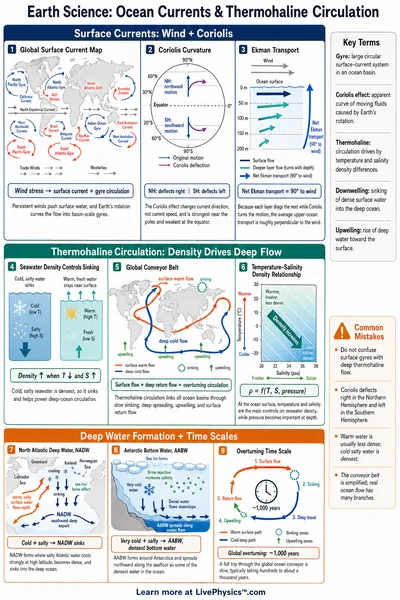
When carbon dioxide dissolves in seawater it forms carbonic acid, which breaks down in a chain of equilibria that controls ocean pH.
CO₂ + H₂O ⇌ H₂CO₃ ⇌ HCO₃⁻ + H⁺ ⇌ CO₃²⁻ + 2H⁺
Near the natural ocean pH of about 8, bicarbonate HCO₃⁻ is by far the dominant carbon species, with smaller amounts of carbonate CO₃²⁻ and dissolved CO₂. The speciation bar in the lab shows these fractions.
Why CO₂ Lowers pH and Carbonate
Adding CO₂ pushes the equilibria to the right, releasing hydrogen ions and lowering the pH. Those extra hydrogen ions then react with carbonate.
CO₂ + H₂O + CO₃²⁻ → 2 HCO₃⁻
So even though total dissolved carbon rises, the carbonate ion needed for shells falls. This is why ocean acidification both sours the water and strips out the building block of calcium carbonate shells.
Saturation State Ω
The saturation state Ω measures how easily calcium carbonate can form or dissolve. It compares the product of calcium and carbonate ion concentrations to the mineral solubility.
- Ω ≥ 3. Favorable. Shells build readily.
- 1 ≤ Ω < 3. Stressful. Calcification slows.
- Ω < 1. Corrosive. Water is undersaturated and shells dissolve.
Because Ω depends on carbonate ion, it falls as CO₂ rises, pushing the ocean toward the dissolving threshold of 1.
Aragonite, Calcite, and Life
Marine calcifiers build shells from two forms of calcium carbonate. Aragonite is more soluble than calcite, so aragonite builders feel acidification first.
- Aragonite. Corals and pteropods. Crosses the stress threshold sooner.
- Calcite. Many shellfish, coccolithophores, and foraminifera. More resilient.
- Impacts. Slower reef growth, thinner shells, and dissolving pteropod shells in cold polar waters.
Preindustrial surface ocean pH was about 8.2; today it is about 8.05, and tropical reefs are already feeling the squeeze.