Glacier Mass Balance Simulator
A valley glacier gains mass from snowfall high on the mountain and loses mass to summer melt lower down. Set the annual snowfall, the summer temperature, and the surface albedo, then run the simulation to see where the equilibrium line sits, how much of the glacier is gaining mass, and whether the terminus advances or retreats over a century of climate.
Guided ExperimentHow much summer warming flips a glacier from advancing to retreating?
Start with a healthy glacier, then warm the summers step by step. Predict the summer temperature at which the net mass balance crosses from positive to negative and the glacier switches from advancing to retreating.
Write your hypothesis in the Lab Report panel, then click Next.
Valley Cross-section and Mass Balance Profile
Controls
Higher albedo means brighter snow that reflects more sunlight and melts less. Darker ice from soot or debris absorbs more heat and melts faster.
Current Readings
The equilibrium line altitude (ELA) is the elevation where annual accumulation equals annual ablation. The accumulation area ratio (AAR) is the fraction of the glacier that lies above the ELA. A healthy glacier keeps an AAR near 0.6.
Data Table
(0 rows)| # | Snowfall(m w.e.) | Summer temp(°C) | Albedo | ELA(m) | AAR(%) | Net balance(m w.e./yr) | Final length(km) | Sea level(mm) | Outcome |
|---|
Reference Guide
Accumulation and Ablation
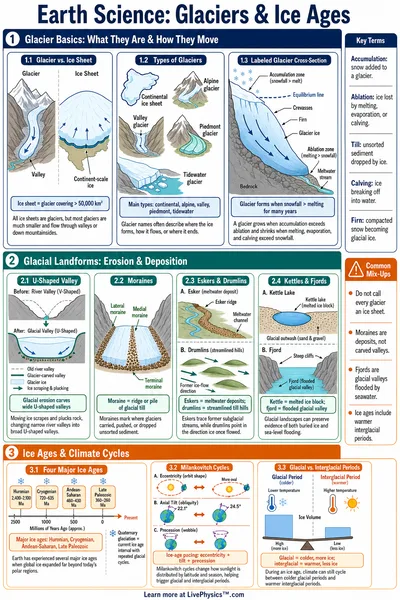
A glacier is a budget. Accumulation is the mass added each year, mostly from snowfall that survives the summer and turns to ice. Ablation is the mass lost each year, mostly from melt but also from sublimation and calving.
The net mass balance is accumulation minus ablation, summed over the whole glacier and measured in metres of water equivalent per year. A positive balance means the glacier is gaining ice, a negative balance means it is shrinking.
Equilibrium Line and Accumulation Area Ratio
The equilibrium line altitude, or ELA, is the elevation where annual accumulation exactly equals annual ablation. Above it the glacier gains mass, below it the glacier loses mass. The ELA rises with warming and with darker ice and falls with more snowfall.
The accumulation area ratio, or AAR, is the fraction of the glacier area that lies above the ELA. A glacier in balance with its climate keeps an AAR near 0.6. When the ratio drops well below that, the glacier is shedding mass.
Temperature Index Melt and Albedo
Melt scales with how warm the air is and how long the melt season lasts. A temperature index model uses a melt factor multiplied by the positive degrees of summer temperature, which is why a few degrees of warming can change the budget sharply.
Albedo is how much sunlight a surface reflects. Bright fresh snow reflects most of the sunlight and melts slowly. Dirty ice darkened by soot, dust, or algae absorbs more heat and melts faster, a feedback that can speed up glacier loss.
Glacier Response and Sea Level
A glacier responds to its climate over years to decades. A sustained positive balance thickens the ice and pushes the terminus down valley, while a sustained negative balance thins the ice and pulls the terminus back up the slope.
Mountain glaciers hold a small fraction of the world ice but respond fast, so their melt is a leading contributor to sea level rise this century. The illustrative readout in this lab scales the specific balance to all mountain glaciers over the ocean area to show the connection.