Viscosity & Poiseuille Flow Lab
Push a real fluid through a pipe and watch the volumetric flow rate respond. Change the pipe radius, length, pressure difference, and the fluid to see why doubling the radius multiplies the flow by sixteen, how the velocity profile becomes a parabola, and when smooth laminar flow gives way to turbulence.
Guided ExperimentVerify the r^4 law, double the radius
If you double the pipe radius while holding pressure, length, and fluid fixed, by what factor do you expect the flow rate to change?
Write your hypothesis in the Lab Report panel, then click Next.
Controls
Water, viscosity η = 0.001 Pa·s, density ρ = 1000 kg/m³
Pipe cross-section and velocity profile
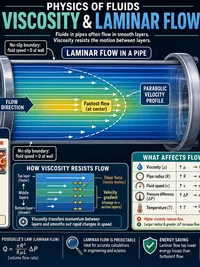
The flow is fastest at the centerline and zero at the walls. The centerline (maximum) speed is twice the mean speed for laminar flow.
Results
Flow rate
25.13mL/s
Flow rate
1.508L/min
Flow rate
2.51 × 10^-5m³/s
Mean velocity
2.000m/s
Max velocity
4.000m/s
Reynolds number
8000
TurbulentFlow rate vs pipe radius
The curve climbs steeply because Q grows with the fourth power of the radius (Q ∝ r⁴). The amber marker shows your current radius.
Takeaways
- •Doubling the radius multiplies the flow by 16, the hallmark of the r⁴ law, while tripling it multiplies the flow by 81.
- •With Water (η = 0.001 Pa·s), the flow rate is about 25.13 mL/s at these settings.
- •The Reynolds number is about 8000, above the laminar limit of 2300, so real flow here would be turbulent and Poiseuille's law overstates it.
Hagen-Poiseuille, Q = π · ΔP · r⁴ / (8 · η · L). Here ΔP = 2000 Pa, r = 2.0 mm, L = 0.50 m, η = 0.001 Pa·s.
Data Table
(0 rows)| # | Radius(mm) | Length(m) | Pressure(Pa) | Fluid | Flow(mL/s) | Reynolds |
|---|
Reference Guide
The Hagen-Poiseuille Law and the r⁴ Dependence
For steady laminar flow of a viscous fluid through a straight circular pipe, the volumetric flow rate is set by the pipe geometry, the fluid viscosity, and the pressure difference.
Q = π ΔP r⁴ / (8 η L)
- Flow grows with the fourth power of the radius.
- Doubling the radius multiplies the flow by sixteen.
- Flow is in direct proportion to the pressure difference.
The fourth-power term explains why a small change in vessel radius produces a large change in flow, both in plumbing and in blood vessels.
Viscosity and Laminar Flow
Viscosity measures a fluid's resistance to shear. A thicker fluid drags more strongly against the pipe walls and against itself, so it flows more slowly under the same pressure.
- Water. About 0.001 Pa·s, flows freely.
- Blood. About 0.0035 Pa·s, a few times thicker than water.
- Honey. About 10 Pa·s, ten thousand times thicker than water.
Flow rate is inversely proportional to viscosity, so switching from water to honey cuts the flow to a tiny fraction of its value.
The Parabolic Velocity Profile
In laminar pipe flow the fluid moves in smooth layers. The layer at the wall is held still by friction, while the fluid at the center moves fastest.
- The speed follows v(s) = v_max (1 minus (s/r)²).
- The centerline speed is twice the mean speed.
- The speed is zero at both walls, the no-slip condition.
The result is a parabola of velocity across the pipe diameter, the shape drawn in the pipe view above.
Reynolds Number and When Laminar Flow Breaks Down
The Reynolds number compares inertial forces to viscous forces. It predicts whether flow stays smooth or becomes turbulent.
Re = ρ v D / η
- Flow is laminar below about 2300 in a pipe.
- Higher speed, wider pipe, or thinner fluid raise the Reynolds number.
- Above the threshold the flow becomes turbulent.
Poiseuille's law applies only to laminar flow, so the model is most accurate when the Reynolds number stays below the threshold.