Chemical Nomenclature Trainer
Pick a compound class and a direction, then study worked examples in Learn mode or test yourself in Practice mode. The trainer checks your answer and shows the naming rule step by step for ionic compounds, covalent molecules, and acids.
Mode
Compound class
Direction
Worked example
1 of 18Sodium chloride
How the name is built
- 1The metal or positive ion keeps its element name: Sodium.
- 2The nonmetal anion uses its root plus the ending "ide": chlorine becomes chloride.
- 3Balancing the charges (+1 and -1) gives the formula NaCl.
Naming Rules at a Glance
Ionic compounds
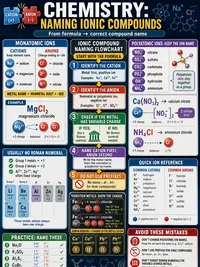
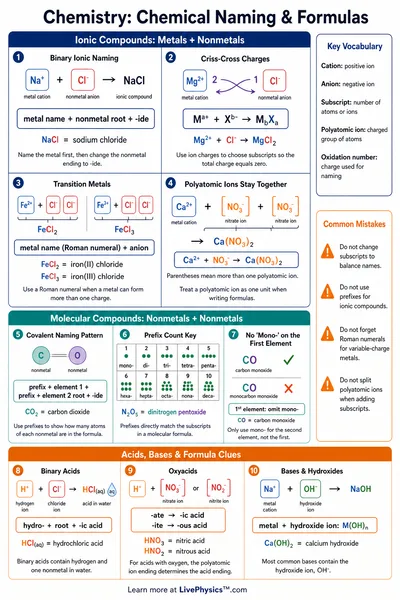
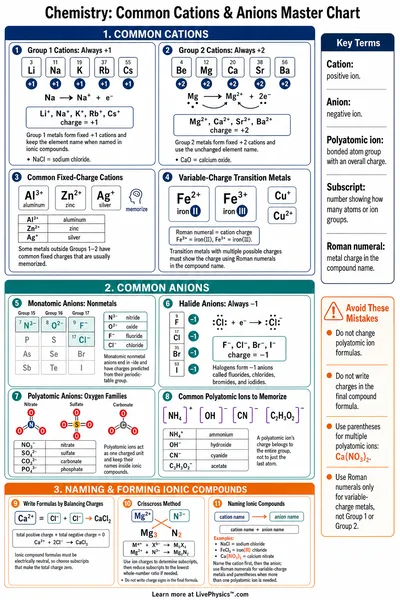
Name the metal (positive ion) first, then the nonmetal anion with its root plus the ending "ide". So NaCl is sodium chloride and MgO is magnesium oxide.
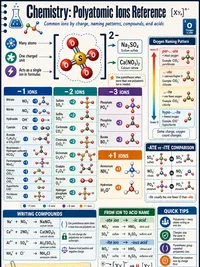
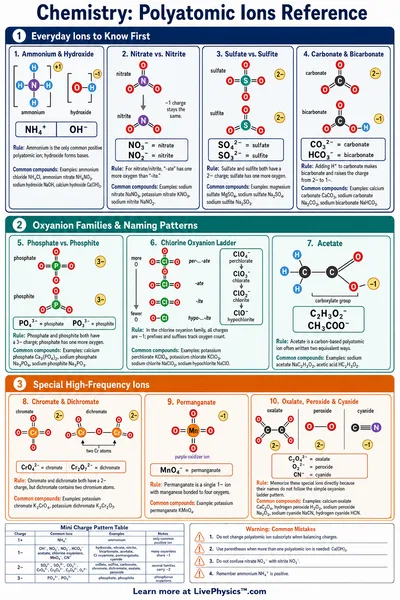
When a metal can take more than one charge, the Stock system adds a Roman numeral equal to the charge. Iron with a 3+ charge in Fe2O3 is iron(III) oxide, while iron with a 2+ charge in FeCl2 is iron(II) chloride. Polyatomic ions keep their own names, so Ca(NO3)2 is calcium nitrate.
Covalent molecules
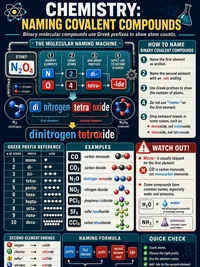
Two nonmetals use Greek prefixes for the count of each atom. The prefix "mono" is dropped on the first element, so CO2 is carbon dioxide and CO is carbon monoxide. Vowels are elided where the name sounds awkward, giving tetroxide and pentoxide.
Acids
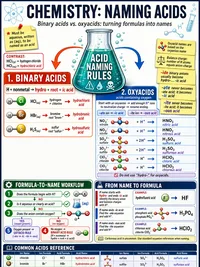
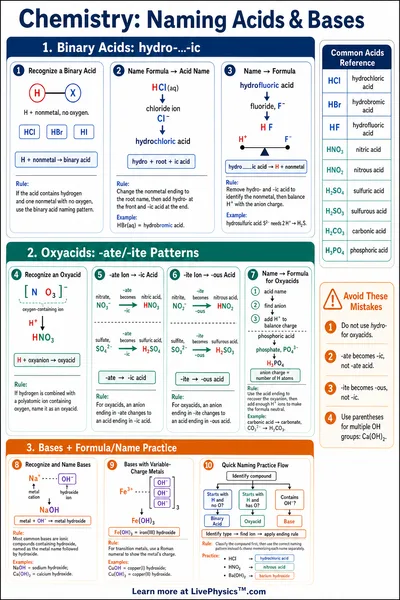
Binary acids have no oxygen and use "hydro" plus the root plus "ic acid", so HCl is hydrochloric acid. Oxyacids come from oxyanions, an "ate" ion gives an "ic acid" and an "ite" ion gives an "ous acid".
Sulfate gives sulfuric acid (H2SO4), nitrate gives nitric acid (HNO3), and nitrite gives nitrous acid (HNO2).