Statistics
Confusing Correlation with Causation
A student sees a strong correlation between ice cream sales and drowning deaths and concludes that ice cream causes drowning.
Quick check
Why students make it
A strong association feels like a cause because two variables move together in a predictable way. The misleading intuition ignores lurking variables, reverse causation, and coincidence.
The rule done right
Correlation measures association, not cause and effect. A causal claim needs stronger evidence, such as a well-designed randomized experiment or a convincing causal argument that rules out confounding.
Related resources
-
 Observational Study vs Experiment Infographic
-
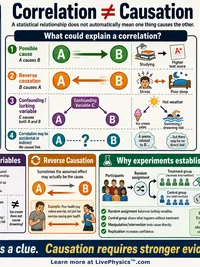 Statistics, Correlation vs Causation Infographic
-
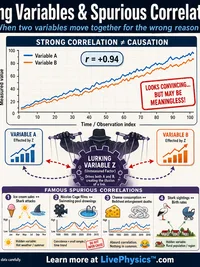 Statistics, Lurking Variables and Spurious Correlation Infographic
-
 Experimental Design Infographic
-
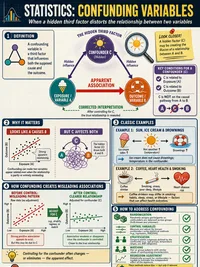 Statistics, Confounding Variables Infographic
- Correlation vs Causation Cheat Sheet
- Experimental Design & Causation Cheat Sheet
- Linear Regression & Correlation Cheat Sheet
- Scatter Plots & Line of Best Fit Cheat Sheet
- Choosing the Right Statistical Test Cheat Sheet
- Statistics, Scatter Plots and Correlation Worksheet
- Statistics, Experimental Design, Control Groups and Confounds Worksheet
- Statistics, Linear Regression and Line of Best Fit Worksheet
- Statistics, Two-Way Tables and Conditional Probability Worksheet
- Statistics, Hypothesis Testing, Null and Alternate Worksheet
- Scatter Plot and Correlation Explorer Tool
- Simpson's Paradox Explorer Tool
- Linear Regression Calculator Tool
- Hypothesis Testing Calculator Tool
- ANOVA Calculator Tool
- Experimental Design & A/B Testing Lab Lab
- ANOVA & Experimental Design Lab Lab
- Sampling & Randomization Lab Lab
- Regression & Residual Diagnostics Lab Lab
- P-Hacking & Multiple Comparisons Lab Lab
Continue learning
- Correlation vs Causation LabLab
- Statistics, Pearson vs Spearman CorrelationStudy poster
- Statistics, The Correlation CoefficientStudy poster
- Confusing a Population with a SampleCommon mistake
- Confusing Margin of Error with Confidence LevelCommon mistake
- Claims from Graphs, Correlation vs CausationWorksheet