Cell Explorer, Animal, Plant & Bacterial Cells
Select a cell type and click any organelle on the diagram to see its name and function. Switch to Quiz mode to test your knowledge, or use Compare mode to see which structures each cell type shares.
For teachers
Cell type
Mode
Click any part of the cell diagram to learn about it.
Organelles in this cell type (12)
For teachers
Reference Guide
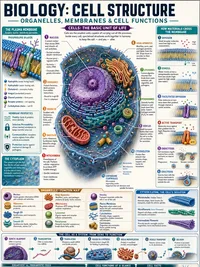
What is a Cell
The cell is the smallest unit of life. Every living organism is made of one or more cells, and all cells come from pre-existing cells. This is the foundation of cell theory, first proposed by Schleiden, Schwann, and Virchow in the 19th century.
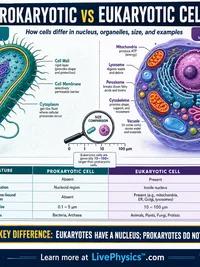
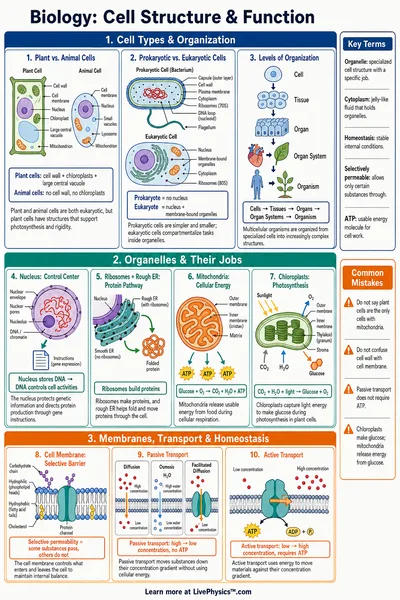
Cells are divided into two broad categories. Prokaryotic cells (bacteria and archaea) have no membrane-bound nucleus. Eukaryotic cells (animals, plants, fungi, and protists) have a true nucleus and many membrane-bound organelles.
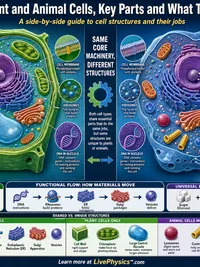
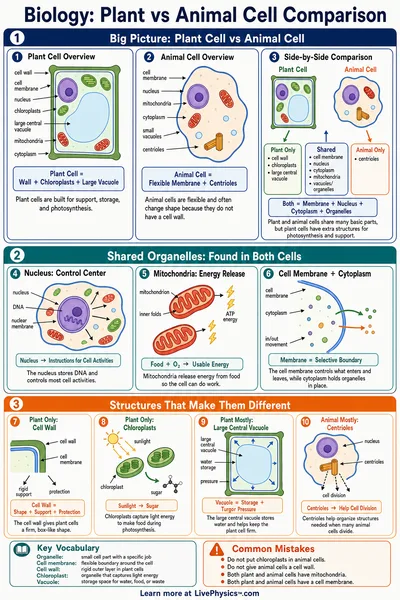
Animal and plant cells are both eukaryotic but differ in key structures. Plants have a cell wall, chloroplasts, and a large central vacuole that animals lack. Bacterial cells are far simpler, with no organelles enclosed by membranes.
The Nucleus and Genetic Control
The nucleus is the command center of eukaryotic cells. It contains the cell's DNA packaged into chromosomes. When a cell needs to make a protein, a gene in the DNA is transcribed into messenger RNA, which then exits the nucleus through pores in the nuclear envelope.
The nucleolus inside the nucleus produces ribosomal RNA, which combines with proteins to form ribosomes. Ribosomes read the messenger RNA and assemble proteins from amino acids.
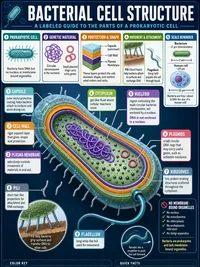
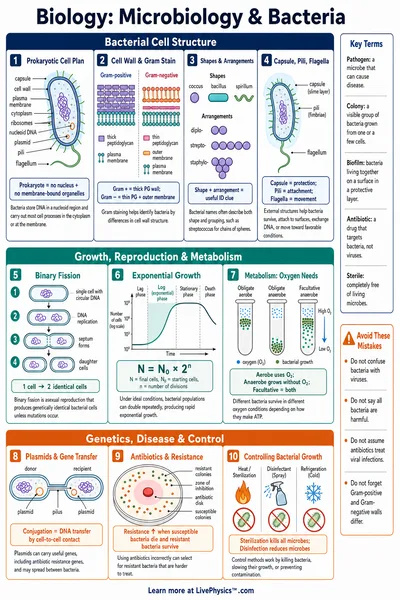
Bacteria do not have a true nucleus. Their single circular chromosome floats in a region called the nucleoid. Bacteria may also carry small extra DNA rings called plasmids, which often carry antibiotic-resistance genes.
Energy Organelles
Mitochondria are the primary energy factories in animal and plant cells. They carry out cellular respiration, breaking down glucose and oxygen to release ATP energy. Mitochondria have their own DNA, evidence that they were once free-living bacteria absorbed by an ancestral eukaryotic cell.
Chloroplasts perform photosynthesis in plant cells. They capture sunlight and use its energy to convert carbon dioxide and water into glucose. Like mitochondria, chloroplasts have their own DNA and double membranes.
Bacterial cells perform respiration and photosynthesis (in photosynthetic species) across their plasma membrane rather than in dedicated organelles. This simpler arrangement works well for single-celled organisms.
What Makes Plant Cells Different
Three structures set plant cells apart from animal cells. The rigid cell wall, made of cellulose, provides structural support and prevents the cell from bursting when it absorbs water. Animal cells rely only on the flexible cell membrane.
Chloroplasts give plants the ability to make their own food through photosynthesis. This makes plants autotrophs (self-feeders), while animal cells must obtain energy by consuming other organisms.
The large central vacuole can occupy 80 to 90 percent of a mature plant cell's volume. It stores water, nutrients, and waste products, and maintains turgor pressure that keeps plant stems and leaves firm. Animal cells have only small, scattered vacuoles used for temporary storage.
Cell Type Summary
| Feature | Animal | Plant | Bacterial |
|---|---|---|---|
| Nucleus | Yes | Yes | No (nucleoid) |
| Cell wall | No | Yes (cellulose) | Yes (peptidoglycan) |
| Chloroplasts | No | Yes | No |
| Mitochondria | Yes | Yes | No |
| Ribosomes | Yes (80S) | Yes (80S) | Yes (70S) |
The Compare tab in the tool above shows the full list of organelles across all three cell types at a glance.