Understanding Compass Bearings Simulator
A direction such as north east is too rough for finding a hilltop in mist. A bearing replaces the name with a number. It is the angle, measured clockwise from north, between the north line and the line to the place you want.
Measuring that angle needs two things, a line that points north and a protractor. A baseplate compass puts both in one hand. The magnetic needle supplies north, and the ring round the housing, called the bezel, is a full circle protractor marked from 0° to 360°.
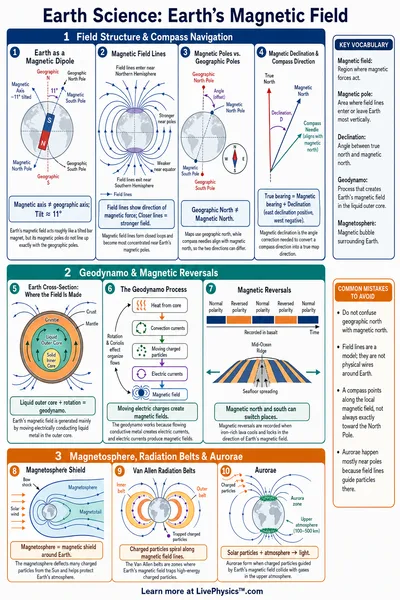
The needle floats in liquid and lines up with the magnetic field of the Earth, with its red end toward magnetic north. It does this however the plate beneath it is turned. The needle is therefore the fixed reference, and everything else is measured against it.
The baseplate carries an arrow that shows the direction of travel. To take a bearing, you point that arrow at the target and hold the plate still. The angle you want is now the angle between the red end of the needle and the arrow.
The housing lets you read that angle. On its floor is an outline arrow that always points to the N on the bezel. Turning the housing until the red end of the needle lies inside the outline lines the zero of the protractor up with north.
The bearing is then read where the bezel meets the index line, which lies along the direction of travel arrow. Each small division is 2° and the numbers come every 20°. If the index line sits three divisions past 280, the bearing is 280 plus 3 times 2, which is 286°.
Bearings are written with three figures so that none is mistaken for another. East is 090°, south is 180° and west is 270°, and a bearing of 8° is written 008°. A bearing of 286° is a little north of west.
Following a bearing runs the same steps in reverse. You set the number at the index line first, then turn your whole body until the red end of the needle sits in the outline arrow. The direction of travel arrow now points the way, and you walk toward a landmark on that line without staring at the compass.
The return direction is the back bearing, which is half a turn away. For a bearing above 180° you subtract 180°, so the back bearing of 286° is 106°. For a bearing below 180° you add it.
The needle points to magnetic north, which is not quite the grid north of a map. The angle between them is the grid magnetic angle, and it varies from place to place and slowly from year to year. With magnetic north 3° west of grid north, a magnetic bearing of 286° becomes a grid bearing of 283°.
A needle responds to any magnet or iron nearby, not only to the Earth. A steel gate, a car or a phone can pull it several degrees off. The compass must also be held level so that the needle swings freely.
The bezel can be read to about a degree, and a hand held sighting is usually good to two or three. Over a kilometre, an error of 3° puts you about 50 m to one side. Walkers therefore aim for clear landmarks and check their position often.