Graham's Law Calculator
Pick two gases or enter molar masses and the calculator finds how many times faster the lighter gas effuses, the matching time ratio, and the full worked formula. Switch modes to solve for an unknown molar mass from a measured rate ratio.
Effusion through a pinhole
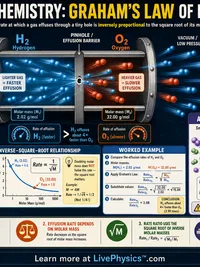
Each box has a tiny pinhole on the right. The lighter gas escapes faster, shown by more particles outside the box and a longer arrow.
Inputs
Presets
Results
Gas 1 is lighter, so it effuses about 3.98× faster than the heavier gas and takes that same factor less time to escape the same amount.
The Science of Effusion and Diffusion
Effusion and Diffusion
Effusion is the escape of gas molecules through a tiny hole into a vacuum, one molecule at a time. Diffusion is the spreading of one gas through another until the mixture is uniform.
Both depend on how fast the molecules move. Lighter molecules move faster on average, so they effuse and diffuse more quickly than heavier ones at the same temperature.
Graham's Law
Thomas Graham found that the rate of effusion of a gas is inversely proportional to the square root of its molar mass.
Because the molar mass sits under a square root, a gas that is four times heavier effuses only half as fast, not a quarter as fast.
The Kinetic-Molecular Basis
At a given temperature, all gases have the same average kinetic energy. Kinetic energy is one half mass times speed squared, so if the energy is fixed, a smaller mass must come with a higher speed.
Solving the equal-energy condition for speed gives an average speed proportional to one over the square root of the molar mass, which is exactly the relationship Graham measured.
The NH₃ and HCl Diffusion Demo
A long glass tube has cotton soaked in ammonia at one end and cotton soaked in hydrochloric acid at the other. The two gases diffuse toward each other and form a white ring of ammonium chloride where they meet.
Ammonia (17.03 g/mol) is lighter than hydrogen chloride (36.46 g/mol), so it diffuses faster and the white ring forms closer to the HCl end. Graham's law predicts the ring position from the ratio of the square roots of the molar masses.
Solving for an Unknown Molar Mass
If you measure how fast an unknown gas effuses compared with a known gas, you can rearrange Graham's law to find the unknown molar mass. With the known gas as gas 1 and the unknown as gas 2, the relationship becomes the following.
This is how scientists historically estimated molar masses of new gases, and it is the principle behind separating uranium isotopes by effusing uranium hexafluoride. The two isotopes have almost identical molar masses, so each pass through a barrier gives only a tiny enrichment.