Great Circle Distance
Click two points on the map to find the shortest path between them on Earth's surface. This great-circle route is why flight paths look curved on flat maps.
Why Flight Paths Look Curved
Spherical Geometry
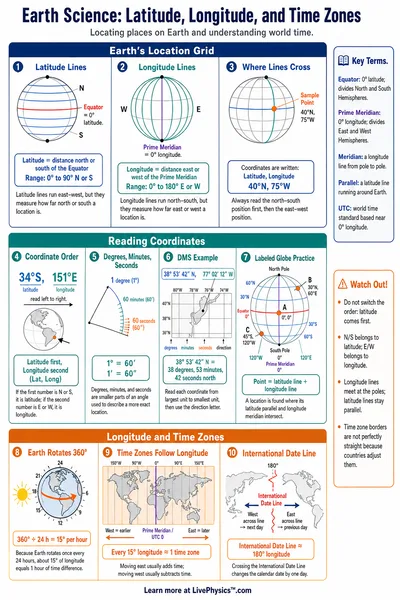
On a sphere, the shortest path between two points follows a great circle, a circle whose center is the center of the sphere. All meridians and the equator are great circles.
Mercator Distortion
Flat maps distort shapes near the poles. A straight line on a Mercator map is not the shortest route. The true shortest path appears as a curve on the flat projection.
Chord vs Arc
The chord distance is the straight-line distance through Earth's interior, useful for seismic waves or theoretical tunnels. The arc distance is the surface path that aircraft and ships actually follow.
The Haversine Formula
The surface distance uses the haversine formula, which accurately computes the angular separation between two points on a sphere
c = 2 × atan2(sqrt(a), sqrt(1-a))
d = R × c
where R = 6371 km (mean Earth radius).
Bearing and Navigation
The initial bearing is the compass direction you start traveling from Point A toward Point B. Because Earth is a sphere, this bearing changes continuously along the great-circle route. Pilots flying great-circle paths must constantly adjust their heading.