Fractional Distillation Lab
Heat a mixture of liquids and the most volatile component boils off first. Pick a mixture, then scrub the volume distilled to watch the head temperature climb through a plateau near each component's boiling point. The distillation curve shows how a fractionating column separates the fractions, the same idea a refinery uses to split crude oil into gasoline, kerosene, and diesel.
Guided Experiment Separating a Mixture by Boiling Point
When you heat a mixture of two liquids with different boiling points in a fractionating column, what do you predict will happen to the head temperature as you collect the distillate, and which component comes over first?
Write your hypothesis in the Lab Report panel, then click Next.
Controls
A classic teaching mixture. Ethanol boils at 78 °C and water at 100 °C, a 22 °C gap that separates cleanly with a good column.
Data Table
(0 rows)| # | Trial | Mixture | Volume Distilled (%) | Head Temp (°C) | Fraction Coming Over |
|---|
Reference Guide
What Fractional Distillation Is
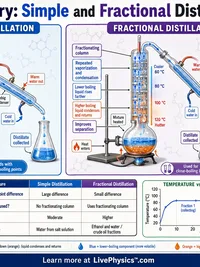
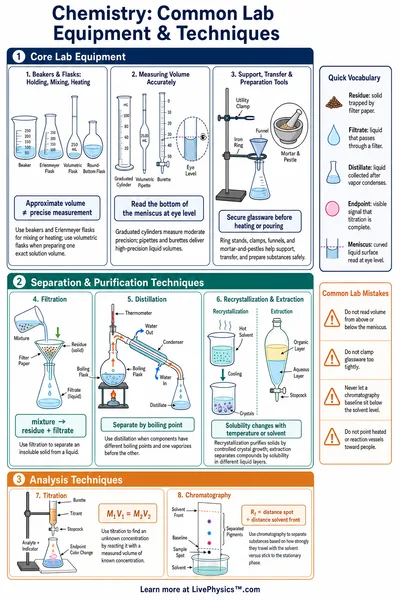
Distillation separates liquids by boiling them and condensing the vapor. Fractional distillation does this with a packed or plated fractionating column between the boiling flask and the condenser, which sharpens the separation when the components have boiling points that are close together.
The more volatile component boils at a lower temperature, so its vapor leaves the mixture first. As you collect distillate, the early fractions are rich in the low-boiling component and the later fractions in the high-boiling component.
Boiling Point and Separation
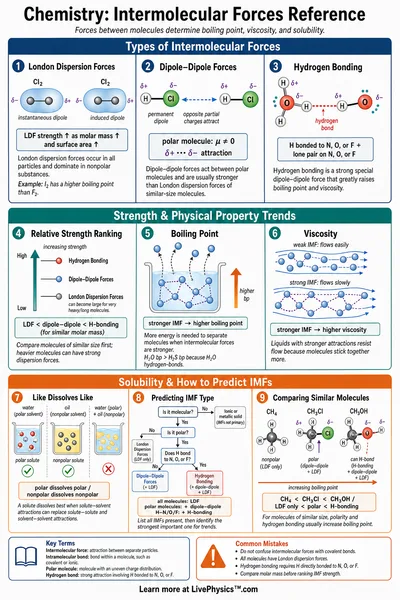
A liquid boils when its vapor pressure equals the surrounding pressure. Each pure component has its own boiling point, so the head temperature at the still head tells you which component is currently coming over.
The wider the gap between boiling points, the easier the separation. Ethanol at 78 °C and water at 100 °C separate cleanly, but methanol at 65 °C and ethanol at 78 °C are only 13 °C apart, so their fractions overlap and a longer column is needed.
Reading the Distillation Curve
Plot the head temperature against the percent of the mixture distilled and you get the distillation curve. It shows a flat plateau while a relatively pure fraction comes over near its boiling point, then a sharp rise as that fraction runs out and the next, higher-boiling fraction begins.
A flat, well-defined plateau means a clean fraction. A sloping plateau or a gentle rise means the fractions are overlapping and the distillate is a mixture. The number of plateaus equals the number of separable components.
Simple vs Fractional, and the Column
Simple distillation uses a single vaporization and condensation, which works only when boiling points are far apart. A fractionating column is packed with glass beads or fitted with plates that give many small vaporization and condensation cycles as vapor rises and partly condenses, each cycle enriching the vapor in the more volatile component.
Each cycle acts like one more distillation, so a tall column gives many theoretical plates and a much sharper separation. Refineries use this in fractionating towers to split crude oil into gasoline, kerosene, diesel, and heavier fractions, and the same principle separates air into oxygen and nitrogen and purifies ethanol from a fermentation mash.