Understanding Nuclear Decay Chain Calculator
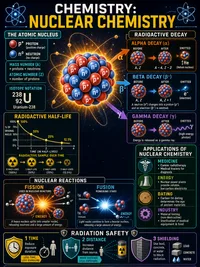
An isotope is unstable when its nucleus has more energy than a nearby possible nuclear arrangement. The balance between neutrons and protons matters because protons repel each other electrically, while the strong nuclear force holds particles together at very short distances. Heavy nuclei need many neutrons to help offset proton repulsion, but too many or too few neutrons can still make a nucleus unstable.
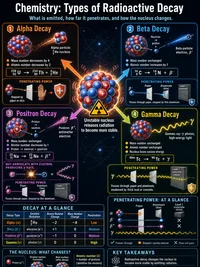
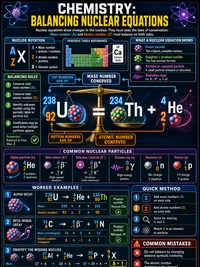
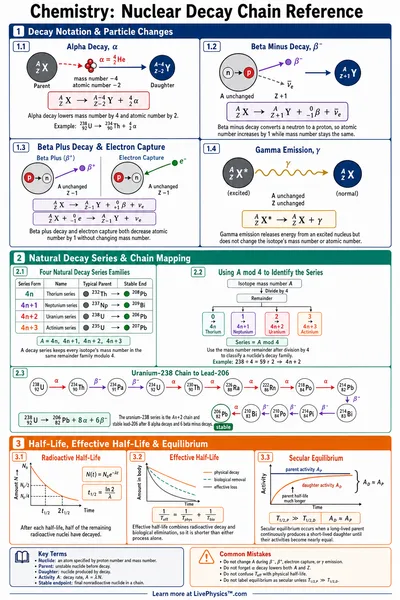
In alpha decay, the nucleus releases a small cluster made of two protons and two neutrons. Its mass number decreases by four and its proton number decreases by two, so it moves toward lighter elements.
In beta minus decay, a neutron changes into a proton and releases an electron plus an antineutrino. The mass number stays the same, while the proton number rises by one.
These changes obey conservation laws. Total electric charge, total nucleon number, energy, and momentum must balance before and after every decay.
The released energy becomes motion of the emitted particles, recoil of the daughter nucleus, or gamma radiation from an excited daughter nucleus. Gamma emission does not change the numbers of protons or neutrons, but it removes excess nuclear energy.
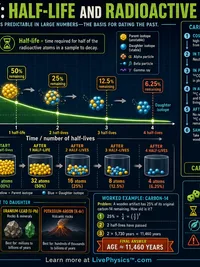
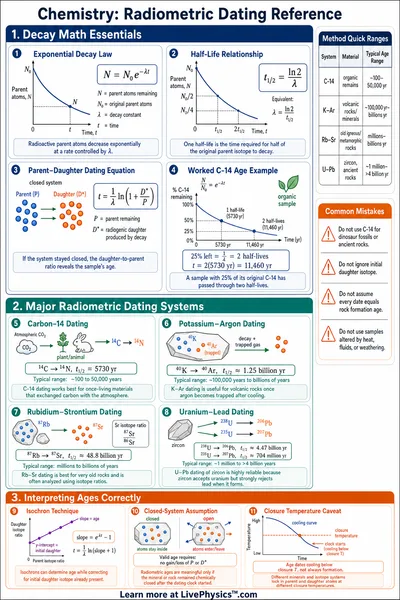
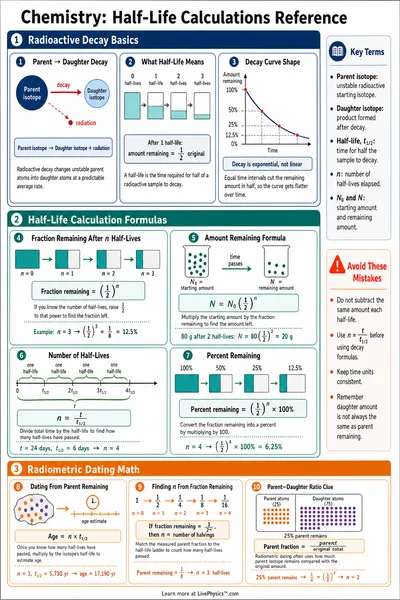
Half-life describes the behavior of a large group of identical nuclei, not a timer inside one nucleus. Any one atom may decay immediately or remain unchanged for a very long time. After one half-life, about half of the original sample remains.
After two half-lives, about one quarter remains. This pattern is why old samples can contain tiny amounts of a parent isotope for billions of years.
Activity means the number of decays occurring each second. A sample with many atoms can have high activity even when its half-life is long.
A short half-life can produce high activity from a small amount, though the activity falls rapidly as atoms disappear. When using a calculator, keep track of whether time is entered in seconds, days, years, or another unit, since unit mistakes can change an answer enormously.
A decay series can include short-lived intermediate isotopes that build up after the parent begins decaying. If a parent lasts much longer than its daughters, production and decay can reach a steady pattern called secular equilibrium.
At that point, several members of the series can have similar activities even though their half-lives are very different. Removing one chemical element from a sample can break this balance.
Branching is important because some nuclei have more than one allowed decay route. One route may be common while another is rare, so a realistic chain may split before later products join or stabilize.
Energy labels help distinguish emissions and estimate how far radiation travels through matter. Alpha particles lose energy quickly, beta particles travel farther, and gamma rays are usually the most penetrating.
Students meet these ideas in uranium ores, radon in buildings, smoke detector sources, medical tracers, and radiometric dating. Radon deserves attention because it is a radioactive gas formed within natural decay series and can collect indoors.
A nuclide chart shows why each step moves in a particular direction. Read proton number and neutron number carefully, then check that every decay step preserves the required totals.