Osmosis & Diffusion Explorer
Set the solute concentration outside a cell relative to the inside, pick an animal or plant cell, and watch which way water moves by osmosis. See how a cell shrinks, swells, or stays the same in hypertonic, hypotonic, and isotonic solutions, and review how diffusion, facilitated diffusion, osmosis, and active transport differ.
Set the conditions
The cell in solution
What happens
Outside concentration is 300 mM and inside is 300 mM.
Isotonic solution
There is no net water movement.
Animal cell result. Stays the same
Water moves in and out at equal rates, so the animal cell keeps its normal shape and volume.
Osmosis is the movement of water. Solute (the dots) moves the other way by diffusion when it can cross the membrane.
Check yourself
In Learn mode, study the cell diagram and read what happens. When you are ready, switch to Practice for guided questions or Challenge for open scenarios.
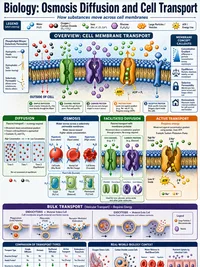
Transport across the membrane
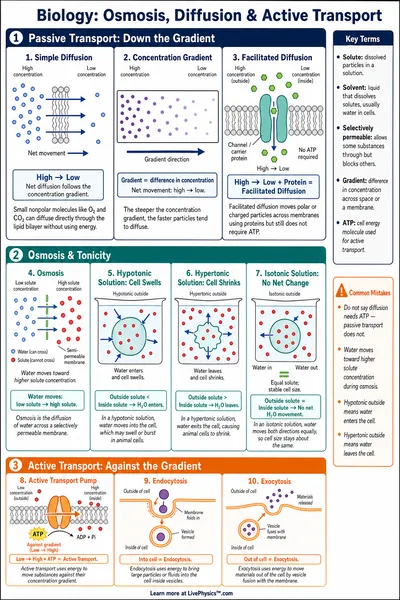
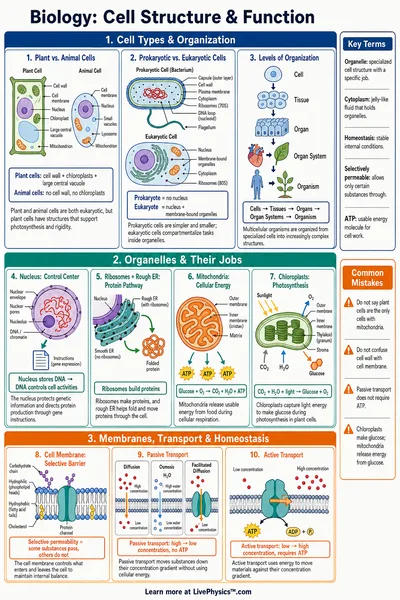
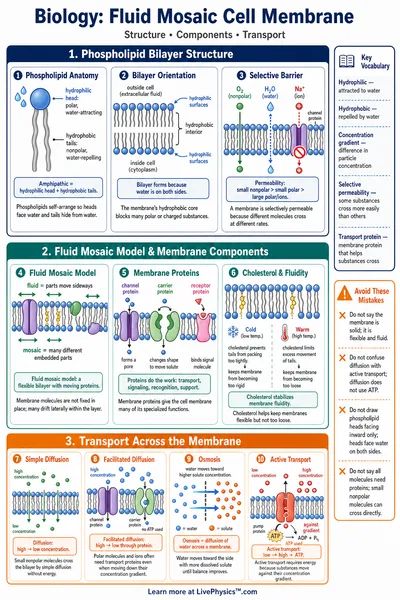
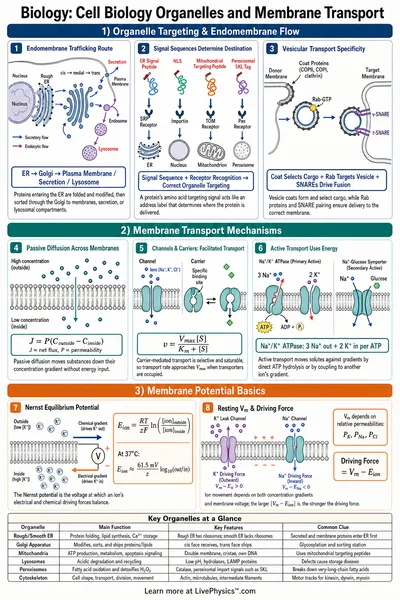
Passive transport moves substances down their concentration gradient and uses no cell energy. Active transport pushes them up the gradient and requires energy (ATP).
Simple diffusion
passiveMolecules spread directly through the membrane from high to low concentration, down their gradient.
- Moves.
- Small or nonpolar molecules (O₂, CO₂)
- Energy.
- No
- Example.
- Oxygen entering a cell, carbon dioxide leaving it.
Facilitated diffusion
passiveMolecules move down their gradient but need a channel or carrier protein to cross the membrane.
- Moves.
- Large or charged molecules (glucose, ions)
- Energy.
- No
- Example.
- Glucose entering a cell through a GLUT transporter.
Osmosis
passiveWater moves across a selectively permeable membrane from low solute toward high solute concentration.
- Moves.
- Water
- Energy.
- No
- Example.
- Water entering a root hair cell from the soil.
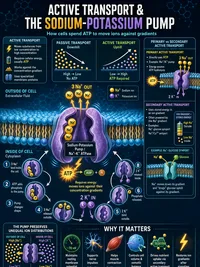
Active transport
activeA pump protein uses energy (ATP) to move substances from low to high concentration, up their gradient.
- Moves.
- Ions and molecules against their gradient
- Energy.
- Yes (ATP)
- Example.
- The sodium-potassium pump moving Na⁺ out and K⁺ in.
Reference Guide
Tonicity (naming the solution)
Tonicity describes the solute concentration of the solution outside a cell, compared to the inside. The names always refer to the solution surrounding the cell.
- Hypertonic. More solute outside than inside. Water leaves the cell.
- Hypotonic. Less solute outside than inside. Water enters the cell.
- Isotonic. Equal solute concentration. There is no net water movement.
Water always moves by osmosis from the side with more water (low solute) toward the side with less water (high solute).
Animal cells vs plant cells
Plant cells have a rigid cell wall outside the membrane, so they respond differently from animal cells in the same solution.
- Hypertonic. Animal cells shrivel (crenation). Plant cells lose water and the membrane pulls from the wall (plasmolysis).
- Hypotonic. Animal cells swell and can burst (lysis). Plant cells fill and become firm (turgid), held safely by the wall.
- Isotonic. Animal cells keep their normal shape. Plant cells lose turgor and go flaccid, so plants wilt.
Osmosis vs diffusion
Both are passive and move particles down a concentration gradient, but they describe different things.
- Diffusion. Any dissolved particle (the solute) spreading from where it is crowded to where it is sparse.
- Osmosis. The diffusion of water across a selectively permeable membrane, from low solute toward high solute.
In the diagram, the dots are solute and the arrows are water. They often move in opposite directions until the system reaches balance.
Passive vs active transport
Passive transport needs no cell energy. Active transport needs energy from ATP because it works against the gradient.
- Simple diffusion. Small molecules like O₂ and CO₂ pass straight through the membrane. Passive.
- Facilitated diffusion. Glucose and ions move down their gradient through channel or carrier proteins. Passive.
- Osmosis. Water crosses the membrane down its water potential gradient. Passive.
- Active transport. Pumps such as the sodium-potassium pump move ions up their gradient using ATP. Active.