Oxidation-Reduction (Redox) Calculator
Enter a supported neutral reaction to balance its atoms, compare oxidation numbers and identify the agents. Review each step and check that electrons lost equal electrons gained.
Electron Transfer Diagram
Reaction
Use supported neutral formulas. The tool balances atoms and uses formal oxidation-number rules. Peroxoacids and mixed atomic sites need a separate analysis.
Supported formulas and limits
Use elements, ordinary binary compounds, hydroxides, hydrogen peroxide and simple metal peroxides. Supported oxyanion acids and metal salts use carbonate, nitrite, nitrate, sulfite, sulfate, phosphate, chlorine/bromine/iodine oxyanions, manganate, permanganate, chromate or dichromate.
Oxygen compounds must fit one ordinary ion family and a neutral charge balance. The tool cannot distinguish structures with the same atom counts. Hydrates, ionic half-reactions and individual sites in mixed-valence compounds need bonding information.
Results
Zn + CuSO4 → ZnSO4 + Cu
Step-by-Step
1. Balance the atom counts
2. Assign reactant oxidation numbers
3. Assign product oxidation numbers
4. Compare oxidation numbers
5. Check electron conservation
Open this tool with your own values
This tool reads its inputs from the page address, so a link can open it with the values from a problem already entered. Include every value the problem needs, because one left out keeps the tool's default. Use plain numbers in the stated units.
- reaction
- reaction with + between substances and -> before the products, such as Cu+AgNO3->Cu(NO3)2+Ag
Example link
Reference guide
Oxidation numbers
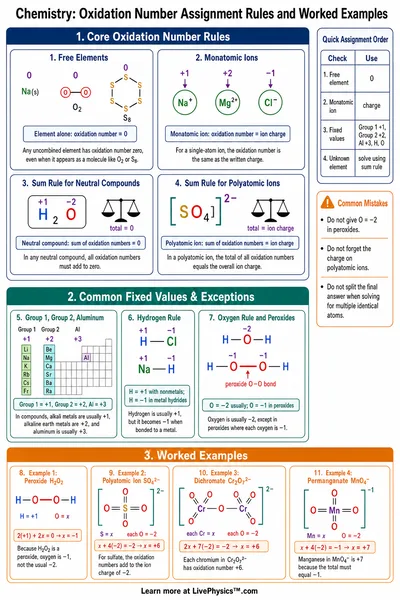
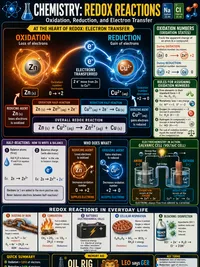
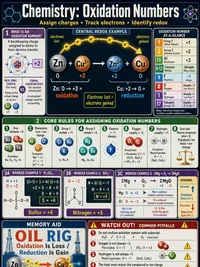
A free element has oxidation number zero. Hydrogen is usually +1 and oxygen is usually -2. Peroxides are an important exception. Oxygen is -1 in hydrogen peroxide. The oxidation numbers in a neutral compound add to zero.
Electron transfer
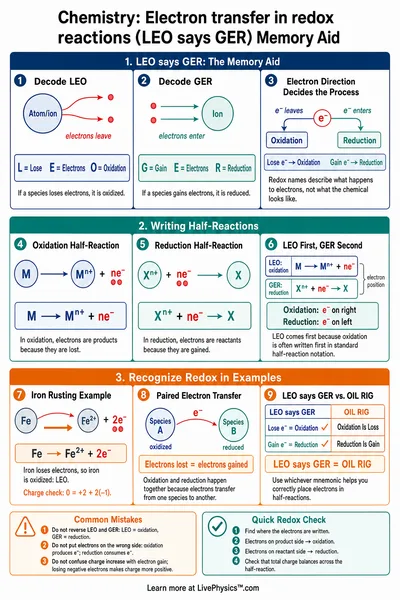
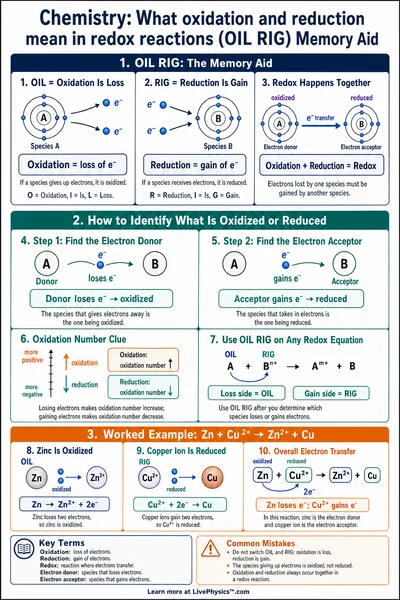
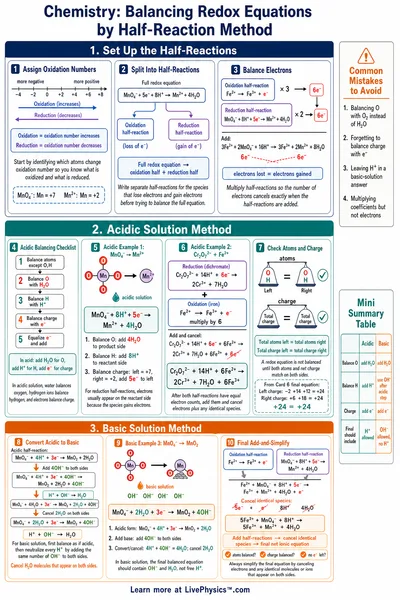
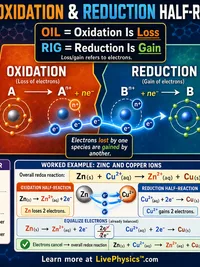
Oxidation increases an oxidation number and reduction decreases it. Balance the atoms first, then include the number of atoms that change. The total electrons lost must equal the total electrons gained.
Oxidizing and reducing agents
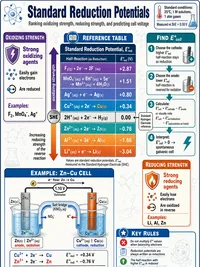
The reducing agent supplies electrons and is oxidized. The oxidizing agent accepts electrons and is reduced. In hydrogen peroxide decomposition, oxygen is both oxidized and reduced, so peroxide acts as both agents.
Supported reactions
Use neutral formulas for elements, ordinary binary compounds, hydroxides and simple peroxides. Supported oxyanion acids and metal salts use carbonate, nitrite, nitrate, sulfite, sulfate, phosphate, chlorine/bromine/iodine oxyanions, manganate, permanganate, chromate or dichromate. Each oxygen compound must fit one ordinary ion family and a neutral charge balance. Peroxoacids, hydrates, ionic half-reactions and mixed atomic sites need bonding information. Atom counts alone cannot distinguish structures with the same formula.
Review the oxidation-number rules and peroxide examples in OpenStax Chemistry.
Related Content
Visual Explainers
Related Tools
Related Labs
Worksheets
Cheat Sheets