Practice analyzing acid-base titration data, identifying endpoints, calculating unknown concentrations, and evaluating sources of error.
Read each problem carefully. Show your setup, units, and calculations in the space provided. Assume all reactions go to completion unless stated otherwise.
Using titration data to find concentration, equivalence point, and endpoint accuracy
Chemistry - Grade 9-12
- 1
A student titrates 25.00 mL of HCl with 0.1000 M NaOH. The endpoint is reached after 18.60 mL of NaOH is added. Write the balanced equation and calculate the molarity of the HCl.
- 2
A 20.00 mL sample of acetic acid, HC2H3O2, is titrated with 0.1500 M NaOH. The average volume of NaOH used is 16.40 mL. Calculate the molarity of the acetic acid. The reaction is HC2H3O2 + NaOH -> NaC2H3O2 + H2O.
- 3
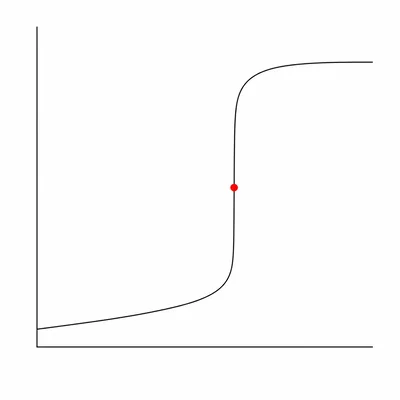
A titration curve for a strong acid titrated with a strong base shows a very steep rise in pH near 24.8 mL of base added. Identify the approximate equivalence point volume and explain your choice.
- 4
A student records the following NaOH volumes for three titrations of the same acid sample: 22.41 mL, 22.38 mL, and 22.44 mL. Calculate the average volume of NaOH used.
- 5
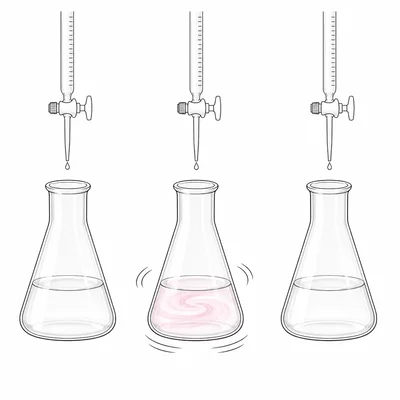
In a titration, the indicator changes from colorless to faint pink. The pink color disappears after swirling. Has the endpoint been reached? Explain what the student should do next.
- 6
A 10.00 mL sample of H2SO4 is titrated with 0.2000 M NaOH. The endpoint requires 15.30 mL of NaOH. The balanced equation is H2SO4 + 2NaOH -> Na2SO4 + 2H2O. Calculate the molarity of the H2SO4.
- 7
A student accidentally overshoots the endpoint while titrating an acid with NaOH. The solution turns dark pink instead of faint pink. How will this affect the calculated acid concentration if the student uses the overshot volume? Explain.
- 8
A buret reading is 1.25 mL at the start and 27.80 mL at the endpoint. What volume of titrant was delivered?
- 9
A 25.00 mL sample of NaOH is titrated with 0.1250 M HCl. The endpoint is reached after 19.75 mL of HCl is added. Calculate the molarity of the NaOH.
- 10
A weak acid is titrated with a strong base. The equivalence point on the titration curve is above pH 7. Explain why the equivalence point is basic.
- 11
A titration uses phenolphthalein, which changes color near pH 8.2 to 10.0. Is phenolphthalein a good indicator for a strong acid-strong base titration? Explain.
- 12
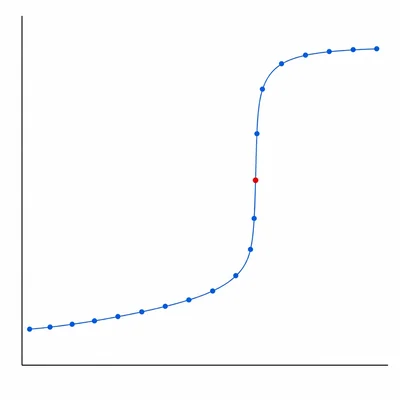
The data table shows pH values during a titration of an unknown acid with NaOH: 0.00 mL, pH 2.10; 10.00 mL, pH 2.75; 20.00 mL, pH 3.80; 24.00 mL, pH 6.20; 25.00 mL, pH 8.70; 26.00 mL, pH 11.30; 30.00 mL, pH 12.10. Estimate the equivalence point volume and justify your answer.
- 13
A student rinses a buret with water but does not rinse it with the NaOH solution before filling it for titration. How could this affect the calculated concentration of the acid being tested?
- 14
A 25.00 mL sample of a monoprotic acid is titrated with 0.1100 M NaOH. The equivalence point occurs at 21.35 mL of NaOH. Calculate the moles of acid in the original sample and the acid molarity.
- 15
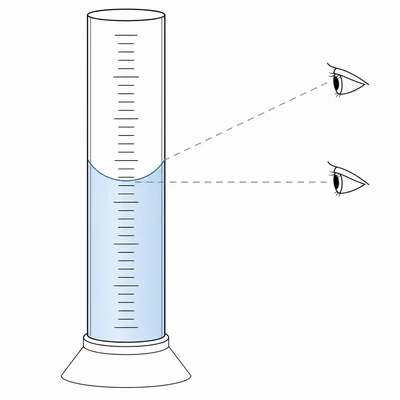
During a titration, a student reads the bottom of the meniscus at eye level for the initial reading but reads from above the meniscus for the final reading. Explain why this is a problem and how it affects data quality.