AP Titration Curve Analyzer
Different from a curve builder. Pick a weak acid dataset or paste lab data, and the analyzer locates the equivalence point from the first derivative, finds the half-equivalence point, and reports the extracted pKa and Ka. Diprotic acids return two pKa values.
Display
How this analyzer works
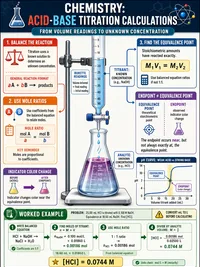
The first derivative dpH/dV is computed by centered finite difference between adjacent points. The equivalence point is the volume where this magnitude is maximum, the steep rise on the titration curve.
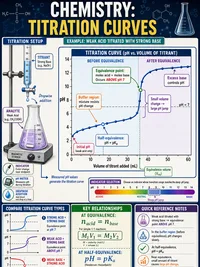
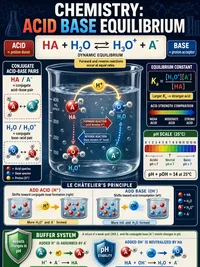
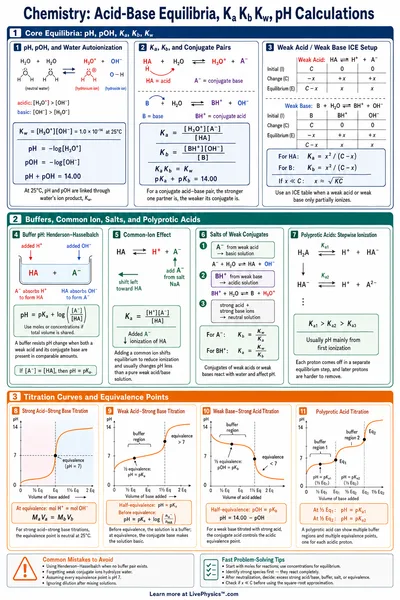
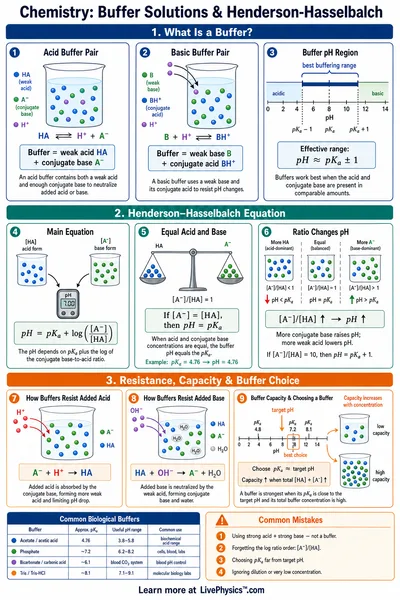
The half-equivalence point sits at half the equivalence volume (or between successive equivalence points for a diprotic acid). At half-equivalence, [HA] = [A⁻], so the Henderson-Hasselbalch equation collapses to pH = pKa. Read pH off the curve at that volume to get the pKa.
Convert pKa to Ka with Ka = 10−pKa. For a diprotic acid, the analyzer finds both equivalence peaks and reports both pKa values.
Reading a Titration Curve at AP Level
The first derivative finds the equivalence
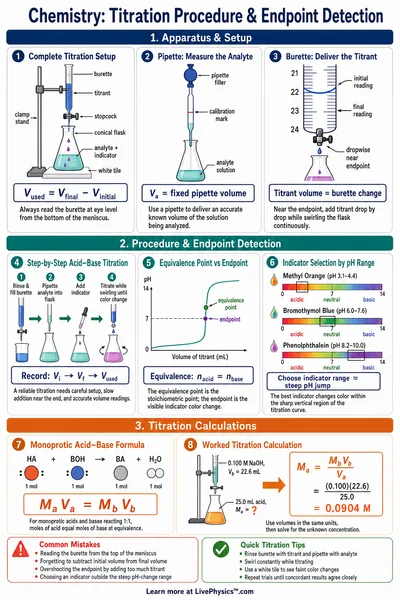
At the equivalence point, a small added volume of titrant produces a large change in pH. The first derivative d pH / d V peaks sharply at exactly that volume.
This is more reliable than reading the equivalence by eye, especially for shallow weak-acid curves. The peak's volume is the equivalence; its position is independent of indicator choice or experimental scatter.
Half-equivalence gives pKa directly
The half-equivalence point sits at exactly half the equivalence volume. At that point, half of the weak acid has been converted to its conjugate base, so [HA] = [A⁻].
Substitute into Henderson-Hasselbalch, pH = pKa + log(1) = pKa. Read pH straight off the curve at V = Veq/2 and you have the pKa. From there, Ka = 10−pKa.
The second derivative pinpoints inflection
The second derivative crosses zero at the inflection point of the curve. For symmetric titrations, this zero crossing coincides with the maximum of d pH / d V, the equivalence point.
Switching on the second-derivative overlay is a cross-check on the first-derivative peak location. They should land on the same volume.
Diprotic acids, two of everything
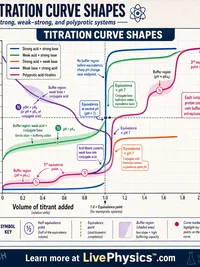
A diprotic acid has two acidic protons and two pKa values. The titration curve shows two equivalence points and two buffer regions.
- First half-equivalence at Veq1/2 gives pKa1.
- Second half-equivalence at (Veq1 + Veq2)/2 gives pKa2.
- The two pKa values are well separated when the acid releases its protons in stages.
On AP exams, identifying both pKa values from a diprotic titration curve is a frequent multi-point sub-task.