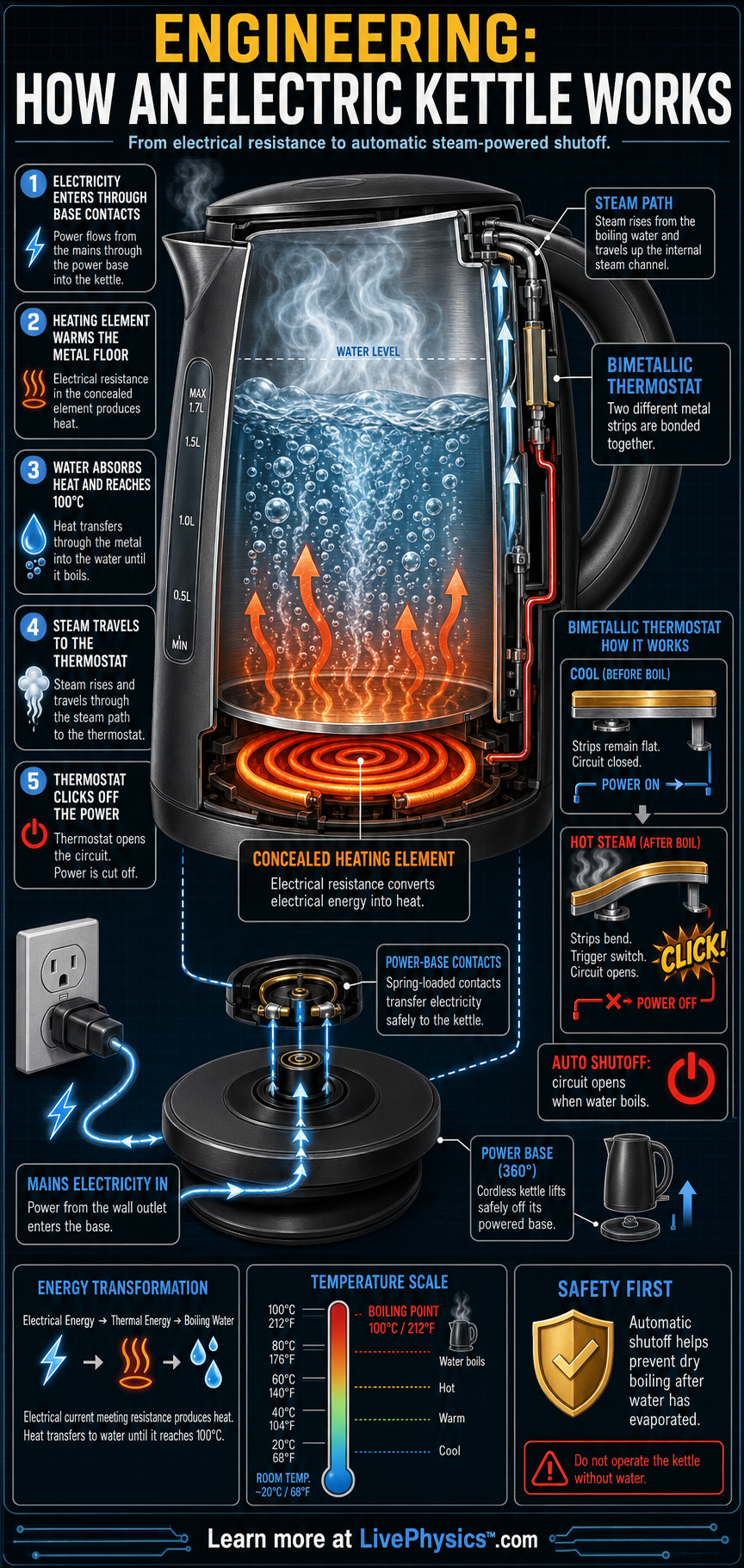
An electric kettle turns electrical energy into thermal energy quickly and efficiently, bringing water to a boil for drinks, cooking, and laboratory-style heating tasks. Its main engineering challenge is to transfer heat into the water while keeping the user safe from electricity, steam, and overheating. A cordless base makes the kettle easy to lift, while internal controls disconnect power once boiling is detected.
The cutaway view reveals that the most important components are hidden below the water container and inside the handle or base.
Understanding Engineering, How an Electric Kettle Works
The element is usually a metal track or coil with carefully chosen resistance. When current passes through it, moving electrons collide with atoms in the metal. Those collisions make the atoms vibrate more strongly.
That microscopic vibration is heat. The element must get hot enough to heat the water fast, but its surface temperature must stay within safe limits. In many modern kettles, the element sits under a flat metal plate rather than directly in the water.
The plate spreads heat across a larger area. This reduces local hot spots and makes cleaning easier. The kettle body, lid, and base are designed to keep most of that heat moving toward the water instead of into the surrounding air.
Water does not warm instantly or evenly. Water touching the hot base becomes less dense and rises. Cooler, denser water sinks to replace it.
This circulation is called convection. It carries energy through the kettle without a pump. Near boiling, bubbles form first at tiny rough points on the hot surface.
These points provide places where water vapour can begin growing into bubbles. A full rolling boil means bubbles rise through much of the water, not merely a few bubbles stuck to the base.
Students should notice that the required heating time depends strongly on how much water is inside. Doubling the water roughly doubles the energy needed for the same temperature rise.
Automatic shutoff depends on steam, not simply on a timer. When the water boils, steam reaches a small channel leading to the control system. The steam heats a bimetal strip made from two bonded metals.
Each metal expands by a different amount when heated, so the strip bends. Its movement releases a latch or pushes open electrical contacts. Once the contacts separate, current stops flowing to the element.
This is a useful example of a sensor, a mechanical response, and a switch working as one control system. The kettle can then cool down. As the strip cools, it changes shape again, though the switch usually stays off until a user resets it.
Safety features deal with faults as well as normal boiling. A kettle should never be operated with too little water, because the element can become far hotter than intended. Many designs include a second thermal cutout that disconnects power if the base overheats.
The electrical connections are kept away from the water path, while plastic insulation and earthing reduce the risk of electric shock. The lid guides steam toward the thermostat, but it must allow pressure to escape safely. When studying a kettle, follow the energy path from wall socket to element to metal base to water.
Then follow the control path from boiling water to steam to thermostat to open circuit. These two paths explain both its speed and its safety.
Key Facts
- The heating element converts electrical energy to heat by resistance, P = VI.
- Electrical energy supplied over time is E = Pt.
- Heating water without a phase change requires Q = mcΔT.
- For water, c ≈ 4186 J/(kg·°C), so raising 1.0 kg of water by 1°C needs about 4186 J.
- A 1500 W kettle delivers about 1500 J of energy each second when operating at full power.
- Steam travels through a channel to a bimetallic thermostat; the heated strip bends and opens the circuit, turning the kettle off.
Vocabulary
- Heating element
- A high-resistance electrical conductor that becomes hot when electric current passes through it.
- Power base
- The stationary base that connects to wall power and transfers electricity to the kettle through metal contacts.
- Bimetallic thermostat
- A temperature-sensitive switch made from two bonded metals that bend by different amounts when heated.
- Conduction
- The transfer of thermal energy through direct contact between materials.
- Latent heat of vaporization
- The energy required to change liquid water into water vapor without increasing its temperature.
Common Mistakes to Avoid
- Assuming the visible bubbles are created directly by electricity in the water. The electric current heats a concealed metal element, and heat then transfers from the element into the water.
- Filling the kettle above the maximum water-level mark. Overfilling can force boiling water or droplets into the steam path and create spills from the spout.
- Thinking the thermostat measures the water temperature by touching the water. In many kettles, it detects hot steam traveling through a dedicated channel near the lid or handle.
- Leaving an empty kettle switched on. Without water to absorb the element's heat, the base can overheat, although a safety cutoff may eventually interrupt the circuit.
Practice Questions
- 1 A kettle is rated at 1500 W and operates for 3.0 min. How much electrical energy does it use in joules?
- 2 How much energy is needed to heat 0.80 kg of water from 20°C to 100°C? Use c = 4186 J/(kg·°C) and ignore heat losses.
- 3 A kettle may switch off before every drop of water has turned into steam. Explain why steam reaching the thermostat is enough to trigger automatic shutoff.