ELA
Mistaking a Sentence Fragment for a Complete Sentence
Students write a group of words as a sentence even though it is missing a subject, a verb, or a complete thought.
Quick check
Why students make it
A fragment often sounds like part of a real sentence because it has interesting details or begins with a capital letter. Students may also mistake a long phrase or dependent clause for a complete sentence.
The rule done right
A complete sentence needs a subject, a verb, and a complete thought. A dependent clause or phrase must be joined to an independent clause or rewritten as a full sentence.
Related resources
-
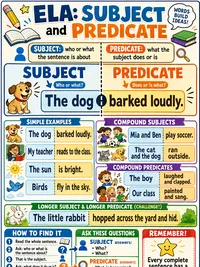 Subject and Predicate Infographic
-
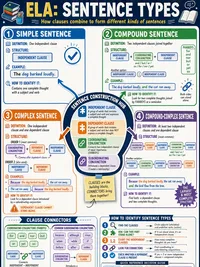 Sentence Types Infographic
-
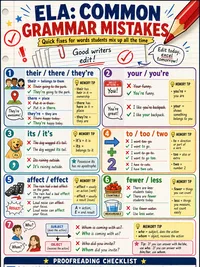 Common Grammar Mistakes Infographic
-
 Parts of Speech Infographic
-
 Punctuation Marks and Their Jobs Infographic
- Grammar & Punctuation Cheat Sheet
- Sentence Structure & Diagramming Cheat Sheet
- Sentence Types & Diagramming Cheat Sheet
- Simple, Compound & Complex Sentences Cheat Sheet
- Coordinate and Subordinate Clauses Reference Cheat Sheet
- Language Arts, Sentence Fragments and Run-On Sentences Worksheet
- Language Arts, Sentence Types, Simple, Compound, and Complex Worksheet
- Language Arts, Parallel Structure and Sentence Variety Worksheet
- Language Arts, Syntax Style and Diction Worksheet
- ELA, Seven Coordinating Conjunctions (FANBOYS) Practice Worksheet
- Grammar Patterns Explorer Tool
- Paragraph Organizer Tool
- Writing Rubric Builder Tool
- Grammar Patterns Lab Lab
- Reading Strategies Lab Lab
- Reading Comprehension Lab Lab