World Biomes Explorer
Explore the world's major biomes with climate ranges, plants, animals, and key adaptations, then take a quiz to identify each biome from its climate or organisms.
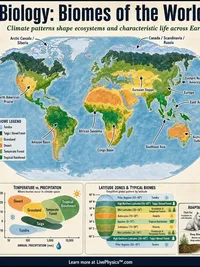
Temperature and precipitation map
Each marker shows a typical yearly average. Warm biomes sit to the right, wetter biomes sit higher up. Tap a marker to open its card.
Hot and very wet year round with a dense, layered canopy.
- Tall canopy trees
- Lianas and vines
- Epiphytes such as orchids
- Ferns
- Jaguars
- Toucans
- Poison dart frogs
- Howler monkeys
How it works
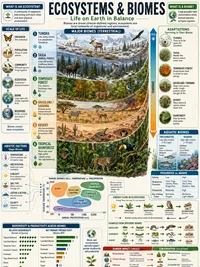
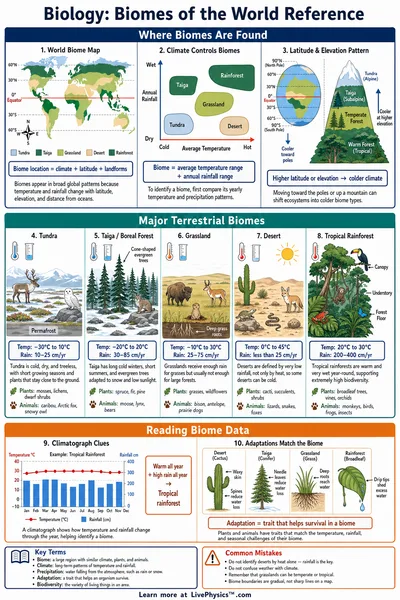
A biome is a large region defined by its climate and the plants and animals that live there. Explore mode lists nine major biomes, each with a typical temperature range, yearly precipitation, characteristic plants and animals, and the adaptation that helps life survive there.
The temperature and precipitation map plots each biome by its yearly averages, so you can see how warm and wet biomes differ from cold and dry ones. In quiz mode you read a clue and pick the matching biome. Learn mode adds a hint, Practice mixes climate and organism clues, and Challenge uses organism clues only.
Curriculum alignment
This tool supports elementary, middle school, and high school life science. It connects to standards on ecosystems, habitats, climate, and adaptation, including NGSS topics on organisms and their environments and on biodiversity in different regions.
Use Explore mode to introduce biomes and compare climates, then switch to the quiz to check understanding. The Challenge level, which gives organism clues only, asks students to reason from evidence to the biome.
Biome reference guide
Tropical Rainforest
Hot and very wet year round with a dense, layered canopy. Tall trees, vines, and orchids grow toward the light above jaguars, toucans, and dart frogs.
Temperate Forest
Four seasons with warm summers and cold winters. Oak and maple trees drop their leaves each autumn, sheltering deer, black bears, and songbirds.
Taiga / Boreal Forest
Long, snowy winters and short summers. Evergreen spruce, pine, and fir keep waxy needles all year, home to moose, lynx, and snowshoe hares.
Tundra
Extremely cold and dry with permafrost and no tall trees. Lichens, mosses, and dwarf shrubs grow low, with caribou, arctic foxes, and snowy owls.
Desert
Very dry with hot days and cold nights. Cacti and succulents store water, while camels, fennec foxes, and scorpions avoid the daytime heat.
Savanna
Warm grassland with scattered trees and clear wet and dry seasons. Tall grasses and acacias support elephants, lions, zebras, and giraffes.
Temperate Grassland
Open prairie with hot summers, cold winters, and too little rain for forests. Deep rooted grasses feed bison, prairie dogs, and pronghorn.
Freshwater
Low-salt lakes, ponds, rivers, and wetlands with sunlit shallow zones. Water lilies and cattails grow among frogs, trout, and dragonflies.
Marine
Salt-water oceans, reefs, and estuaries that cover most of Earth. Phytoplankton and kelp feed whales, sharks, sea turtles, and coral reef life.