ENSO / El Niño Climate Simulator
The trade winds, the tilted thermocline, and the sea surface temperature of the tropical Pacific are locked together in the Bjerknes feedback. Weaken the trades and the warm pool slides east into El Niño. Strengthen them and cold upwelling locks in La Niña. Set the two controls and watch the Niño 3.4 index and global rainfall respond.
Guided ExperimentHow do weakening trade winds flip the Pacific into El Niño and shift the rain?
Start from neutral conditions with the SST nudge at 0 °C. Predict what happens to the Niño 3.4 anomaly, the eastern thermocline, and the position of the heaviest rain as you gradually weaken the trade winds (make the wind anomaly more negative).
Write your hypothesis in the Lab Report panel, then click Next.
Controls
Negative = weaker or reversed trade winds (El Niño favorable, less upwelling). Positive = stronger trades (La Niña favorable, more cold upwelling). Zero is neutral.
A direct warm (+) or cool (−) perturbation of the eastern equatorial Pacific surface.
Equatorial Pacific cross-section
Tropical Pacific state
Neutral / ENSO-neutral
Niño 3.4 anomaly = 0.00 °C
Niño 3.4 index
0.00 °C
central-east Pacific SST
West Pacific SST anomaly
0.00 °C
warm pool change
Eastern thermocline depth
0 m
positive = deeper, less upwelling
Walker circulation
normal
anomaly 0.00
East Pacific rainfall
normal
anomaly 0.0
West Pacific rainfall
normal
anomaly 0.0
Global teleconnections
Indonesia & Australia
Near normal
Peru & Ecuador coast
Near normal
Southern United States
Near normal
Pacific Northwest
Near normal
Atlantic hurricanes
Near normal
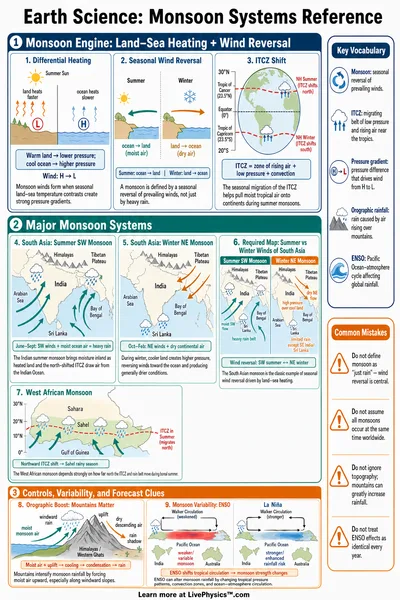
India & SE Asia monsoon
Near normal
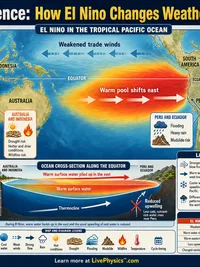
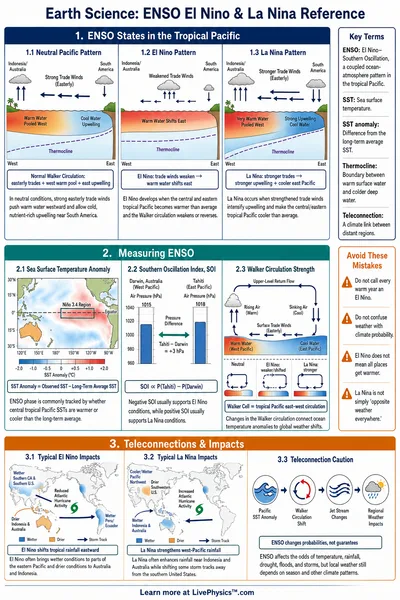
El Niño shifts the warm pool and heavy rain eastward and weakens the Walker circulation. La Niña steepens the thermocline tilt, boosts cold upwelling off South America, and shifts rain back toward Indonesia.
Data Table
(0 rows)| # | Wind anomaly | SST nudge (°C) | Niño3.4 (°C) | Phase | East rain | West rain | Atlantic hurricanes |
|---|
Reference Guide
Trade Winds and the Walker Circulation
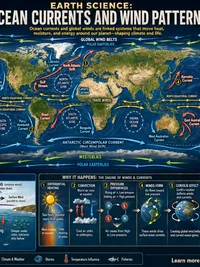
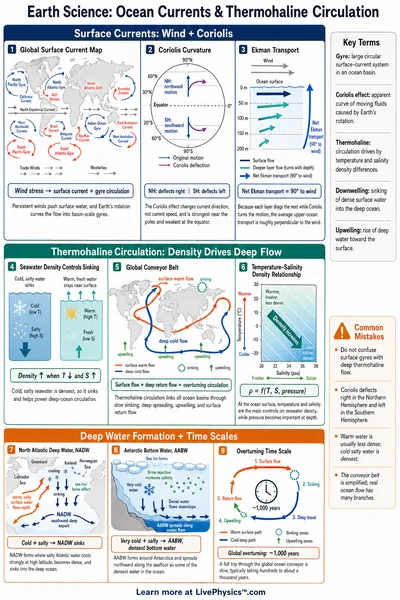
In neutral conditions the easterly trade winds blow steadily across the equatorial Pacific from South America toward Indonesia. They drag warm surface water westward, piling it up in the western warm pool.
- Warm pool. Deep warm water and heavy rain over Indonesia and the west.
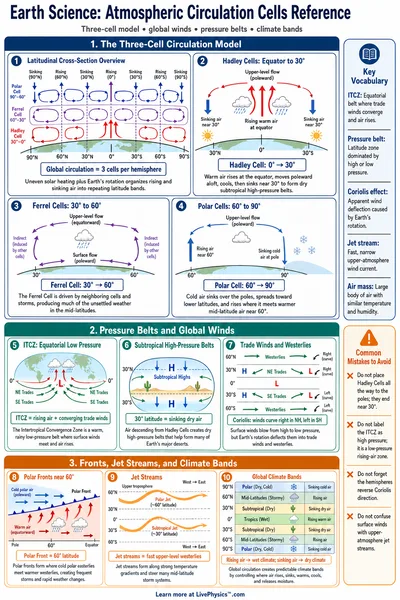
- Walker cell. Air rises over the warm west, sinks over the cool east.
- Upwelling. Cold, nutrient rich water rises along the South American coast.
The Bjerknes Feedback
The Bjerknes feedback is a self reinforcing loop that couples the winds, the ocean temperature, and the thermocline.
Weaker trades → warm water spreads east → eastern thermocline deepens → surface warms → trades weaken further
Once the loop tips one way it amplifies itself, which is why a small wind change can flip the whole basin into El Niño or La Niña.
El Niño, La Niña, and the Niño 3.4 Index
Scientists track ENSO with the Niño 3.4 index, the sea surface temperature anomaly in the central and eastern equatorial Pacific.
- Niño 3.4 ≥ +0.5 °C. El Niño. Warm east, weakened trades.
- Between −0.5 and +0.5 °C. Neutral. Near average conditions.
- Niño 3.4 ≤ −0.5 °C. La Niña. Cold east, strengthened trades.
- Beyond ±1.5 °C. Strong El Niño or strong La Niña.
The Tilting Thermocline and Upwelling
The thermocline is the boundary between warm surface water and cold deep water. The trade winds tilt it so it is deep in the west and shallow in the east.
- La Niña. Steep tilt, shallow eastern thermocline, vigorous cold upwelling.
- El Niño. The tilt flattens, the eastern thermocline deepens, and upwelling shuts down.
- Fisheries. When upwelling fails the cold, nutrient rich water no longer reaches the surface, so the Peruvian anchovy fishery collapses.
Global Teleconnections
Because the warm rising branch of the Walker circulation moves with the warmest water, ENSO reshapes weather far beyond the Pacific.
- Indonesia and Australia. Drought in El Niño, flooding risk in La Niña.
- Peru and Ecuador. Heavy coastal rain in El Niño, drier in La Niña.
- Southern United States. Wetter and cooler in El Niño, drier and warmer in La Niña.
- Atlantic hurricanes. Suppressed by El Niño wind shear, more active in La Niña.
- Asian monsoon. Weaker in El Niño, stronger in La Niña.