Conservation of Mass Lab
Explore six classic chemical reactions and verify that the total mass of reactants always equals the total mass of products. Watch the virtual balance scale tilt or hold steady as you test each reaction.
Difficulty
Molar mass hints shown
Reactants
Sodium bicarbonate (NaHCO₃)
Molar mass 84.007 g/mol × 1 = 84.007 g
Acetic acid (HC₂H₃O₂)
Molar mass 60.052 g/mol × 1 = 60.052 g
Mass Summary
| Side | Total (g) |
|---|---|
| Reactants | 144.059 |
| Products | — |
| Difference (|Δm|) | — |
| Percent error | — |
Balance Scale
Reactants
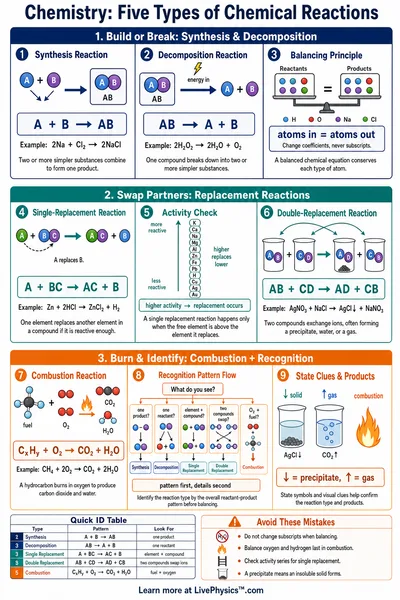
NaHCO₃ + HC₂H₃O₂ → NaC₂H₃O₂ + H₂O + CO₂
Reference Guide
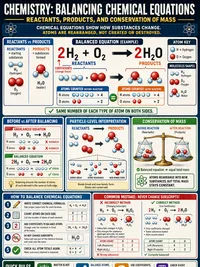
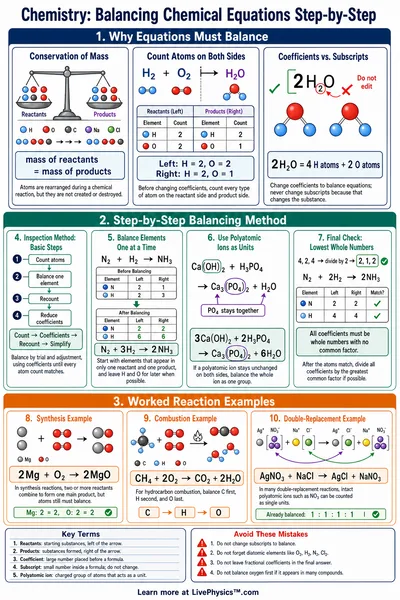
Law of Conservation of Mass
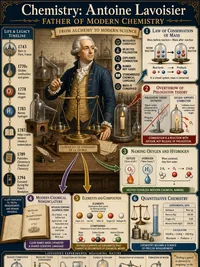
Antoine Lavoisier established in 1789 that matter is neither created nor destroyed in a chemical reaction. The total mass of all reactants equals the total mass of all products.
This law holds in any closed system. In an open system, gases may escape, making the measured mass appear to change even though mass is still conserved overall.
Counting Atoms
A balanced chemical equation has the same number of each element on both sides. Coefficients multiply all atoms in a formula.
Example for iron rusting (4Fe + 3O₂ to 2Fe₂O₃), the left side has 4 Fe atoms and 6 O atoms; the right side has 4 Fe atoms and 6 O atoms. Atoms are conserved, so mass is conserved.
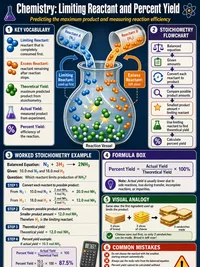
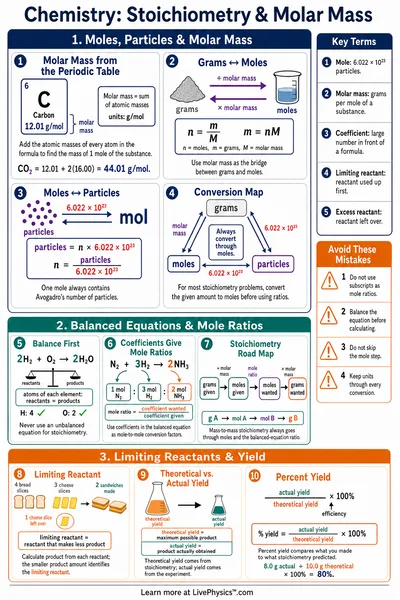
Molar mass (g/mol) tells you the mass of one mole of a substance. Multiply by the stoichiometric coefficient to find the mass of that component in the reaction.
Open vs Closed Systems
A closed system does not allow matter to enter or leave. Mass is straightforward to verify because nothing escapes.
An open system can exchange matter with the surroundings. The baking soda and vinegar reaction produces CO₂ gas that escapes into the air. If you weigh only the remaining liquid and solid, the mass appears to decrease.
Performing the same reaction inside a sealed bag or bottle traps the gas and shows that total mass is unchanged.
Molar Mass and Stoichiometry
Molar mass is calculated by summing atomic masses for every atom in the formula. For water (H₂O), 2 x 1.008 + 15.999 = 18.015 g/mol.
Stoichiometric coefficients tell you how many moles of each substance react. Multiply the molar mass by the coefficient to get the mass of that component used in one reaction event.