Crystal Lattice Viewer
Explore the atomic geometry of seven foundational crystal structures. Drag to rotate, scroll to zoom, and toggle bonds, cell edges, and the 2×2×2 supercell to see how unit cells tile through space.
Each sphere is one atom. Drag to rotate the crystal. Switch lattice types in the panel to see how atomic arrangement changes.
View Controls
Drag to rotate. Scroll to zoom. Right-click and drag to pan.
Face-Centered Cubic (FCC)
Bravais class. Cubic (F)
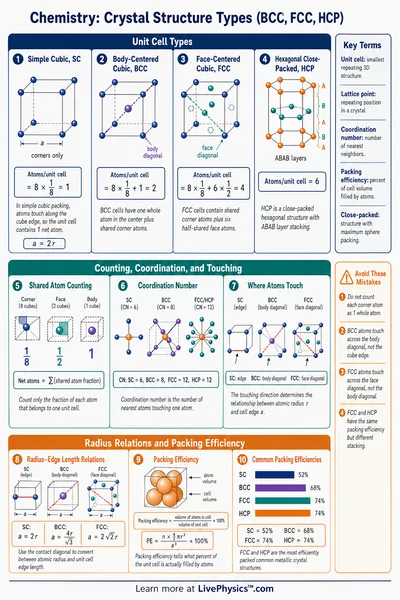
Atoms at corners plus one at the center of each face. Eight corners × 1/8 plus six faces × 1/2 gives 4 atoms per cell. Maximally close-packed.
Lattice Parameters
| a, b, c | 3.610, 3.610, 3.610 Å |
| α, β, γ | 90°, 90°, 90° |
| Atoms per cell | 4 |
| Coordination number | 12 |
| Packing efficiency | 74.0% |
Real-World Examples
Cu, Au, Al, Ag, Pb, Ni
Reference Guide
Bravais Lattices
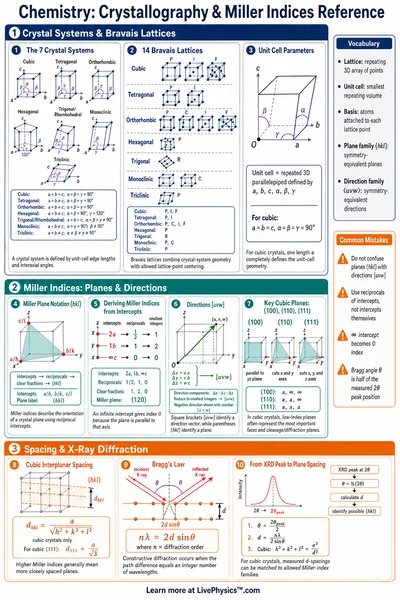
Every crystal can be classified into one of 14 Bravais lattices, defined by the cell shape and the centering of additional lattice points.
| Symbol | Centering | Atoms / Cell |
|---|---|---|
| P | Primitive (corners only) | 1 |
| I | Body centered | 2 |
| F | Face centered | 4 |
| C | Base centered | 2 |
The seven crystal systems (cubic, tetragonal, orthorhombic, hexagonal, trigonal, monoclinic, triclinic) combine with these centering modes to give the 14 unique Bravais lattices.
Packing Efficiency
Packing efficiency is the fraction of unit-cell volume occupied by hard-sphere atoms. Higher means less wasted space.
| Structure | APF | Coord. # |
|---|---|---|
| Simple cubic | 52.4% | 6 |
| BCC | 68.0% | 8 |
| FCC | 74.0% | 12 |
| HCP | 74.0% | 12 |
| Diamond cubic | 34.0% | 4 |
FCC and HCP are tied as the densest possible sphere packings (74.05%). Diamond is the loosest of the common structures because its tetrahedral bonding leaves big interstitial gaps.
Real-World Materials
- Iron (BCC). At room temperature, alpha iron forms BCC. Above 912 °C it transforms to FCC (austenite), allowing carbon to dissolve and enabling steel hardening.
- Copper, gold, aluminum (FCC). Soft, ductile metals owe their malleability to the close-packed FCC slip planes.
- Magnesium and zinc (HCP). HCP metals are stronger but more brittle than FCC because they have fewer independent slip systems.
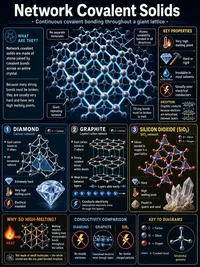
- Silicon and diamond (Diamond cubic). Each atom bonds tetrahedrally to four neighbours, producing the rigid covalent network that makes diamond the hardest natural material.
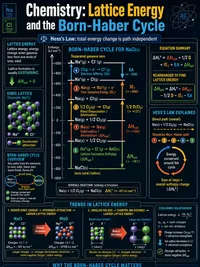
- Table salt (NaCl rock salt). Two interpenetrating FCC sublattices of Na and Cl ions, each surrounded by 6 opposite-charge neighbours.
Why Crystal Structure Matters
- Mechanical properties. Slip planes determine ductility. FCC metals deform plastically; BCC and HCP metals tend toward brittle failure at low temperatures.
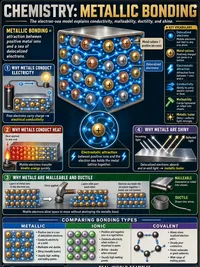
- Electrical and thermal conduction. Lattice geometry sets electron band structure, governing whether a solid is a metal, semiconductor, or insulator.
- X-ray diffraction. Bragg peaks at angles satisfying nλ = 2d·sin(θ) reveal the lattice spacing d, letting scientists deduce structure from diffraction patterns.
- Phase transitions. Many materials change lattice type with temperature or pressure. Iron switches BCC to FCC at 912 °C; carbon goes from graphite (hexagonal) to diamond (cubic) under high pressure.