Understanding Tsunami Propagation Simulator
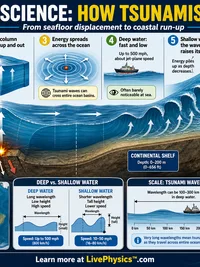
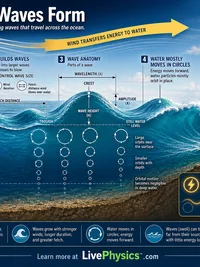
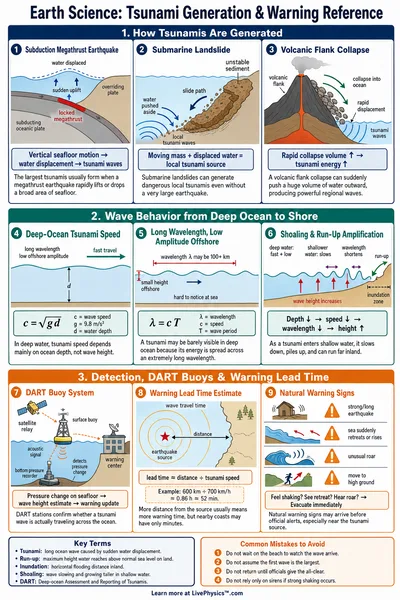
Tsunamis behave differently from the waves you see at a beach. Wind waves have wavelengths measured in tens of meters, so they only disturb water near the surface. A tsunami wavelength often stretches for hundreds of kilometers, which is far greater than the depth of any ocean, so the entire water column moves together.
Because the wave is long compared to the depth, it travels as a shallow water wave. Its speed equals the square root of gravitational acceleration multiplied by water depth. In four thousand meters of open ocean that works out to roughly 713 kilometers per hour, comparable to a commercial airliner.
The wave slows as it moves into shallower water near a coast. Energy that was spread through a deep water column gets compressed into a shorter one, so the wave height grows. Height rises roughly in proportion to depth raised to the power of negative one quarter, which is why a swell barely noticeable at sea can arrive as a wall of water many meters tall.
Because speed depends only on depth, and ocean depth is well mapped, arrival times can be calculated in advance. Warning centers use exactly this relationship to estimate when a wave will reach each coastline after an undersea earthquake. The simulator above applies the same calculation to twenty coastal cities.
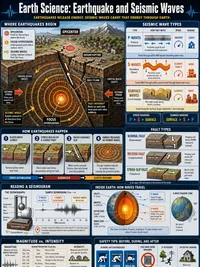
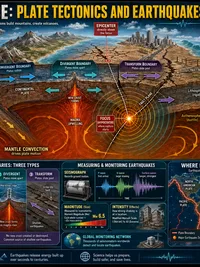
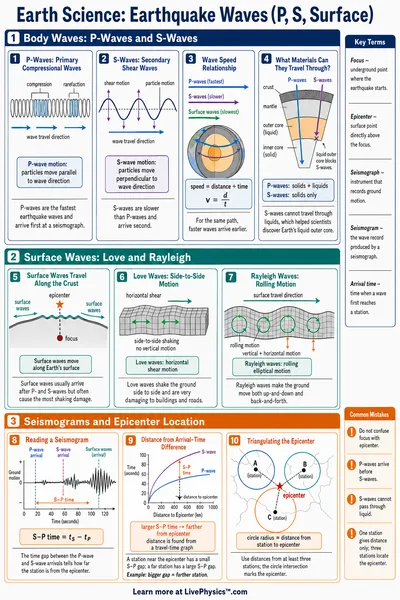
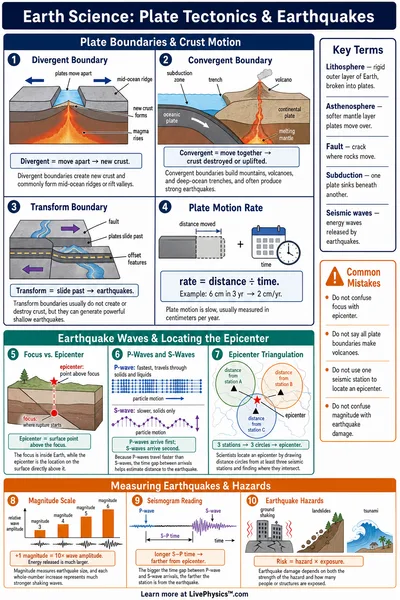
Earthquake magnitude sets how much water is displaced and therefore the initial wave height. The moment magnitude scale is logarithmic, so each whole step upward represents about thirty two times more energy released. A magnitude nine event displaces vastly more water than a magnitude seven, which is why only the largest undersea earthquakes generate ocean crossing tsunamis.