Virus Replication Explorer
Walk through the lytic and lysogenic cycles of a bacteriophage one stage at a time. See where the two cycles share steps, where they diverge, and how a single infected cell can release hundreds of new virions that amplify across infection cycles.
Stage 1. Attachment
The phage binds to specific receptor molecules on the surface of the host bacterium. Tail fibers lock the phage onto the cell wall.
Lytic amplification
Each infected cell bursts to release many new phages, which infect more cells. The population grows by a power of the burst size every cycle.
Real burst sizes range from roughly 50 to several hundred phages per cell, so the numbers grow explosively after only a few cycles.
How Bacteriophages Replicate
The Lytic Cycle Step by Step
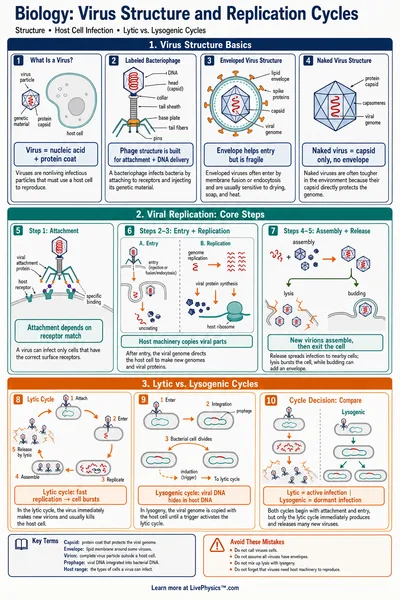
The lytic cycle is the fast, destructive path. A phage runs through five stages and the host cell is killed at the end.
- Attachment. The phage binds to specific receptors on the host cell wall.
- Penetration. The phage injects its genome while the capsid stays outside.
- Biosynthesis. The host machinery is hijacked to build viral parts.
- Assembly. New capsids, tails, and genome copies form complete virions.
- Lysis and release. The cell bursts, freeing new phages.
The Lysogenic Cycle and the Prophage
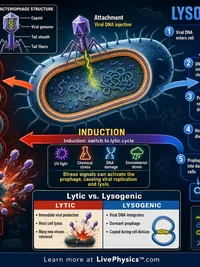
The lysogenic cycle is the quiet path. Instead of immediately making new virions, the phage hides its genome inside the host.
After attachment and penetration, the viral DNA integrates into the host chromosome and becomes a prophage. The phage genes are switched off, so the cell survives and keeps dividing normally.
Every time the host divides, the prophage is copied along with the host genome. A single integration event can spread the viral DNA through many generations of bacteria without ever bursting a cell.
How Induction Switches Lysogenic to Lytic
A prophage does not stay dormant forever. A trigger such as UV light, radiation, or chemical stress can start induction.
During induction the prophage is excised from the host chromosome and the phage genes switch back on. The infection then enters the lytic cycle, producing new virions and lysing the cell.
This is why the two cycles are linked. A temperate phage can spend many generations in the lysogenic cycle and only later shift into the lytic cycle when conditions change.
Lytic Versus Lysogenic Compared
Both cycles share the first two stages, attachment and penetration. They diverge at stage three.
| Feature | Lytic | Lysogenic |
|---|---|---|
| Host cell | Destroyed | Survives |
| Viral DNA | Stays free | Integrated |
| New virions | Made at once | Delayed |
| Speed | Fast | Slow, latent |
Phages that only use the lytic cycle are called virulent. Phages that can also enter the lysogenic cycle are called temperate.
Why This Matters
The difference between virulent and temperate phages shapes how bacterial populations evolve and how scientists use phages.
Prophages can carry extra genes that change the host. Some give bacteria resistance to other phages, and some carry toxin genes that turn a harmless bacterium into a disease-causing strain.
Phage therapy uses virulent phages to kill bacterial infections, because they reliably lyse their hosts. Understanding burst size and infection cycles, shown in the amplification panel, helps explain how quickly a phage population can clear a culture.
The Amplification Math
Each cycle multiplies the phage population by the burst size. If you start with N phages and each infected cell releases b new phages, after c cycles you have N times b to the power c.
Starting from one phage with a burst size of 100, two cycles give 10,000 virions and three cycles give one million. This exponential growth is why a phage infection can clear a dense bacterial culture in just a few hours.