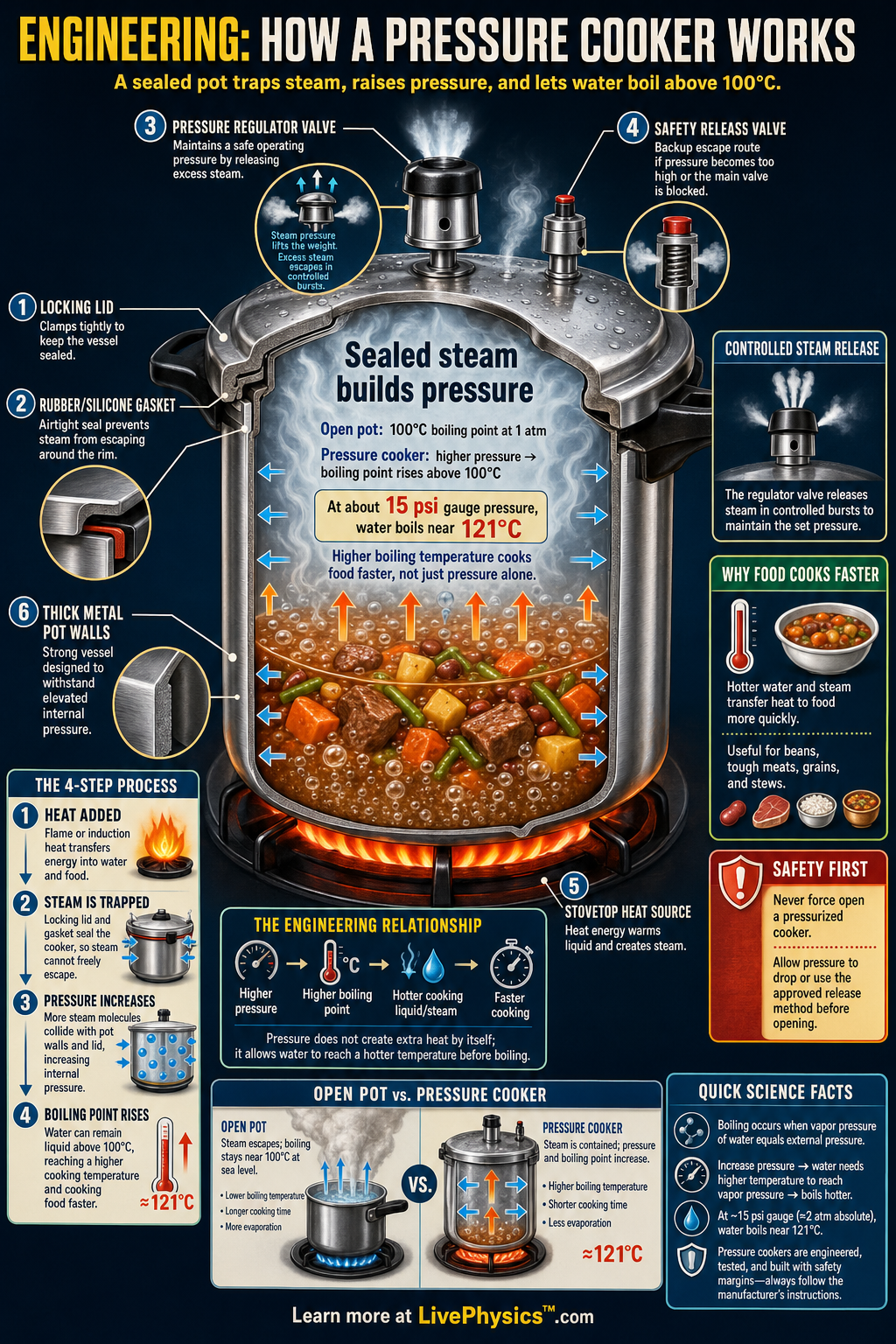
A pressure cooker is a sealed cooking vessel that uses steam pressure to raise the temperature at which water boils. In an open pot at sea level, water boils at about 100 °C, so liquid food cannot get much hotter than that while it contains plenty of water. Inside a sealed cooker, steam is trapped and pressure rises above atmospheric pressure.
The higher boiling temperature lets food cook faster and can reduce energy use.
Understanding Engineering, How a Pressure Cooker Works
Boiling happens when water molecules have enough energy to form bubbles of water vapour throughout the liquid. Those bubbles can grow only when their internal pressure matches the pressure pushing down on the liquid. In an ordinary saucepan, that outside pressure is mainly the air above the water.
In a pressure cooker, the lid seal prevents vapour from freely escaping. More vapour collects in the small space above the food, so the pressure on the liquid surface increases.
Water must then reach a higher temperature before stable bubbles can form. Many household cookers operate near 120 degrees Celsius, though the exact value depends on the design and setting.
The heat source still supplies energy through the metal base into the food and liquid. At first, much of that energy raises the temperature. Once the cooker reaches its operating pressure, steam production becomes steady.
A regulator on the lid releases small amounts of steam when pressure becomes too high. Some models make a repeated hiss or rattle because the regulator lifts briefly, releases vapour, then closes again. This controlled release keeps the internal pressure near a chosen limit.
The cooker does not create heat from nothing. It allows moist food to reach a higher cooking temperature without drying out as quickly as it might in an uncovered pan.
Pressure cookers need several safety features because hot steam stores a large amount of energy. A locking mechanism stops the lid opening while pressure remains inside. A gasket, usually made from rubber or silicone, seals the gap between lid and pot.
A main valve controls normal pressure, while a separate safety valve provides another escape route if the main valve is blocked. The steam vent must stay clear. Starchy foods, foam, or pieces of food can clog it if the pot is overfilled.
For this reason, cookers have a maximum fill line, with lower limits for foods such as beans, rice, pasta, and soup. Opening a pressurised vessel too soon can release steam violently and cause burns.
Students can connect this idea to familiar situations. At high altitude, the air pressure is lower, so water boils at a lower temperature and foods take longer to cook. A pressure cooker reverses that effect by increasing pressure inside the pot.
The same basic relationship matters in steam engines, industrial boilers, autoclaves used to sterilise equipment, and some espresso machines. When learning this topic, separate temperature from total heat energy. A hotter object is not automatically holding more energy than a cooler larger object.
It is also useful to distinguish boiling from evaporation. Evaporation can happen at the surface at many temperatures, while boiling forms vapour bubbles throughout the liquid when pressure conditions allow it.