Earth Science
Confusing Convergent, Divergent, and Transform Boundaries
Students label a plate boundary by the landform they remember instead of by the direction the plates move.
Quick check
Why students make it
Many diagrams show mountains, trenches, ridges, and earthquakes all at once, so students memorize pictures instead of motion. They may also think every boundary with earthquakes is the same type.
The rule done right
Convergent boundaries move toward each other, divergent boundaries move away from each other, and transform boundaries slide past each other. Identify the boundary from plate motion first, then connect it to common features.
Related resources
-
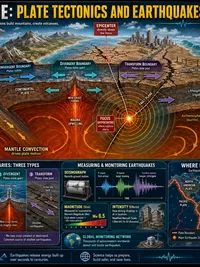 Plate Tectonics and Earthquakes Infographic
-
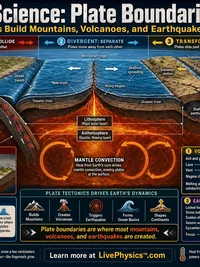 Plate Boundaries Infographic
-
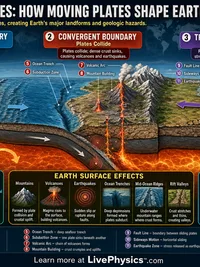 Plate Boundaries Infographic
-
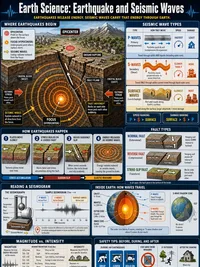 Earthquake and Seismic Waves Infographic
- Plate Boundary Types & Examples Cheat Sheet
- Plate Tectonic Boundary Types Detailed Cheat Sheet
- Plate Tectonics & Earthquakes Cheat Sheet
- Subduction Zones Detailed Reference Cheat Sheet
- Mid-Ocean Ridges & Seafloor Spreading Cheat Sheet
- Earth Science, Plate Boundaries, Convergent, Divergent, Transform Worksheet
- Science, Plate Tectonics Worksheet
- Earth Science, Plate Tectonics and Continental Drift Worksheet
- Science, Plate Tectonics and Earthquakes Worksheet
- Earth Science, Mapping the Ocean Floor, Trenches and Ridges Worksheet
- Plate Boundary Simulator Tool
- Plate Tectonics Explorer Tool
- Earthquake Magnitude Calculator Tool
- Tsunami Propagation Simulator Tool
- Earthquake Feed Map Lab
- Earth History Lab Lab
- Volcano Eruption Lab Lab
- Earthquake-Proof Building Lab Lab