Chemistry
Ignoring the Limiting Reactant
Students calculate product from the reactant they notice first and ignore which reactant runs out first.
Quick check
Why students make it
The balanced equation makes the mole ratios look like a direct recipe, so students assume every given reactant is fully used. They forget that the smallest starting amount is not always the limiting reactant.
The rule done right
Convert each reactant amount to the same product using the balanced mole ratios. The limiting reactant is the one that produces the smaller amount of product, and that amount is the theoretical yield.
Related resources
-
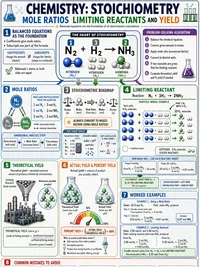 Stoichiometry (Full) Infographic
-
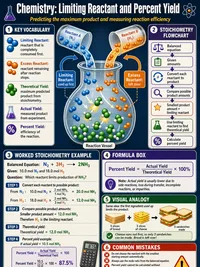 Chemistry, Limiting Reactant and Percent Yield Infographic
-
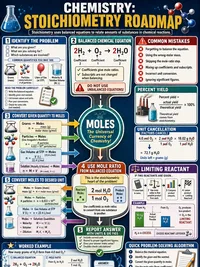 Stoichiometry Roadmap Infographic
-
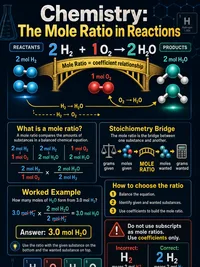 Chemistry, The Mole Ratio in Reactions Infographic
-
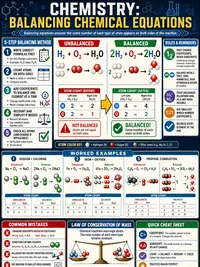 Balancing Chemical Equations Infographic
- Limiting Reactant & Percent Yield Cheat Sheet
- Stoichiometry & Molar Mass Cheat Sheet
- Gas Stoichiometry at STP and Non-STP Worked Examples Cheat Sheet
- Mole Conversion Roadmap Cheat Sheet
- Avogadro's Number and the Mole Concept Worked Examples Cheat Sheet
- Chemistry, Stoichiometry Worksheet
- Science, Stoichiometry Calculations Worksheet
- Science, Balancing Chemical Equations Worksheet
- Science, The Mole and Avogadros Number Worksheet
- Mole Converter & Gas Stoichiometry Tool
- Molar Mass & Stoichiometry Calculator Tool
- Balance Chemical Equations Tool
- Molarity & Dilution Calculator Tool
- Limiting Reactant & Percent Yield Lab Lab
- Stoichiometry Lab Lab
- Gravimetric Analysis Lab Lab