DNA/RNA Codon Translator
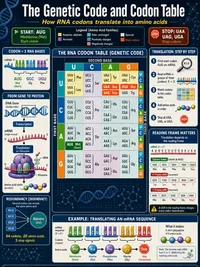
Transcribe DNA to mRNA and translate codons into a protein chain. See the full sequence diagram with color-coded nucleotides, codon brackets, and amino acid pills. Explore the complete genetic code table or reverse-translate amino acids into all possible codons.
Input
Enter DNA bases, A, T, G, C
Sequences
Protein Chain (3 amino acids)
Open Reading Frame (ORF)
Sequence Visualization
Open this tool with your own values
This tool reads its inputs from the page address, so a link can open it with the values from a problem already entered. Include every value the problem needs, because one left out keeps the tool's default. Use plain numbers in the stated units.
- mode
- dna or mrna, matching the sequence given
- dna
- DNA sequence
- mrna
- mRNA sequence
Example links
Reference Guide
DNA Structure
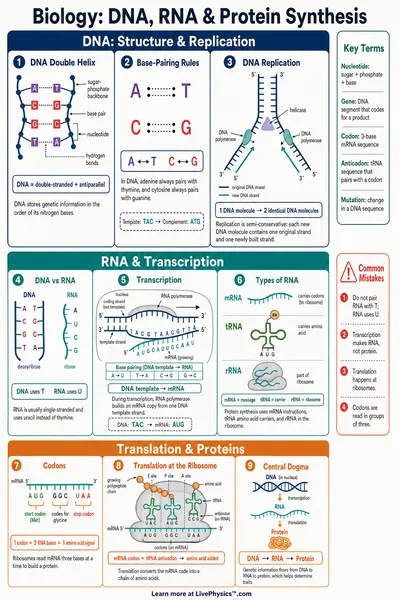
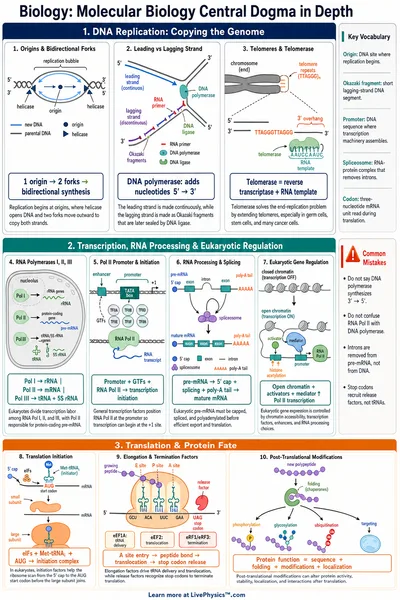
DNA is a double-stranded molecule made of four nucleotide bases. The two strands run antiparallel and are held together by hydrogen bonds between complementary base pairs.
The template strand (3' to 5') is read by RNA polymerase. The coding strand (5' to 3') has the same sequence as the mRNA (with T instead of U).
Transcription (DNA to RNA)
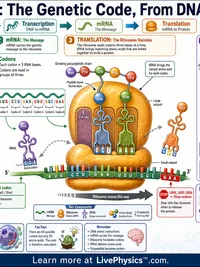
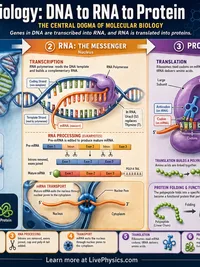
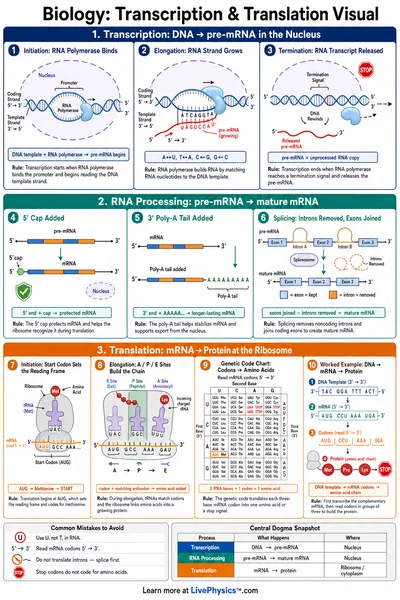
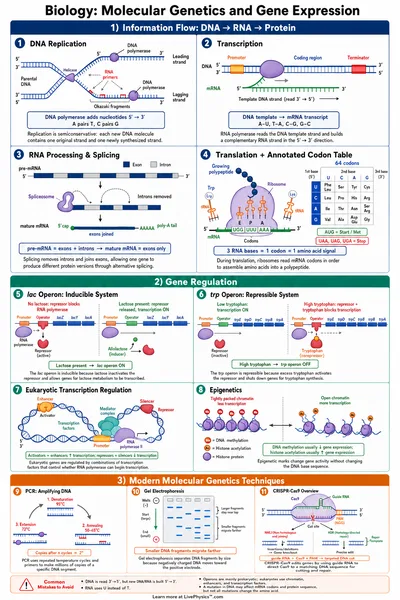
RNA polymerase reads the DNA template strand and synthesizes a complementary mRNA strand. Thymine (T) in DNA is replaced by uracil (U) in RNA.
mRNA is synthesized in the 5' to 3' direction and carries the genetic message from the nucleus to the ribosome.
Translation (RNA to Protein)
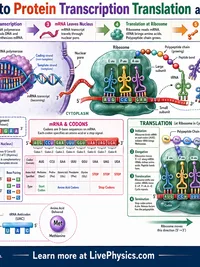
Ribosomes read mRNA in groups of three bases called codons. Each codon specifies one amino acid. Translation begins at the start codon AUG (methionine) and ends at a stop codon.
The reading frame determines how bases are grouped into codons. Shifting by one or two bases produces a completely different protein.
The Genetic Code
The genetic code maps 64 possible codons to 20 amino acids plus 3 stop signals. It is degenerate because most amino acids are encoded by more than one codon.
The code is nearly universal across all life. A few exceptions exist in mitochondria and some organisms, but the standard code applies to the vast majority of genes.