Nuclear Binding Energy and Mass Defect Calculator
A bound nucleus weighs less than the sum of its protons and neutrons. That missing mass, the mass defect, is the energy that holds the nucleus together. Choose a nuclide or enter your own values to compute the mass defect, the total binding energy from E = Δm c², and the binding energy per nucleon, then see where the nuclide sits on the binding-energy curve.
Choose a nuclide
When checked, the constituent side uses the neutral hydrogen-1 atom mass so the electrons cancel against the measured atomic mass. Uncheck to treat the entered mass as a bare nuclear mass and use the bare proton mass.
Results
- Mass number A = Z + N
- 56
- Constituent mass
- 56.463400 u
- Measured mass M
- 55.934936 u
- Mass defect Δm
- 0.528464 u
- Total binding energy E_B
- 492.261 MeV
- Binding energy per nucleon
- 8.790 MeV
Binding energy per nucleon
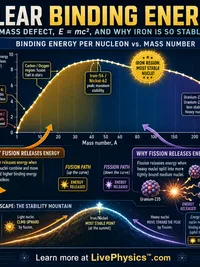
The curve rises steeply for light nuclei, peaks near iron-56 (about 8.79 MeV per nucleon), then slowly declines. Light nuclei release energy by fusing toward the peak; heavy nuclei release energy by splitting toward it.
Reference Guide
What the mass defect is
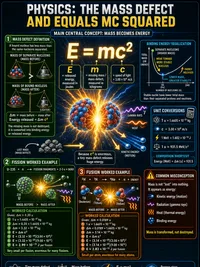
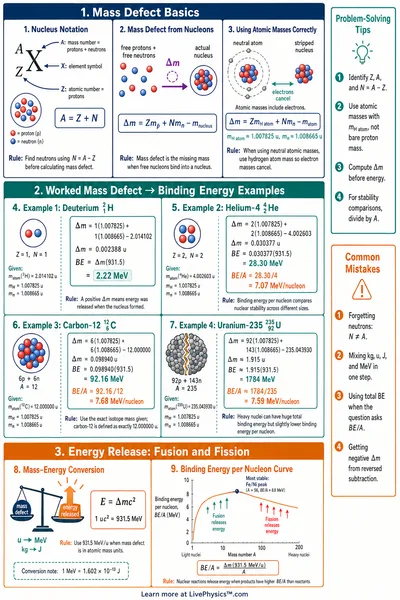
Add up the masses of the free protons and neutrons in a nucleus and the total is always larger than the measured mass of the nucleus. The difference is the mass defect Δm.
Using neutral atomic masses, the proton term uses the hydrogen-1 atom mass so the Z electrons cancel against the electrons already counted in the neutral atomic mass M. The mass defect of a real bound nucleus is always positive.
E = mc² and where the energy goes
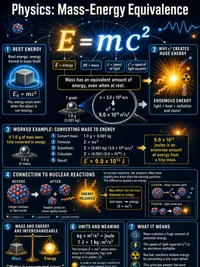
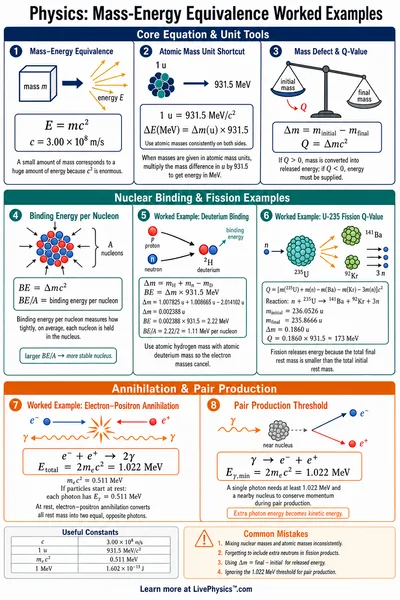
The mass defect is the mass equivalent of the energy released when the nucleons are assembled into a nucleus. Convert it to energy with Einstein's relation.
This total binding energy is exactly the energy you would have to supply to pull the nucleus completely apart into separate protons and neutrons. The same energy was carried away (as photons and particle kinetic energy) when the nucleus formed.
Binding energy per nucleon
Dividing the total binding energy by the mass number A = Z + N gives the average energy holding each nucleon in place. It is the fair way to compare how tightly different nuclei are bound.
A higher value means a more tightly bound, more stable nucleus. Helium-4 sits at about 7.07 MeV per nucleon, carbon-12 at about 7.68, and iron-56 near the maximum at about 8.79 MeV per nucleon.
Why the curve peaks at iron
The binding energy per nucleon rises steeply for light nuclei, reaches a broad maximum near iron-56 and nickel-62, then declines slowly for heavy nuclei. Iron is close to the most tightly bound region.
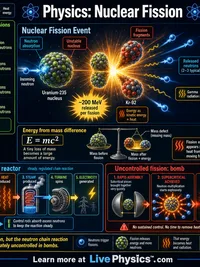
Light nuclei can move toward the peak by joining together, so fusion of light nuclei releases energy and powers stars. Heavy nuclei move toward the peak by splitting, so fission of heavy nuclei such as uranium-235 also releases energy. Both processes climb the curve toward iron.
Atomic mass unit to MeV
Nuclear masses are quoted in unified atomic mass units (u), where carbon-12 is defined as exactly 12 u. One atomic mass unit of mass corresponds to a fixed amount of energy.
So a binding energy in MeV is just the mass defect in u multiplied by 931.494. The constants used here are the hydrogen-1 atom mass 1.007825 u, the neutron mass 1.008665 u, and the bare proton mass 1.007276 u.
Worked example, helium-4
Helium-4 has Z = 2, N = 2 and a measured atomic mass of 4.002602 u.
Per nucleon that is about 28.3 / 4 ≈ 7.07 MeV, which places helium-4 well up the rising part of the curve.