Symbiosis & Species Interactions Explorer
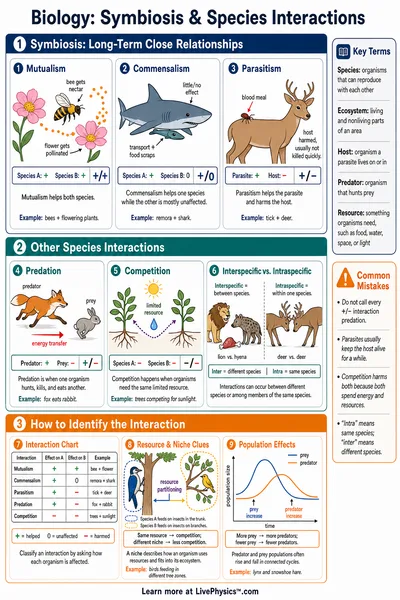
Species in an ecosystem affect one another in different ways. Explore the six classic interaction types, see whether each partner benefits, is harmed, or feels no effect, and then identify real examples in the quiz.
Mutualism
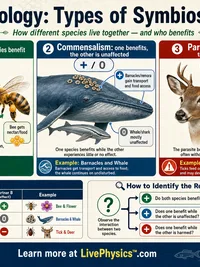
+ / +Both species benefit from the relationship. Each one gains food, protection, transport, or another resource.
Commensalism
+ / 0One species benefits while the other is neither helped nor harmed. The second species is largely unaffected.
Parasitism
+ / −One species (the parasite) benefits while the other (the host) is harmed but usually not killed right away.
Predation
+ / −One species (the predator) benefits by catching and eating the other (the prey), which is killed.
Competition
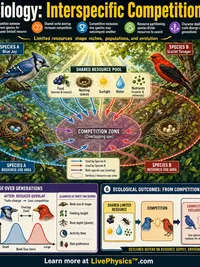
− / −Both species are harmed because they compete for the same limited resource such as food, water, light, or space.
Amensalism
− / 0One species is harmed while the other is neither helped nor harmed. The harm is often a side effect.
Species Interactions Reference
Reading the Effect Symbols
Each interaction is described by how it affects the two species involved. The symbols use plus for benefit, minus for harm, and zero for no effect.
- Plus. The species gains food, shelter, transport, or another resource.
- Minus. The species loses energy, health, or its life.
- Zero. The species is neither helped nor harmed.
The Six Interaction Types
- Mutualism. Both species benefit, plus and plus.
- Commensalism. One benefits, the other is unaffected, plus and zero.
- Parasitism. One benefits, the host is harmed, plus and minus.
- Predation. The predator benefits, the prey is killed, plus and minus.
- Competition. Both are harmed by sharing a limited resource, minus and minus.
- Amensalism. One is harmed, the other is unaffected, minus and zero.
Worked Examples
- Bees and flowering plants. Mutualism, since bees get nectar and plants get pollinated.
- Barnacle on a whale. Commensalism, since the barnacle hitches a ride and the whale is unaffected.
- Tick on a dog. Parasitism, since the tick feeds while the dog is harmed.
- Lion hunting a zebra. Predation, since the lion eats and the zebra is killed.
- Two plants competing for light. Competition, since both are limited by shading.
Curriculum Alignment
This tool supports middle school and high school life science units on ecology and ecosystems. It connects to NGSS standards MS-LS2-2 and HS-LS2-6, which ask students to explain interactions among organisms and how those relationships shape a community.
Use Learn mode to introduce the vocabulary, Practice mode to build fluency, and Challenge mode to sort apart the pairs that students most often confuse, such as commensalism versus mutualism and predation versus parasitism.