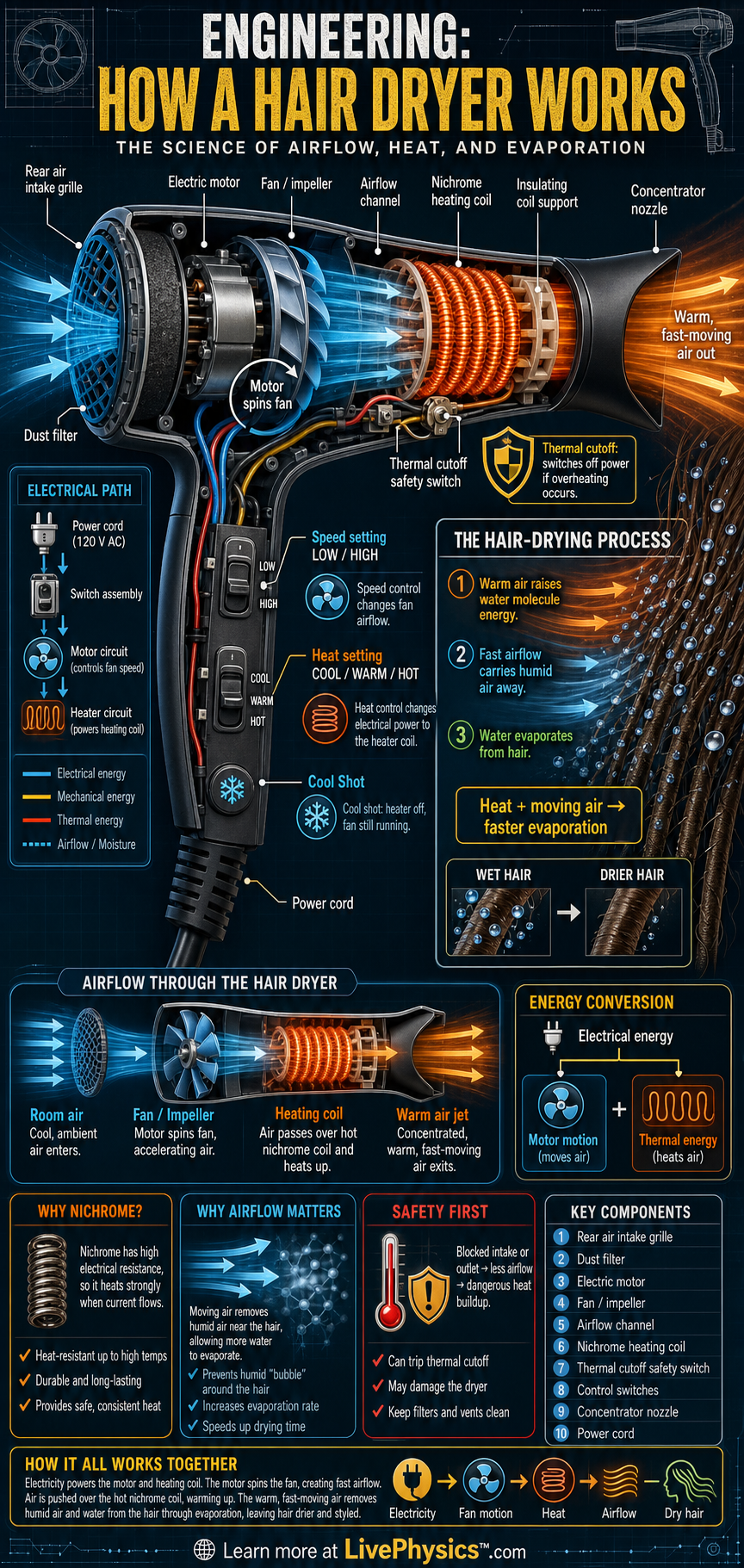
A hair dryer is a compact system that converts electrical energy into moving air and heat. A motor spins a fan that draws room air through a rear grille, then pushes it through the dryer barrel. In heated mode, the air passes over a nichrome wire coil and exits the nozzle as a fast warm stream.
This matters because controlled airflow and heating can dry hair quickly while limiting damage to the appliance and user.
Understanding Engineering, How a Hair Dryer Works
The heating element works because nichrome has greater electrical resistance than the copper wires that carry power to it. As electric charges move through the thin nichrome wire, energy is transferred to the metal. The wire becomes very hot.
Nichrome is useful because it can withstand repeated heating without melting or rusting quickly. The coil is spread out on a heat resistant frame so nearby parts do not receive too much heat.
Air moving past the coil carries thermal energy away. This is convection, the transfer of heat by a moving fluid such as air.
The fan does more than aim air at hair. It keeps the heating element within a safe operating range. If the fan slows, becomes blocked by dust, or the rear grille is covered, less air removes heat from the coil.
The temperature inside can rise very fast. Most dryers contain a thermostat that opens the electrical circuit when it gets too hot. After cooling, some thermostats switch on again.
A thermal fuse provides a second level of protection. It breaks the circuit permanently if dangerous overheating occurs. This is why a dryer should never be used with blocked vents or a damaged grille.
Different heat and speed settings are made by changing the electrical paths inside the dryer. A lower heat setting may send less current through part of the heating coil. A higher setting uses more of the coil or a circuit with lower resistance.
The motor can have separate speed settings that change how strongly it drives the fan. These controls affect more than comfort. Faster air can remove water from hair efficiently even at a lower temperature.
Water molecules at the hair surface gain energy and escape into the air as water vapour. Very high heat can remove moisture too quickly and may harm hair or irritate skin.
The nozzle shape is an engineering choice. A narrow outlet guides the moving air into a smaller region, producing a more focused stream. A diffuser spreads the stream across a wider area and reduces the force on any one part of the hair.
The rear filter is important too. It catches lint and loose hair before they reach the fan and coil. Students can connect these parts to ideas about energy transfer, electric circuits, resistance, heat, and fluid flow.
A useful habit is to trace the path of electrical energy through each component, then trace where that energy finally goes. Much of it leaves as warm moving air, while some is lost as sound and heat in the motor.
Safety design is especially important because a hair dryer is used near water. Modern models may include a ground fault protection device in the plug. It compares the current entering through one wire with the current returning through another.
A difference can mean electricity is leaking through an unsafe path, so the device cuts power quickly. The insulated plastic case, recessed switches, strain relief around the cord, and protective grilles each reduce a different risk.
Good engineering rarely depends on one perfect part. It uses several simple protections so that one fault does not become an injury.