Molar Mass & Stoichiometry Calculator
Enter a chemical formula to compute its molar mass, see the element breakdown with mass percentages, and follow the step-by-step calculation. Supports parenthesized groups like Ca(OH)2.
Chemical Formula
Results
| Element | Count | Atomic Mass | Subtotal | Mass % |
|---|---|---|---|---|
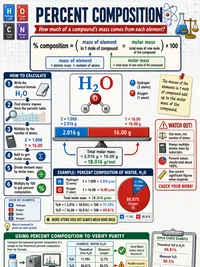
| O (Oxygen) | 1 | 15.999 | 15.999 | 88.81% |
| H (Hydrogen) | 2 | 1.008 | 2.016 | 11.19% |
Mass Composition
Step-by-Step Calculation
1. Identify elements and counts
2. Multiply atomic mass by count
3. Sum all contributions
Open this tool with your own values
This tool reads its inputs from the page address, so a link can open it with the values from a problem already entered. Include every value the problem needs, because one left out keeps the tool's default. Use plain numbers in the stated units.
- formula
- chemical formula, such as C6H12O6 or Ca(OH)2
Example link
Reference Guide
What is Molar Mass
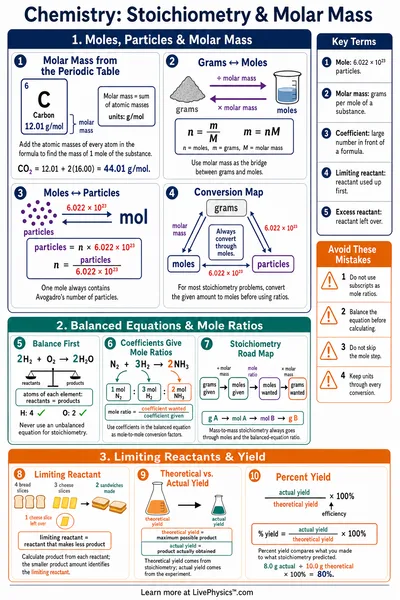
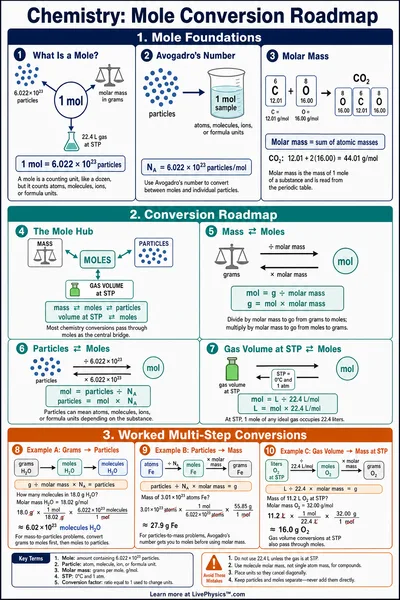
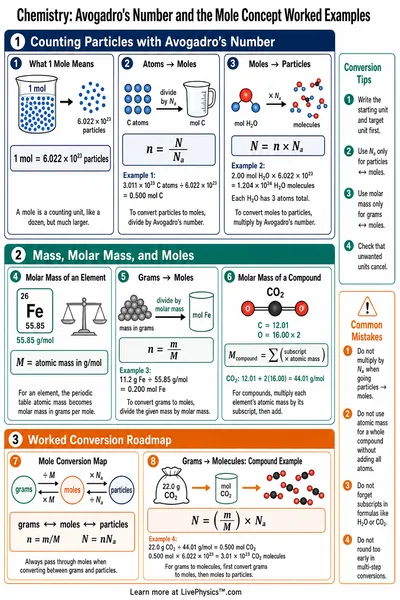
Molar mass is the mass of one mole of a substance, measured in grams per mole (g/mol). It equals the sum of the atomic masses of every atom in the formula.
Mass Percent
Mass percent tells you what fraction of the total molar mass comes from each element. It is useful for determining empirical formulas from experimental data.
Parsing Chemical Formulas
Chemical formulas use element symbols and subscripts. Parentheses group atoms that repeat together, like Ca(OH)2 which contains 1 calcium, 2 oxygens, and 2 hydrogens.
Moles and Grams
To convert between grams and moles, divide or multiply by the molar mass. One mole of any substance contains Avogadro's number of particles.